Archive for the ‘Fields’ Category
Stadiums, parks etc.
Posted by mynormas on November 6, 2014
For the record, some guy from Bernama called me while I was having lunch on Tuesday. It was rather noisy.
Dia kata to rectify current Stadium Nasional Bukit Jalil problem, PSM/the management tak tahu either nak tukar rumput to Cowgrass or nak pecah bumbung (coz not enough sunlight), I said there is a 3rd option, which is to use grow light like in Europe. But to choose which is best option, will be about costs, so “kena tanya accountant lah ha ha ha”. Dia pun gelak. I sambung;
“By the way, bukan sahaja Cowgrass, Zoysia matrella pun shade tolerant jugak”. He asked for the spelling, I told him and that was that. I did not mean to suggest Zoysia matrella per se.
From the beginning I insisted that I cannot comment on the specifics of the stadium field’s problems but only in general; maintenance and turf issues. Because I wasn’t involved and don’t know the details.
Yet, I will admit that the facts are right, it is also sometimes known as Manila grass, it has lower maintenance needs in some aspects, and when pressed by the reporter, I did say I would choose option 1 – to change the grass.
Why, because I believe that if it is a different grass, we can then use the field for multiple events and not just football. I know, I’m going against popular opinion but let me assure you that if the field is used ONLY for football 1. The stadium will be a waste of space and 2. You will wear the same places out faster (penalty box, kickoff spot, and linesman’s rut) as compared to spreading the wear and tear over many other places if it is used for other activities. 3. Bear in mind that whether we use the stadium or not, we still have to cut the grass, fertilise it etc. Its not like the stadium building where we can switch off the lights and leave it till the next event. 4. Most importantly, the field is designed to bear the weight of one person at any point on its surface. So, whether its 22 people or 22,000, if each person only occupies his/her personal space, the field can take it.


Posted in Fields, Padang, Rumput, Rumput secara am | Tagged: bola, Bukit Jalil, football field | Leave a Comment »
Posted by mynormas on August 26, 2014
In a democracy, majority rules, but in the world of grass keeping, we have something called “the rule of one-third”. Did I make it sound dramatic? Well its one of the main mistake being made by a lot of people. So being dramatic gets me more attention and I think you need to pay attention.
Most Malaysian homeowners, some football fields, municipal councils and even golf courses would be using knapsack brushcutters to cut grass. On top of that, they will use nylon cutting heads and untrained labour. This tends to get the grass to be cut too low. Lower than what it should be which is; no more than one-third of its original height. Irregular or mowing at too long an interval will cause this too. Its one of the reason that I told most golf clubs that are my clients to “never not mow your greens for more than one day”: i.e. Skip mowing greens ONE DAY only.
Terdapat satu peraturan dalam pemotongan rumput yang di namakan “Rule of one-third” atau “Peraturan satu-pertiga”. Ini adalah peraturan paling kerap yang di langgar oleh penjaga rumput di Malaysia. Sebab utamanya ialah kerana tidak tahu; tetapi juga kerana lebih mudah dan murah menggunakan:

Rumput yang di potong sekarang terlalu rendah. Warna keputihan yang kita lihat ialah warna ‘batang’ rumput.
- Mesin galas belakang (atau brushcutter) yang tidak dapat di tentukan ketinggian potongan.
- Menggunakan pisau di perbuat dari tali nylon yang juga merumitkan menentukan ketinggian potongan kerana panjang tali nylon tersebut tidak sama.
- Menggunakan buruh yang tidak terlatih.
- Menunggu masa yang terlalu lama sebelum mengulang potongan.
- Memotong tanpa mengambil kira jadual pemhajaan dan penyiraman.
Peraturan satu-pertiga ini mengatakan bahawa rumput tidak boleh di potong lebih dari satu pertiga dari ketinggian asal nya. Ini untuk mengekalkan jumlah permukaan daun yang cukup untuk melakukan fotosintesis dan juga menjamin masih terdapat cukup rumput untuk tumbesaran seterusnya.

Jangan potong lebih dari satu pertiga ketinggian rumput
Menggunakan brush cutter dan tali nylon akan menyebabkan pekerja menekan pisau ke tanah dan menyebabkan rumput di potong hingga ke batang. Begitu juga amalan memotong selepas membaja dan juga selepas menyiram atau hujan lebat. Rumput akan tumbuh lebih banyak dan lebih banyak daun akan hilang sewaktu memotong.
Jadi jika anda penjaga rumput (atau anda ada rumput yang orang lain jaga):
- Hentikan penggunaan brush cutter dengan nylon head di kawasan terbuka (kita masih perlukan nya di kawasan yang ada perabut atau tebing batu)
- Gunakan mesin yang kita boleh ‘set’ ketinggian potongan. Ini ertinya mesin yang ada tayar.
- Set ketinggian potongan supaya mesin tidak memotong lebih dari satu pertiga dari ketinggian rumput.
- Tentukan jadual pemotongan bergantung kepada pertumbuhan rumput: biasanya rumput yang pendek (3 – 8 mm) di potong setiap hari atau selang sehari; 15 mm (contohnya padang bola atau halaman rumah) di potong seminggu sekali atau dua kali terutamanya lepas hujan atau lepas baja; 25mm dan ke atas, 7 – 10 hari sekali. Kecuali jika di baja atau pada waktu musim hujan yang mana rumput lebih galak tumbuh.
Jika kawasan anda terlalu berbukit dan tidak boleh di potong menggunakan mesin bertayar; cuba gunakan mesin yang mempunyai kipas yang kuat dan akan terapung sedikit sewaktu memotong. Kami panggilnya ‘hover mower’.
Jika anda perlukan nasihat pemotongan, jadual pemotongan atau anda perlukan pembelian mesin untuk memotong rumput: hubungi saya di mynormasATconsultant.com dengan menggantikan AT dengan @
Posted in Fields, Golf Course, Greens, Landscape, Lanskap, Padang, Padang Golf, Rumput halaman rumah, Rumput secara am, Taman | Tagged: football field, gardener, golf course, majlis daerah, municipal council, stadium, taman | Leave a Comment »
Posted by mynormas on April 7, 2014
Just like maintaining turf on golf courses, football field turf also has its share of cultural practices. Last week, I had the privilege of briefing a group of MSN (National Sports Council) staff on football field maintenance. I consider this topic to be one of the most important of the two-day course. So important that I feel that I should share some of the info here. Most of the slides are self explanatory.
Seperti juga penjagaan rumput di padang golf, penjaga rumput di padang bola (ataupun padang padang rumput hiasan lain) perlu melakukan kerja kerja amalan kultura untuk kesihatan rumput. Saya selalu menyamakan ‘amalan kultura’ dengan senaman untuk manusia. Sebagaimana manusia perlukan senaman untuk kesihatan, rumput juga perlukan amalan kultura. Minggu lepas saya berpeluang untuk memberi taklimat kepada kakitangan dari Majlis Sukan Negara tentang penjagaan padang bola. Ini adalah salah satu topik yang paling penting. Saya harap slaid slaid ini dapat membantu orang lain juga dalam penjagaan padang bola.
Posted in Fields, Landscape, Lanskap, Maintenance, Padang, Rumput | Tagged: Lanskap, padang bola, Rumput, stadium, taman | 3 Comments »
Posted by mynormas on February 7, 2014
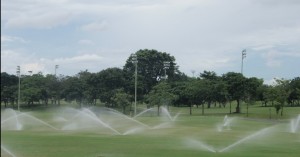
Proses penyiraman padang golf
Menyiram adalah aktiviti ‘instinct’ penggemar rumput ataupun lanskap. Lebih dari membaja atau memotong. Mungkin kerana ia paling mudah atau paling murah atau kerana kita juga boleh merasa dahaga kita boleh empati dengan rumput yang kekurangan air.
Watering is an instinctive activity for most grass or landscape owners; especially in the Malaysian context, 2,500mm of rain notwithstanding. Whether a 200 acre golf course or postage stamp lawn, we water our lawns regularly. Two days of no rain and we would be watering our grass even if looks like it will rain later in the day.
I am arguing that the timing and schedule of watering needs to be examined.
- Lets not water late in the evening. Watering in the evening causes the water to left in the soil when the weather is cool and in Malaysia; humid. Damp and wet soil conditions too often can lead to diseases and algae. Plus, we are watering AFTER the grass have dehydrated! Water in the morning so that there will be water in the soil for the grass when the sun is heating up.
- Don’t water every 24 hours or any other regular schedule. Water deeply and irregularly. Keep in tune with the water needs of the grass, don’t stress them too much but don’t water them too easily too; we want the grass to have deep roots.
- There is another method called ‘syringing’ especially for grass that is cut at a low cutting height. Its about ‘wetting’ the grass when the sun is at its hottest. Don’t worry about what you read that the sun will turn the water droplets into magnifying glass type of concave lens and focus the ray onto the leaf; the water will evaporate before any major damage is done.
Kebanyakkan kita menyiram rumput, terutama nya masa baru tanam. Ini bagus. Tetapi pada pandangan saya, kebanyakkan orang terlalu banyak siram dan ‘timing’ siram juga salah. Saya mempunyai beberapa pendapat.
- Siram di waktu pagi. Dengan cara ini air akan ada di dalam tanah bila tiba tengahari dan matahari terik. Menyiram di waktu petang pada hari panas ibarat memberi air kepada orang yang dah nak mati kehausan. Menyiram di waktu petang juga mengakibatkan tanah basah di waktu malam yang akan menggalakkan penyakit dan lumut.
- Siram ikut keperluan. Bila siram, siram banyak (supaya air masuk jauh ke bawah) dan jangan siram ikut jadual. Menyiram ikut jadual menyebabkan kita siram waktu air masih ada dalam tanah dan ini 1. membazir dan 2. memanjakan rumput. Rumput tidak belajar untuk mencari air. Check tanah, dengan cara memijak ataupun mengorek sedikit dengan jari untuk tengok basah atau tidak.
- ‘Syringe’. Kadang kadang, matahari terlalu terik dan kita kesian kat rumput yang layu. Cahaya matahari juga boleh membakar pasir topdressing kita dan mematikan akar rerambut (root hair) di permukaan atas tanah. Apa yang saya cadangkan – terutamanya rumput yang di potong pendek dan kawasan terdedah – ialah menyejukkan rumput dengan siraman lima minit ataupun dua pusingan penuh sprinkler pada waktu tengahari dan awal petang. Jangan takut pada teori bahawa air akan bertindak sebagai kanta untuk cahaya matahari membakar daun; kalau ia dah panas macam tu, air itu akan melowap.
Jika rumput anda telah kuning akibat kurang siram; kemungkinan besar ia tidak mati, hanya menjadi dorman. Teruskan siram supaya ia tidak mati terus. Bila cuaca dah sesuai, insya Allah ia akan baik semula.
Posted in Fields, Golf Course, Golf Course Superintendents, Greens, Landscape, Lanskap, Maintenance, Padang, Padang Golf, Rumput, Taman | Tagged: golf course, golf course maintenance, golf course superintendents, grass, greens, Halaman rumah, landskap, Lanskap, padang, Rumput, stadium | 4 Comments »
Posted by mynormas on January 20, 2014
It is said that there are three important things on a golf course and they are: drainage, drainage and drainage.
In a talk to club managers in an MGA event, I tried to explain the issue especially the part about helping water to get to the drains: the dethatching, the scarifying and especially the aeration part.
Saliran adalah isu penting untuk padang golf, dan sebarang kawasan yang ditanam dengan rumput hiasan. Seorang pemain golf terkenal yang kini menjadi seorang pereka padang golf pernah berkata; “Ada tiga perkara yang paling penting untuk sebuah padang golf, saliran, saliran dan saliran”. Di sini saya cuba untuk menekan kan bahawa ianya bukan sahaja tentang parit dan salir air, tetapi ia juga tentang bagaimana air boleh tembus atau masuk ke dalam tanah. Contohnya melalui proses ‘Pengudaraan‘ ataupun ‘slicing’
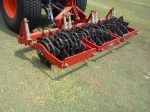
Slicing will help with aeration and water penetration.
Posted in Fields, Golf Course, Greens, Landscape, Lanskap, Padang, Padang Golf | 2 Comments »
Posted by mynormas on August 26, 2013

Ok jer?
(Nota: Ini bukan di Bukit Jalil ATAUPUN di Malaysia.
Kenapa tak boleh? Asalkan stadium tu di design untuk itu maka saya tak nampak kenapa tak boleh. Stadium satu kegunaan adalah kemewahan; kalau mampu bagus; kalau tak mampu, lebih baik kita buat dari awal lagi stadium itu pelbagai-guna.
Apa guna buat stadium besar dan hebat tapi tiada duit atau hanya mengharapkan bantuan dana untuk maintenance? Dana yang datang hanya pada tahun ada pilihan raya? Lebih baik spend a little more untuk dapatkan stadium yang boleh di sewakan kepada orang ramai untuk pelbagai guna. Sebahagian (contohnya 10%) dari keuntungan setiap bulan mesti di simpan dalam suatu tabung yang akan di gunakan untuk memperbaik stadium setiap 8-10 tahun.
Kalau kita ada stadium yang hanya akan digunakan untuk bola sahaja; termasuk untuk ‘sesi latihan’ mungkin keseluruhan padang tak rosak tapi saya boleh jamin yang rosak dan lebih susah di baiki ialah depan pintu gol, tengah-tengah bulatan padang dan juga tempat penjaga garisan lari.
I read with interest the views and comments from various quarters with regards to the current state of football field maintenance in the country.
The golf course industry has a head start in the maintenance of turfgrass in Malaysia and perhaps there are some lessons to be learnt; choice of grass, cultural practice, grass cutting and multi-use.
First of all, the type of grass to be planted is important. There are three important criteria to think about when choosing grass: 1. Location; how much sunlight does it get? Is it a water-logged area? 2. What will it be used for; is it for aesthetics? Is it for rough and rugged use? And 3. What is the cost or level of maintenance that can be afforded to be spent on the field in future?
Maintenance of turfgrasses are beyond grass cutting or fertilizing or even just the occasional ‘hollow-tining’. There is a category of work called ‘cultural practice’ which includes aeration, mowing, topdressing, vertical-cutting and irrigation that is often ignored by football fields. There needs to be a regular schedule for these activities.
The Ministry of Youth and Sports started a regular panel discussion on the curriculum for the training of groundskeepers with input from various quarters for the past few years. I’m sure when it is implemented; there will be more people with knowledge about field maintenance. Even grass cutting isn’t as easy as it sounds.
My opinion somewhat differs from most; I do not strongly feel that football stadiums should be limited to football matches. At least not until our football associations actually have enough funds to maintain the fields. Let’s face it; can the authorities financially afford to have single use fields? If we can; well and good. If we can’t; let’s design (or redesign) the field to be multipurpose from the start. I think we’d rather have a well utilized field with enough funds to do proper maintenance than have a field reserved for the occasional football match but no money to maintain it; Barcelona may still refuse to play there.
Seriously, to earn extra income, even if we rent the field for football training or local football games, it will just wreck areas of focus like the penalty spot and in front of the goalmouth. Renting the field for a march past or a ‘demonstration’ will be safer for the field since they would stay away from football’s area of focus. Will 100,000 people damage the field? I’d say not on a well built field. A field will be designed to support the weight of a robust and aggressive person wearing shoes with studs. One person will take up as much space and put the same pressure whether he is a footballer or a demonstrator or marcher. Whether it is a 22-person football match or a 100,000-person show of support; any one person will only step on the one amount of field at any one time.The field is not like a bridge or building where the combined weight will have to be supported by a beam, foundation or certain parts of the building. Concerts? The field must be designed for it. Whats most damaging to the grass is the sunlight denied to it by any equipment put on it for any amount of time longer than one day (depending on types of grass); they can’t do photosynthesis.
A combination of the most suitable grass, scheduled maintenance, regular cultural practice and enough funds for machinery, knowledge and other inputs will ensure our football fields will improve, even if our footballers don’t.
Posted in Fields, Maintenance, Padang | Tagged: Bukit Jalil, Rumput, stadium | Leave a Comment »
Posted by mynormas on August 13, 2013

Paspalum yg subur
Lately, many Malaysians have asked me the name of the grass at the Bukit Jalil National Stadium. The fact that Barcelona FC have demanded a change in venue and the rumour that one of their player was injured during training due to the quality of the field has caused national embarassment. Add to that; a last-minute change in venue and the combined effect has sent quite a bit of traffic to this website. Not to mention a few phone calls and a couple of tweets. Not all of them nice. FYI the grass is called ‘Seashore Paspalum’.
Untuk menjawab pertanyaan yang banyak datang sejak kebelakangan ini, rumput di stadium nasional Bukit Jalil ialah dari jenis Seashore Paspalum atau nama saintifik nya Paspalum vaginatum. ‘Seashore’ bermaksud ‘tepi pantai’.
Biasanya ia di pilih kerana ia mempunyai warna hijau gelap yg jarang ada pada rumput lain kecuali Cowgrass. Untuk padang golf, sebab-sebab ia di pilih ialah kerana ia tahan pengairan oleh air yang telah dicemari dengan air masin (untuk padang golf di tepi laut) dan juga ia boleh di potong pada ketinggian yang amat pendek.
Di tepi laut, ia adalah ‘hero’; ia mempunyai sedikit saingan daripada rumput atau tumbuhan lain dan ia juga mempunyai kurang masalah dari serangan serangga, bakteria ataupun kulat yang boleh hidup di kawasan itu. Ertinya ia telah sesuai dengan persekitaran tepi laut.
Bawa ia jauh dari laut, maka ia terpaksa bersaing dengan rumput dan tumbuhan lain yang kini mempunyai ‘level playing field’ (pun intended). Ia juga akan ‘menjumpai’ makhluk perosak seperti serangga (yang mungkin sebelum ini tidak ada di tepi laut) dan juga pelbagai jenis kulat yang sekarang mempunyai mangsa baru. Saya belum dengar lagi tentang virus atau bakteria menyerang Paspalum.
Bukan tidak boleh menggunakan Paspalum jauh dari laut, tetapi ia akan mempunyai kos penyelenggaraan yang tinggi. Lebih tinggi dari rumput yang dah memang sesuai di tanam di kawasan itu. Dua padang golf jauh dari laut yang menggunakan Paspalum dengan jayanya ialah KLGCC dan Royale Jakarta. Dari apa yang saya tahu, kos penjagaan padang2 ini adalah sangat tinggi.
Untuk mendapatkan rumput yang mempunyai sifat yang lebih baik, pembiak rumput akan melakukan pengkacukkan, mutasi ataupun memerhatikan tompok atau kawasan rumput yang lebih subur dari kelilingnya.
Rumput itu akan di asingkan dan di tanam di nursery dan jika memang ia subur serta mempunyai sifat yang berbeza dari rumput sekelilingnya ia akan di beri nama sebagai variety baru. Bila ia di biakkan atau di ‘cultivate’ maka ia akan di gelar sebagai ‘cultivar’ iaitu ‘cultivated variety’. Paspalum juga mempunyai beberapa cultivar nya seperti Salam, Supreme, SeaIsle 2000 dan beberapa lagi.
Saya di beritahu bahawa cultivar yang digunakan di stadium nasional Bukit Jalil ialah Marimo. Saya tidak tahu tentang kebaikkan cultivar ini berbanding dengan cultivar lain.
Kebanyakkan rakan-rakan saya yang menjaga rumput berpendapat bahawa Paspalum mempunyai sifat daun yang gemuk dan ‘berisi’. Ini tidak kami gemari kerana inilah yang menyebabkan ia di sukai oleh serangga dan kulat. Ia juga boleh menjadi lembut dan kurang lasak jika pembajaan tidak di kawal rapi.
Untuk mengetahui tentang rumput lain untuk padang bola, anda boleh baca di laman web ini.
Untuk mengetahui lebih banyak tentang rumput ini, sila layari http://www.ipm.ucdavis.edu/TOOLS/TURF/TURFSPECIES/seashore.html.
Posted in Fields, Padang, Rumput | Tagged: Bukit Jalil, Rumput, stadium | Leave a Comment »
Posted by mynormas on May 31, 2013

Jika alasan anda ialah kecerunan; cuba cari mesin “hover mower”
The recent case of a child injured by flying debris gave me the impetus to write this letter. I see a lot of people – from local authorities to homeowners to football associations – planting grass but the most common method used to cut the grass is by using the backpack mower called the ‘brush-cutter’; ‘bush-cutter’; ‘whipper-snapper’ or even the ‘helicopter’.
This machine is favoured because it is cheap, portable, simple to use and require almost no maintenance. When the blades are changed to nylon strings heads, there is one added advantage: there is no need for sharpening.
A few observations about this “brush-cutter”:
- The business end of this machine consists of naked rotating blades or nylon strings. These blades/strings would turn at high speed to cut the grass by impact. Needless to say the same impact would fling stones, pebbles, sand particles and other debris on the ground at high speed towards the operator and those around him or her. Its made worse when the operator rests the strings on the ground.
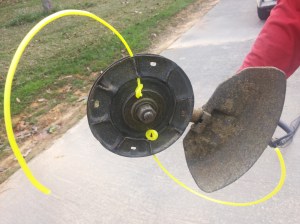
The nylon string head of a brush-cutter
- Due to the weight and vibration of this machine only the tough and hardy are willing to operate it for long periods. Hence we see this work being ‘monopolized’ by foreign employees. If we really want to reduce our dependency on foreign workers, lets reduce our dependency on this machine first, at least in this context.
- This also has the effect of keeping turfgrass and landscape maintenance in the realm of labourers or part-time odd-job workers. This would negate the efforts of the efforts of the Youth and Sports Ministry – among others – that for the past few years has been working on a syllabus to train youths in landscape, stadium and golf course maintenance with the intention of turning this into a career.
- In the hands of the untrained – or the tired – operator, the tendency is to rest the blades or the strings on the grass. This would cause a very low height of cut (think: ground height) Grass needs leaf to do photosynthesis to produce food and cutting at low heights just removes too much leaves. There is a “rule of thumb” of not cutting more than one-third of the grass when mowing. No way can the “brush cutter” maintain a consistent mowing height of one-third of anything.
I call on everyone who has authority over grass cutting (and that includes homeowners) to stop or limit the use of these machines. Homeowners should consider buying their own electric grass mowers (available in most hypermarkets). Local authorities, building and golf course owners should consider renovating their turfed areas so that its more accessible to ride-on mowers. Architects too must design turfed areas with ride-on machines in mind or look at alternatives other than grass for example ground-covers, wild flowers, weeping lovegrass, pebbles or even artificial turf.
Homeowners should mow their grasses more often than the occasional time when the grass cutter knocks on your gate when he sees your grass long. The grass Malaysians call Carpet grass grows very quickly and should be mown as often as at least once a week. Petrol engined mowers are high maintenance so do consider an electric or ground-driven mowers.
Many land owners, football associations, golf courses and even homeowners dream of striping their grass. This can never be achieved with “brush cutters”. And no; contrary to popular belief, you don’t need golf course priced machinery to stripe your grass, any mower with a heavy roller behind it (and this can be modified with a metal or GI pipe) will stripe a field with enough discipline on the part of the operator.
With a brush cutter? All you need is a sneezy operator and you can kiss your beloved grass goodbye.

These poor grass has been mown with a brush cutter – maybe the operator has the flu.
Posted in Fields, Golf Course, Landscape, Lanskap, Padang Golf, Rumput, Rumput halaman rumah, Rumput secara am, Taman | Tagged: halaman, Halaman rumah, padang, Rumput | Leave a Comment »
Posted by mynormas on May 20, 2013
It is time that we give better thought to how we cut grass. Cutting (‘mowing’ sounds so much beter) grass should be one of the most important thing to consider for anyone who is growing grass. Yet most people seem to not give it much thought.
Rumput adalah benda hidup yang sentiasa tumbuh. Jadi kepada orang yang menanam rumput, samada sebagai kerja atau hobi: samada sebagai tempat rekreasi atau aesthetik; samada tempat kecil atau besar: samada rumput import atau tempatan: samada murah atau mahal; kalau tanam rumput, kenalah potong rumput. The only rumput yang tak payah di potong ialah rumput plastik. Atau mingkin rumput mati.
Bila perlu potong?
How often should we mow? Kekerapan memotong bergantung kepada beberapa faktor seperti kesuburan rumput, kegunaan kawasan dan jenis rumput yang akan mempengaruhi kecepatan ia tumbuh panjang. Ada rumput yang lebih cenderung tumbuh melata dari ke atas dan ada rumput yang lebih cepat panjang dari membiak.
Ada rumput yang dipotong seminggu sekali, dan ada rumput yang dipotong setiap hari (contohnya atas green padang golf). Kalau kita nak potong sebulan sekali, saya cadangkan rumput plastik.
Begini, “rule of thumb” untuk memotong rumput ialah memotong hanya satu pertiga dari ketinggian rumput. Ingat: rumput mendapat makanan dari proses fotosintesis di daun, bukan dari baja. Oleh kerana itu, pemotongan yg drastik dan memotong hampir keseluruhan daun akan mencederakan rumput.
Di kebanyakkan halaman dan padang yang ditanam dengan cowgrass yang tidak di baja; memotong satu kali setiap dua minggu MUNGKIN memadai. Tapi musim hujan selalunya memerlukan pemotongan lebih kerap. Kalau.rumput yang seringkali di panggil sebagai rumput karpet: pemotongan seminggu sekali (paling sikit) di perlukan.
Penggunaan Mesin.
Selain itu, penggunaan mesin yang jenis pikul belakang atau dikenali sebagai “brush-cutter” juga memburukkan keadaan.
“Brush cutter”, “bush cutter”, “whipper snapper” ataupun “helicopter”; mesin ini di gemari kerana ia murah, mudah digunakan dan adalah mudah-alih. Ia mempunyai enjin dua lejang ertinya ia mempunyai kekuatan yang lebih berbanding saiznya yang kecil. Tapi ini juga menyebabkan ia tak baik untuk alam sekitar.
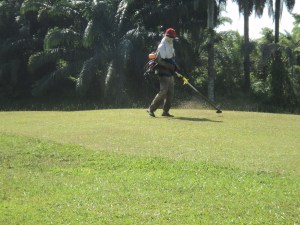
sebenarnya rumput tak sekata dan terlalu rendah.
Mesin ini juga sukar di gunakan untuk waktu yang panjang. Ini menyebabkan kerja ini di pikul oleh pekerja yang lasak. Ini menghadkan jenis orang yang mahu menceburi bidang penjagaan rumput.
Saya menyeru kepada tuan rumah, pemilik lanskap, kerajaan tempatan dan sebagainya untuk menghadkan atau menghentikan penggunaan mesin “brush cutter” ini. Ini boleh di lakukan dengan membuat perubahan padang supaya ia menjadi lebih mesra kepada mesin yang boleh di pandu. Untuk kawasan yang tak dapat di ubahsuai: gunakan alternatif yang ‘low-maintenance’ lain kepada rumput seperti ground-cover (Arachis pinto?), bunga (wildflower atau weeping lovegrass), batu hiasan kecil, tile ataupun rumput tiruan.
Tuan rumah seharusnya melabur untuk membeli mesin sendiri yang boleh didapati di supermarket atau hypermarket ataupun di kedai hardware yang besar. Untuk mendapat rumput karpet yang cantik; amalkan pemotongan yang kerap. Sekurangkurangnya satu minggu satu kali.
Posted in Fields, Landscape, Lanskap, Rumput | 13 Comments »
Posted by mynormas on January 2, 2013
In the context of Malaysian weather where heavy and frequent rain is the norm, plus with poorly or compacted greens, shade from surrounding trees; algae is quite common.I found this slideshare article that is very informative and thought that I should share it.
Be advised that even though the title is about golf greens, much of the info are also applicable to other parts of turfed areas (yes your lawn too madam)
If you think most of the slides’ contents are too ‘academic’ jump straight to slide number 53, though you might be searching backwards for background info but at least you know what you are looking for is what you need to know.
This is the first time I am doing this so I hope this turns out alright…
Posted in Fields, Golf club, Golf Course, Golf Course Superintendents, Greens, Padang, Padang Golf, Rumput, Rumput halaman rumah | Tagged: algae, grass, green, Rumput, turf | 1 Comment »


 Turf Matters