Turf Matters

The Site To Go To For All Your Turf Matters

  • Facebook Likes

  • The new Brushcutter

    Pengganti Brushcutter

    Increase productivity, cut labour. Try the AM61A

  • Trees Nursery

    Forest trees nursery

    Get your Trees from this nursery

Author Archive

Lubang Golf

Posted by mynormas on June 24, 2015

Di antara pembaca laman web ini adalah pelajar yang sedang belajar tentang penjagaan padang golf dan saya cuba mengisi kekosongan rujukan dalam Bahasa Malaysia. Kebanyakkan terma yang digunapakai adalah dalam Bahasa Inggeris dan terjemahan yang di gunakan biasanya tidak di terima secara meluas oleh umum.

Kadang-kadang kekeliruan timbul contohnya dalam perkataan ‘lubang’ yang membawa maksud satu daripada 18 lubang di padang golf itu ataupun lubang di mana bola golf itu di masukkan. Kekeliruan ini pun biasa wujud dalam bahasa Inggeris dan mudah di selesaikan berdasarkan konteks ayat. Tapi saya cadangkan untuk mengelakkan kekeliruan di kalangan pelajar ataupun orang yang tidak bermain golf (dan tidak faham konteks) kita gunakan ‘L’ besar untul lubang yang menunjukkan nombor (Lubang 1 atau Lubang 7) dan ‘l’ kecil untuk lubang yang di masukkan dengan bola golf di setiap Lubang.

Satu lagi ialah perkataan “tee box”. Saya faham perasaan Dr. James Beard dalam satu seminarnya yang saya  hadiri 20 tahun dulu bila dia cuba menceritakan bahawa asal perkataan ‘tee box’ ialah pada zaman dahulu, tempat bermula pukulan suatu Lubang ialah sebaik sahaja selepas green Lubang sebelumnya dan tempat bermula pukulan (sekarang di panggil tee) hanya terdiri dari sebuah kotak berisi pasir. Pemain golf akan mengambil pasir dari kotak tersebut, membuat suatu busut kecil, meletakkan bola golf di atasnya sebelum pukul. Kotak pasir itu ialah ‘tee box’.

Sekarang, tee di sediakan khas untuk pemain maka perkataan yang di gunakan seharusnya ialah ‘teeing ground’ (seperti dalam buku undang-undang golf) atau di pendekkan kepada ‘tee’ sahaja. Saya kira terlalu ramai orang menggunakan perkataan ‘tee box’ yang ia kini telah di masukkan ke dalam kamus golf harian.

Ambil perhatian bahawa setiap padang golf akan mempunyai polisi nya sendiri tentang bahagian bahagian di setiap Lubang nya; samada dari segi ketinggian rumput ataupun memberi mereka perincian lagi seperti contohnya mempunyai collar untuk green, mempunyai apron di hadapan green ataupun mempunyai collar di fairway. Tapi apa yang saya berikan berikutnya adalah bahagian asas suatu Lubang di padang golf.

Untuk rujukan perbezaan di antara water hazard dan lateral water hazard; sila lihat di sini. Atau di Youtube jika perlu gambaran lebih jelas.

Tertakluk kepada polisi, kemahuan kelab dan kadang-kadang, keperluan pertandingan.

Tertakluk kepada polisi, kemampuan kelab, kemahuan pemain dan kadang-kadang, keperluan pertandingan.

Posted in Golf Course | Leave a Comment »

Rumput Plastik

Posted by mynormas on June 19, 2015

Kebanyakan padang di Malaysia sekarang menggunakan rumput betul dan di bina dengan kos yang tinggi tetapi selepas beberapa bulan, ia tidak kelihatan seperti padang lagi kerana faktor cuaca, penggunaan, kesilapan pembinaan, rumput yang tidak sesuai ataupun faktor penyelenggaraan. Oleh itu ada yang telah menggunakan rumput tiruan – setakat ini, Malaysia belum lagi ada padang hybrid seperti di Singapura – untuk mengatasi faktor-faktor tersebut.

Seperti hampir semua benda, rumput tiruan ada kebaikan dan keburukkan nya. Sebelum kita pergi lebih jauh, rumput tiruan bukan di buat dari ‘plastik’ per se; sebalknya ia adalah fiber yang boleh di buat menggunakan tiga jenis komponen iaitu polyethylene (PE), polypropylene (PP) dan nylon.

Di antara kebaikan rumput tiruan ialah:

  1. Sangat sedikit penyelenggaraan di perlukan. Tiada baja, penyakit, serangga atau pemotongan di perlukan.
  2. Ia boleh di gunakan di setiap ketika. Selepas hujan, awal pagi, lewat petang sebaik sahaja selepas pasukan sebelum itu meninggalkan padang dsb.
  3. Pelbagai kegunaan. Suatu padang boleh digunakan untuk pelbagai aktiviti sukan atau bukan sukan. Ia boleh di warnakan dengan pelbagai warna untuk membezakan garisan warna sukan.
  4. Padang rumput tiruan tidak menakung air dengan syarat ia di bina dengan betul, ia tidak mempunyai lapisan organik atau thatch yang akan bertindak seperti sponge untuk ‘memegang’ air.
  5. Ia di laporkan boleh mengurangkan kecederaan yang datang dari permukaan padang yang tidak rata atau licin atau berlumpur.
  6. Padang rumput tiruan juga menjimatkan air.

http://www.momsteam.com/health-safety/turf-wars-pros-and-cons-of-artificial-turf

http://www.dessosports.com/artificial-turf/benefits

http://www.syntheticturfcouncil.org/?page=FAQs

Keburukkan rumput tiruan? Sebelum lihat senarai, apa kata kita lihat video pendek tentang Women’s World Cup yang berlangsung di Canada dan kesemua perlawanan adalah di atas rumput tiruan (sebahagian pemain telah mengemukakan saman keatas FIFA tentang ini). Untuk pengetahuan semua 120 darjah Fahrenheit (suhu padang dalam video tersebut) = 49 darjah Celsius, dan 130 darjah Fahrenheit = 54 darjah Celsius. Suhu cuaca Kanada? Pada waktu itu ia di laporkan sebagai lebihkurang 21 darjah Celsius. Sebagai perbandingan suhu cuaca di Kuala Lumpur di siang hari ialah di antara 32 hingga 34 darjah Celsius.

Keburukan rumput tiruan ialah :

  1. Kos pemasangan yang tinggi. Saya pernah di beritahu ia melebihi RM1 juta ringgit satu padang bola.
  2. Suhu padang yang tinggi. Bahan yang di gunakan untuk membuat rumput tiruan dan juga bahan yang berada di bawah rumput menaikkan suhu padang.
  3. Pencemaran. Rumput asli mempunyai sifat penapisan bila air mengalir di atasnya, rumput tiruan tiada sifat ini malah akan melajukan pengeluaran air dari padang (yang juga merupakan kebaikkan nya).
  4. Ketika membuat sliding di atas rumput tiruan, ataupun jatuh secara terseret; pemain akan terdedah kepada luka atau dipanggil sebagai ‘turf burn’.
  5. Tempat pembiakan bakteria. Pakar perubatan mendapati bakteria staphylococci dan lain lain mampu hidup lebih dari 90 hari di atas rumput tiruan. Di tambah dengan risiko luka atau turf burn; jangkitan lebih mudah berlaku.
  6. Rumput tiruan di ‘topdress’ dengan getah halus yang mampu memburukkan orang yang memang mempunyai masalah pernafasan seperti pesakit asma.
  7. Selepas sekali menggunakan rumput tiruan, rumput asli tidak lagi dapat digunakan kerana tanah di bawah tiada lagi organisma hidup yang menyokong pertumbuhan rumput asli.
  8. kecederaan pemain; pemain-pemain profesional atau elit  (berbanding dengan pemain rekreasi atau riadah) mempunyai risiko kecederaan lutut atau ACL yang lebih tinggi secara perbandingan (lihat video seterusnya untuk statistik). Nota: kebanyakkan kajian adalah pada pemain American Football. Dan kebanyakkan nya di atas padang rumput tiruan generasi pertama.
  9. Ada pendapat yang mengaitkan rumput tiruan dengan kanser dan ada juga pendapat yang tidak bersetuju. Saya tidak akan perpanjangkan ini, sila Google sendiri.
  10. Padang rumput tiruan yang lama atau banyak di gunakan akan mempunyai rumput yang telah mula rosak mampu me lepaskan plumbum (lead) yang merupakan sumber toksik kepada manusia. Tiada masalah pada padang baru yang di buat dari rumput polyethylene sahaja.

http://www.momsteam.com/health-safety/turf-wars-pros-and-cons-of-artificial-turf

https://www.health.ny.gov/environmental/outdoors/synthetic_turf/crumb-rubber_infilled/fact_sheet.htm

http://news.discovery.com/earth/plants/world-cup-turf-battle-is-grass-better-150605.htm

Kita lihat video seterusnya:

Posted in Padang, Padang Bola, Rumput, stadium | Tagged: , , , , , | 4 Comments »

Licence to Kill

Posted by mynormas on June 8, 2015

Very few turfgrass professionals in Malaysia realise that there is such a thing as a licence to apply pesticides. Except perhaps suppliers who have to have a licence to keep pesticides in their stores; they would be aware because it is given by the same body which is the Department of Agriculture.

Wait. What? You’re a supplier and you don’t have a licence to store pesticides? Oops. Well, perhaps because nobody checks so nobody knows. Except that recently a client who was worried about using pesticides that are irresistably cheap they actually kill – not only the target pests – but the grass as well, have asked me to narrow down specifications for pesticides and the three things that I can think of were to find chemicals that are registered with the LRMP (Pesticide Board), have MSDS (Material Safety Data Sheet) and buy from suppliers that have licences from DOA. So maybe one day, your customers will ask for your licence, then maybe you have to have one.

Pesticides, which includes herbicides by the way and not just insecticides and fungicides, are often used in relatively large quantities on a golf course. I say relatively because in Malaysia, it is rare to find them being used on fairways which is about 50% of a golf course never mind roughs (30%?) so for most of Malaysian golf courses; pesticides are restricted only on greens which constitutes about 5 – 10% of the golf course – ditto fertiliser (does that solve the mystery of Malaysian golf course quality for you?) – and because of Malaysia’s rainfall and humidity, the greens’ grass are quite often infected so we are still talking about a big amount of pesticides; though not as big as if it is also applied to fairways and rough hence the word ‘relatively’. Get my drift? Pun intended.

Despite applying mostly on greens, pesticides can consume up to 10 – 20% of the material cost on the golf course maintenance budget.

Even though the greens constitute only about 5 – 10% of the golf course area, golfers spend about 75% of their game on the greens so the greens are considered as the most important part of the golf course and the most highly maintained. It also means that golfers spend a lot of time on the most pesticide-applied area of the golf course. Constant exposure to pesticides can cause a multitude of reactions to different people; some are harmless and some can be dangerous. Of course a low level of exposure to a very toxic pesticide may be no more dangerous than a high level of exposure to a relatively low toxicity pesticide; so most of the risk is assumed by the applicators themselves. But still, I feel that golfers must beware the grass they are playing on is applied with chemicals that are potentially toxic. Then there’s also the risk of pesticide ‘drifting’ when applied at the neighbouring holes.

So we would expect that because of the risks to the applicators, to the greens, to the golfers and to the environment; most golf courses have applicators that are specially trained in this area with special equipment; right?

Not really…

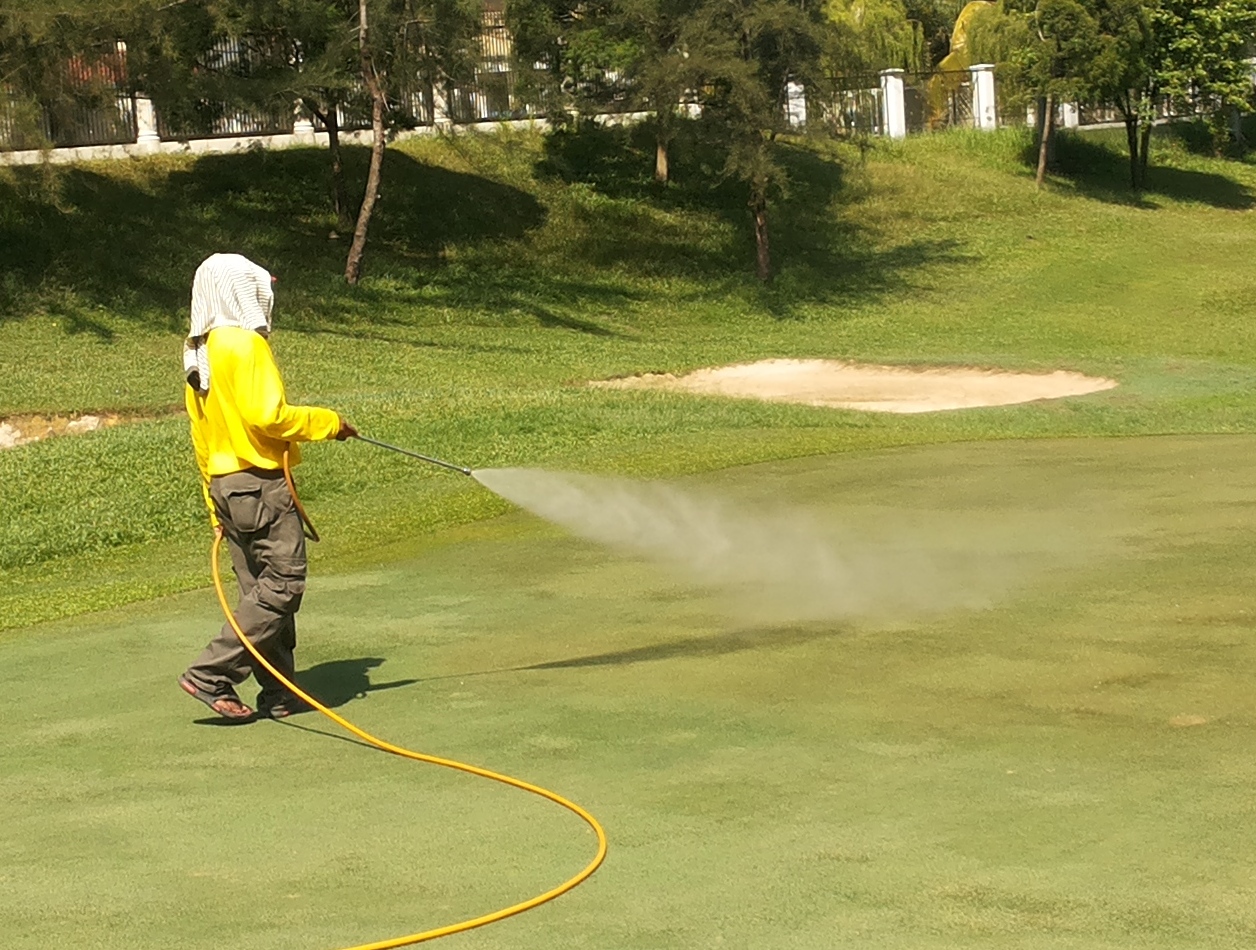
Spraying greens with knapsack sprayer

Spraying greens with knapsack sprayer

Spraying iwth walking boom.

Spraying with walking boom.

Manual spray in progress

Manual spray in progress. Note the amount of spray coming out. How to know how much was sprayed in one area?

I’ve always find it strange and slightly worrying that the concept of ‘calibrating’ of sprayers are not common among Malaysian pesticide applicators, be them golf courses or even football fields. How do you know how much pesticide you are using or have applied? How do you know you have sprayed once or overlapped?

I suppose most of us have seen the application of chemicals so often that we are immune to what is wrong or right.

Unfortunately, the applicators licence issued by DoA are not compulsory on golf courses because they are considered as private property and the licence are compulsory for applicators in public property such as houses (for pest-control companies) but wouldn’t it be nice if ALL golf courses and football fields in Malaysia have trained pesticide applicators? Wouldn’t we feel safer?

I conduct a two-day hands-on training limited to six person to a class at your golf course with your current equipment (which means I can evaluate it too) so if you want to make sure that your grass gets the right amount of pesticide to treat the disease/insects/weeds, I assure you, the cost of using too much or the wrong chemicals is much, much higher than the cost of training. Call O3-5I3I OO66 or email mynormasATconsultant (AT=@) now.

I had to brag (liar) but I'm probably one of the few in the industry in Malaysia that has an applicators licence.

I hate to brag (liar) but I’m probably one of the few in the turf industry in Malaysia that has a pesticide applicator’s licence.

Posted in Golf club, Golf Course, Golf Course Superintendents, Greens, Lanskap | Tagged: , , , | Leave a Comment »

The Biggest Office

Posted by mynormas on June 3, 2015

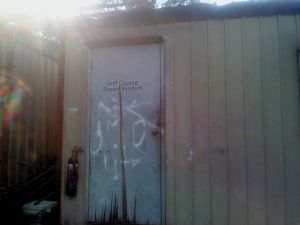
This picture? The

This picture? The “Golf Course Superintendent” sign? Totally not photoshopped or tricked out in any way.
To be fair, the super has moved to new facilities; thanks to new management and they went on be one of the top clubs in Malaysia.

Reading or writing by squinting through one eye is a bummer; I’ve had to go through a minor operation on one eye due to cataract yet I really felt the need to say something about this issue. This past week I’ve had four discussions about Malaysian golf course conditions  (I know thats what you go through in a day but bear with me) and all of it relates to the man in charge, commonly called as the golf course superintendent. In Malaysia, they are also referred to as the golf course manager, supervisor, director or assistant superintendent but the fact remains, they are in charge. I divide them into a few categories:

  1. Superintendents who don’t know what to do
  2. Superintendents who won’t do
  3. Superintendents who can’t do
  4. Superintendents who’s knowledgeable, can and will do.
  5. The corrupt.

It has been said that the golf course superintendent (or whatever the designation) has the biggest office in a golf club; anything between 120 to 300 acres. He, other than the club manager, should be the highest paid person in the club. Such privileges do not come easy; on his shoulder rest the reputation and prestige of the club and he is responsible for the highest expense department, not to mention taking care of the item with the highest construction cost; the golf course.

Right about now I can hear the cliché already; “it is a team effort”. Of course it is, but the team would have to be led by someone that needs to know agronomy, plant pathology, soil science, entomology, agriculture engineering, hydrology, not to mention golf rules and even golf itself. No? Then how is he (or she) to know about plant health, fertility, insects, drainage, machinery, irrigation and how to set up the golf course?

Cliché alert: “It’s not rocket science”, “it’s just growing grass”, anyone can do it bla bla bla. For these managers/owners, I say good luck in managing your clubs but actually, these are the minority. The majority of clubs know that maintaining a golf course takes a knowledgable person with skills. Here’s the tricky part, many clubs know that and want to hire them, but most clubs do not seem to recognise or respect what they already have and I mean this as recognition to both sides of the argument: some superintendents are lacking in knowledge but are still retained, some superintendents are in their comfort zone (and still retained) and some superintendents know what to do but do not get the support and respect they deserve. Of course, there are some who are knowledgable and are supported.

I’d love to comment about the superintendents who are lacking in knowledge but I won’t. Sometimes I can’t help but pity them; for the most part they were thrown into the deep end because of their good work in a previous position or loyalty (or they can’t find jobs elsewhere) and really don’t know what to do except repeating what their predecessor have done or what they think what their predecessor have done and what the suppliers advise. Somehow I can’t find in my heart to blame these people, they were examples of the Peter Principle: people who were promoted and promoted until they reach the level of their incompetence. To these clubs, there is hope because these people in general have good attitudes and are hardworking (hence the promotions), so send them to seminars, courses or pay for them to attend classes (I had a club willing to pay for my Diploma in Accountancy which was of no use to them at all!) or send them to a neighbouring club once a week or month to learn from the superintendent there; or pay the superintendent to come over to teach – just make sure you know the superintendent’s background too.

I’ve also met superintendents who are – on paper – knowledgeable but have voluntarily capped their limits at a certain level. They would not do more than that level, never mind the condition of the golf course. There are of course, justifications and reasons for it: no budget, interference, not enough workers, the weather, poor construction bla bla bla. Have a chat with them and you realise that it is easier to play the victim’s role in a blame game. You get told the idea that this is a hopeless situation even if you know of other clubs who faced similiar circumstances yet are in better condition. This also means that the golf course’s potential is also capped at that level and would not rise any time soon. To the clubs that hired these superintendents; tough luck. No seminar I know will change your golf course. No consultant or adviser too, unless the reports are discussed with the bosses; then maybe there is a chance. I’ve seen that happen, then again, I’ve also seen where the report was discussed with the boss; and the little that was done was to cover the bigger things that was supposed to be done but not, and after listening to the old story of “why it can’t be done”, the bosses gave up (thats part of the problem anyway) and things go back to what it was. To these clubs: good luck. Some superintendents in this category have been … wait: no… a MAJORITY of these superintendents have been in the same club for a very very long time.

What? You don’t know what I’m talking about, but yet your heart rate is increasing, temperature rising and you are upset? That, sonny, means you DO know what I am talking about; you’re just in denial. Okay fine, there are some superintendents who are in one place for too long with their golf course is in good condition. Happy? I’m talking about other clubs where the condition is poor and it is always someone else’s fault. But now that we’re at it, how about taking your club up another notch? Perhaps the weeds on the fairways? The greenspeed? No you can’t? Because of (insert excuse here) right? I rest my case.

The third category of superintendents is the one I pity most. He (or she, I know of one lady super) can usually get a job elsewhere but to him (or her) this job is a challenge to his/her ability and they just want to give it a try. These superintendents are usually  young or relatively new at the club and usually are up against a culture or a bureaucracy that has dug in, fortified and willing to fight to not change. Buying a fungicide that the superintendent needs to apply by the end of the week will take three weeks to process because it has to be justified, three quotations have to be searched and that one form needs to have three (or five!) signatures from three or five levels up and those people are usually not at their desks because of course they are in charge of other projects too. Or the superintendent is regarded as an outsider, an alien, an aberration even. Or a club that can only make decision after a committee meets which is usually at the end of the month… maybe three. Then there are clubs with real issues, for example; a non-responsive workforce – for want of a better description – they have the numbers but they can only work certain hours and at certain limits, never mind clubs with a small work force. Or a club that really tie their superintendents down with a very low budget. Just in case you think I am contradicting myself with superintendents in the second category, be advised that superintendents in this here third category, are still putting up a good show despite their restrictions.

Clubs with these two challenges (1. the non-performing superintendent as well as workforce – because it permeates into the department’s work culture, I promise you – and 2. the club with plodding bureaucracy or work culture – because it permeates into the club’s work culture, I promise you) are good candidates for the golf course maintenance contractor. No kidding. Hire one company to maintain your golf course and you will rid yourself of non-performers and plodders; and consign your golf course to forever be average. What? You think these companies were set up to serve golfdom and golferkind while turning your golf club into the best? No, they were set up to make a profit, so they think fast on their feet and are super-efficient for their own good but it will translate into comparatively better golf courses for you, at least for the first year and the final year of the contract. After which you are ‘doomed’ to appoint a contractor again because you don’t have the know-how and lets face it, you don’t know what went on the past five years anyway.

Someone is upset reading this is it? Lets be realistic, to look for the ‘right’ contractor, you are going to call for a tender exercise which will primarily focus on the cheapest tender after which you will negotiate again until the guy with the cheapest price hurt his knee begging you to stop: so of course lah the contractor will work his a$$ off to beautify your golf course without cutting any corners. Right? Unless – dare I say it? Oh heck, there are some people who will thank me – the contracting company is orang putih/gwailo/angmoh; then we will be the one on our knees begging. And the golf course will be better than average while some of us wonder why the expats do a better job than locals. No, not really about skin colour or just about the budget too. Find out why in the next category of superintendents.

I would be remiss in my ranting to not talk about the fourth category of lucky superintendents and their clubs. The superintendent who knows what to do or if they don’t; they find out, they are willing to do what it takes and they are allowed to do what it takes as they see fit. They are working for clubs who say things like “What? You need a new RM180K fairway mower? We don’t have the budget now but can we talk about it and see if we can postpone or perhaps look for a reconditioned mower or repair what you have now?” Or “So you need to hollow-tine the greens next month eh? Let me talk to the tournament organiser and see how he feels or if he wants to postpone or if he is willing to continue if you use smaller tines/do half of the greens”. In the world of management it is called ‘discussion’.

Did you notice that the two top clubs in Malaysia routinely get their superintendents on stage during award presentation ceremonies? Even if its held overseas? You think that’s because of gratitude to the superintendents’ efforts? No, that’s the mark of the attitude of the clubs to the superintendents’ office. It started long before that walk up the stage. It causes the walk. Not the budget. Not the machinery. Not the skin colour.  Its the attitude. The respect. The clubs respected the superintendents work, decision and opinion.

Ya, ya, ya… here comes the cliche: “Respect has to be earned”. Kinda hard to sympathise or empathise with some clubs (I hesitate to use the pronoun ‘you’ here, because there are some who will take this personally) who insist on hiring the cheapest person they can, to maintain the most expensive department they have. Respect your superintendent and see the difference. If there’s no difference, then perhaps, change the superintendent (sounds harsh? It has to work both ways fellas).

This article is too long already. Is anybody still reading? Very few now I bet. So it is time to introduce the fifth category of superintendents; the ones that people know but talk about only in whispered circles. The almost-unmentionables; the Mr. 10 percent. The what-do-I-get-in-return guy. The corrupt (oh, you think that’s too harsh? Lets see if I can find another term… urm… nope).

You think every one else does it? No, you are a minority. You think because your boss/purchaser/storekeeper does it, it is ok for you to do it? No; two wrongs do not make a right. You think because your salary is lower than market rate then it is ok for you? No. It ruins your reputation to go look for another job that can pay you higher than market rate. You think because the golf course looks good you can do it? No you can’t, because it IS your job to make the golf course looks good. You think nobody knows? Wrong, the industry is small (in Malaysia) and people talk. Ok, they whisper. Behind your back.

Stop. You are ruining not only your reputation but the other superintendents’ too. You will be indebted, nay trapped, to one or two particular suppliers and you will find it hard to change because… easy money is addictive or after a while your hand in the other guy’s pocket so often that you get used to it and he becomes your twin; hard to tell where he ends and you start. Your office is his office. There’s also guilt, fear and conscience. Then the golf course stagnates because your pool of resources and ideas has shrunk to one or two companies. No doubt they’re good and the golf course is good, but it won’t get any better.

So, to improve the golf course conditions in Malaysia; to the superintendents, let’s pull up our socks, raise our game, stay clean, increase our skills, share our knowledge or find another job. To the clubs themselves, treat the superintendents as a professional, respect his position, give him authority: if you can’t, send him for training or a makeover, or find a new one. Otherwise we have to continue as if nothing is our fault and like everything else that goes wrong… blame the government.

Note:

I wrote this opinion based on my observations in Malaysia. It should not be used without evidence to point fingers to any single person, club or group or organisation in particular. Hopefully it provokes thought, if not action. Get angry if you want but do something productive we must. 

Anonymous comments will not see the light of day on this site; I won’t even read it.

Posted in Golf club, Golf Course, Golf Course Superintendents | Tagged: , , , , , , | Leave a Comment »

Ekonomik Baja

Posted by mynormas on May 19, 2015

Ini adalah isu yang selalu juga di tanyakan kepada saya: baja apa yang saya patut guna untuk rumput saya? Di dalam blog nya, Dr. Micah Woods seorang pakar rumput, dalam menjawab persoalan yang di tanyakan kepadanya tentang baja apakah yang perlu di gunakan di padang telah memberi suatu jawapan yang menarik

Gambar hiasan

Gambar hiasan

. Untuk pengetahuan; terdapat tiga atau empat jenis baja.

  1. Straight fertiliser (err… baja lurus?) iaitu baja yang mempunyai hanya satu nutrien sahaja seperti urea, MoP atau SoP.
  2. Baja campuran iaitu baja yang terdiri dari campuran baja di atas dalam kadar tertentu. Jadi ada seketul untuk nitrogen, seketul untuk phosphorus, seketul untuk kalium dan sebagainya.
  3. Baja compound iaitu baja yang dalam setiap ketul terdiri dari pelbagai nutrien.
  4. Baja organik.

Selain itu kita boleh juga membincangkan samada nak guna baja ‘slow-release’ iaitu ketulan baja yang mempunyai selaput khas yang akan menyebabkan nutrien keluar secara perlahan ataupun ia di ikat secara kimia dan di lepaskan secara perlahan.

Mengikut kata Dr Woods, pemilihan baja berbeza dari satu tempat ke satu tempat asalkan pembajaan itu mengikut keperluan rumput dan faktor utama yang menentukan samada kita akan menggunakan baja slow-release yang mahal dan mengaplikasi sebulan sekali atau seminggu sekali berbanding dengan menggunakan baja urea (contohnya) yang di aplikasi seminggu sekali atau dua kali ialah perbandingan harga dan kemampuan. Baja urea mungkin lebih murah dari baja slow-release tetapi kos penggunaan buruh mungkin berbeza dari satu tempat ke satu tempat.

Maka, pemilihan baja apa yang kita akan guna mesti di kira mengikut perbandingan kos per aplikasi dan bukan kos per bag sahaja. Itu pun kalau kita serius tentang pembajaan, selalu juga saya lihat orang yang membaja sekadar nama “Dah baja” sahaja; mereka tak pernah buat soil test dan tak tahu samada baja yang mereka tabur itu cukup atau terlebih.

Ada juga orang yang baja bila dia merasakan ‘rumput dah kuning’ dan perlu baja. Pasal tu lah Cowgrass selalu tak menjadi di padang bola kita; kerana ia secara genetik memang hijau gelap walaupun lama tak baja dan memang kurang sihat.

Jadi: kira kos aplikasi (gaji pekerja sehari + kos mesin + kos baja) bukan hanya berapa harga baja itu.

P.S. Untuk tuan rumah yang lebih selalu berinteraksi dengan saya di laman web ini berbanding dengan orang padang; saya cadangkan baja organik kerana baja organik ialah juga sejenis baja ‘slow-release’ yang akan mengeluarkan nutrien setelah di urai oleh bakteria atau mikro-organisma lain. Jika anda menggunakan sebarang jenis rumput karpet: dua bulan sekali. Jika Cowgrass setahun sekali atau dua kali. Lakukan pada masa anda mahukan rumput yang subur contohnya sebulan sebelum Hari Raya atau Chinese New Year atau Christmas atau seumpamanya yang senang ingat.

Posted in Golf Course | Tagged: , , , , | 3 Comments »

Berapa tinggi Bukit Jalil?

Posted by mynormas on May 14, 2015

Post ini adalah tambahan kepada penulisan sebelum ini. Saya baru teringat nak letak gambar bayang bayang di stadium tu di laman web ini untuk membuktikan kesukaran menggunakan rumput yang perlukan matahari. Sedang saya meneliti gambar stadium saya terperasan ada nombor kecik kat hujung kanan bawah gambar Google Earth ni.  Satu daripadanya adalah ‘eye altitud’  iaitu saya rasa menunjukkan ketinggian ‘mata’ yang melihat gambar ini, dan satu lagi ialah ‘elevation’. Apa itu ‘elevation’? Adakah ia ketinggian dari aras laut? Tapi kan padang ini dikatakan lebih rendah dari aras laut? Kenapa dia tulis 55 meter?

Bacaan elevation adalah 55 meter

Perhatikan bayang bayang di stadium (dan juga elevation di sebelah kanan bawah gambar)

Oleh kerana tak puas hati dengan pengetahuan saya, saya pun buat search di internet apa itu elevation dalam context Google Earth. Tidak berhasil…

Maka saya ambil keputusan untuk cari titik rujukan (point of reference). Saya periksa dengan kawasan sekelliling stadium tapi itu tidak menjawab soalan saya: 55 meter dari apa?

Terdetik di fikiran saya; mungkin dari paras laut? Tapi… tak mungkin. Walau macamanapun saya pergi (dengan Google Earth) ke laut yang terdekat dengan stadium Bukit Jalil iaitu di daerah Klang.

Boom.

“elev 0 meter”.

Maknanya, stadium Bukit Jalil adalah 55 meter lebih tinggi dari aras laut di pelabuhan Klang.

Ia adalah 0 meter elevation

Lihat ‘elev’ yang bunyi macam nama orang tapi sebenarnya adalah singkatan utk ‘elevation’

Kalau ada yang tanya kenapa saya ambil point of reference kat hujung Sungai Klang dan bukan kat laut; ini adalah kerana saya nak nampak nama Pelabuhan Klang itu. Plus, Google Earth ukur elevation tanah, so kat tengah laut dia dah jadi nombor negatif.

Perhatian, part ini bukan lah kepakaran saya, jadi kalau ada pakar yang kata Google ada silap baca ke apa ke… sila lah komen.

Posted in Fields, Padang | Tagged: , | 2 Comments »

Weed Succession

Posted by mynormas on May 11, 2015

The title is not about the success in removing weeds altogether… but… dream on. What I wanted to talk about is called weed succession. It was taught to me by a fresh graduate 20 years ago. God… that makes me feel really old. I don’t remember learning about it at all in college, so it must be something new… then.

‘Succession’ happens naturally in nature. Let me give you a moment to digest that ‘deep’ statement of mine. Basically in nature, species come and go; when soil is bare, the first species that come would be the pioneer species that are adapted to grow in such spaces, when they die they will be replaced by other species, usually grasses; which then over time will be replaced stronger and bigger species.

Men and in this context golf course keepers, tend to push the process along a bit when we want to remove some species with herbicides. Herbicides will affect some plants more than others, especially at different dosages. Plants do not develop resistance to herbicides as fast as fungi or insects but it can happen. What is more common is that plants that are more vulnerable to a herbicide that are applied continuously to an area will die off and replaced (aka ‘succeeded’) with plants that are not affected or recover faster from that particular herbicide.

I noticed this in oil palm areas that are grown in between holes in some golf courses in Malaysia. Only a few types of weeds would survive. It could have been because of the lack of sunlight because its exclusively broad-leaved plants. I used to work in oil palm plantations so I don’t think it was due to the oil palm planters’ practices. When I asked the Superintendent, sure enough, he used only one type of herbicide to maintain the areas closest to his rough.

I have also seen this in some graveyards in Malaysia where right before the time when people visit them (in Malaysia, this is seasonal) the groundskeepers (for want of a better name for them) would be spraying herbicide rather than cutting the grass. Presumably because they work on a seasonal basis too; and yes, only one type of herbicide is used.

Instead of mowing, they sprayed with the same herbicide for years.

Instead of mowing, they sprayed with the same herbicide for years.

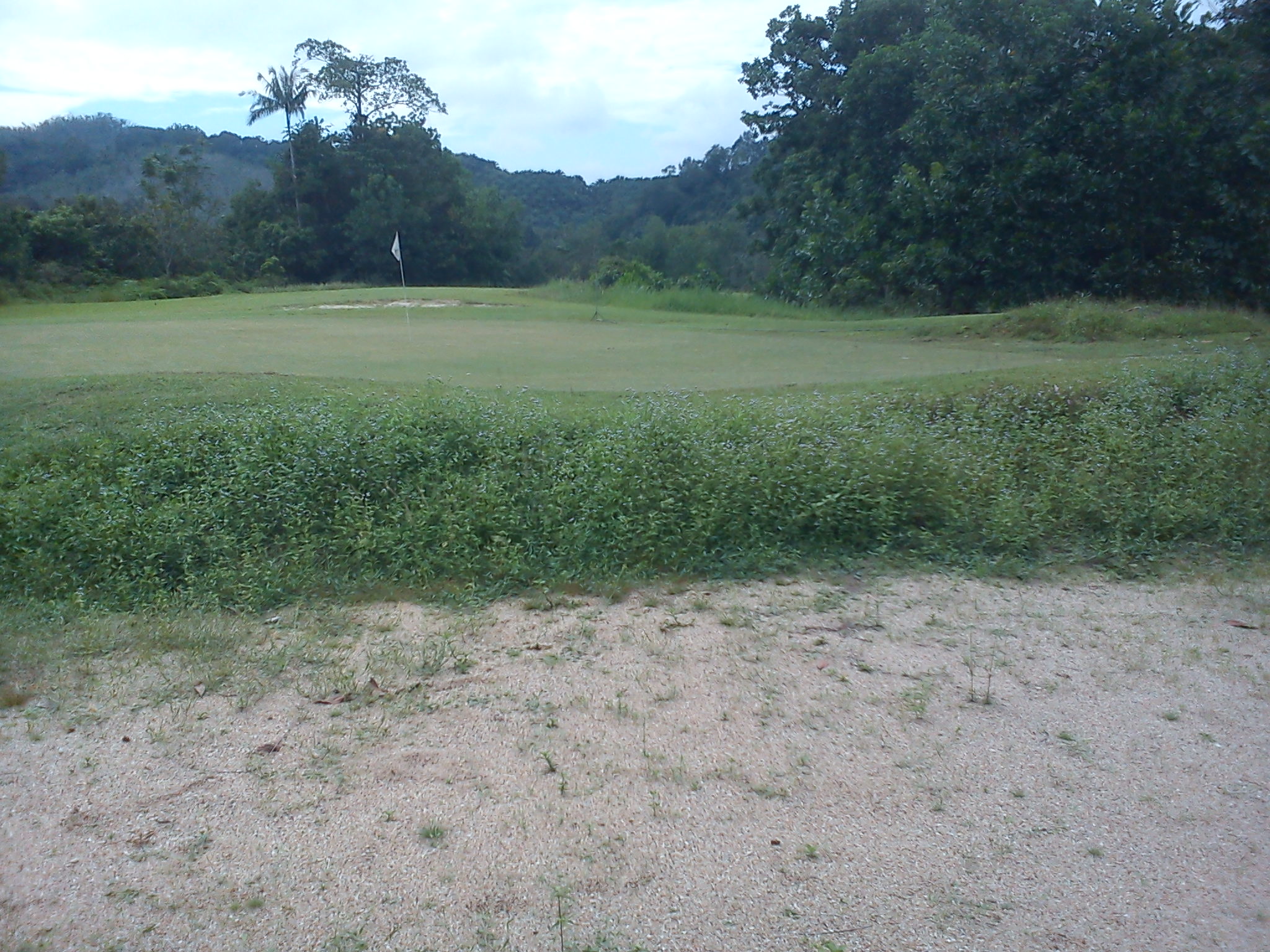
I have sadly seen this on bunkers in one golf course where instead of mowing the faces; they took the easy way out by spraying them. After many years, the bunker faces erode and species that are not affected by that particular herbicide; succeeds. And that, I suppose why the phenomenon (is the spelling right?) is called weed succession.

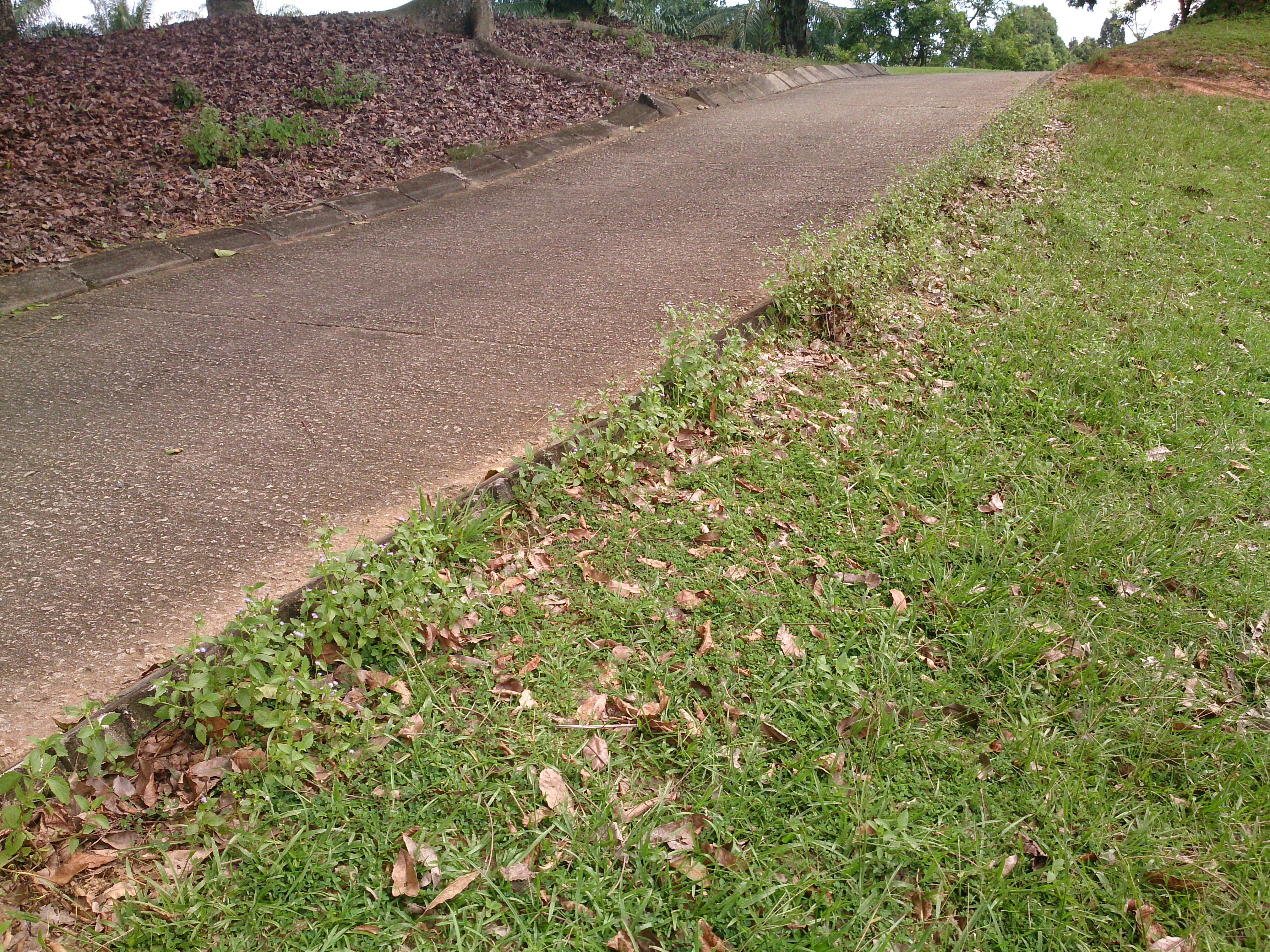
Now sadlier (that means even more sadly. Duh) some clubs also spray around trees, beside buggy paths and drains with herbicide; with the same results.

Edging with herbicide

Edging with herbicide

The herbicide usually used is glyphosate which works against grasses but in high doses would kill broadleaves too and if it doesn’t, some operators would just increase the rate.

I worked at one club that had a few kilometers of fencing that they used herbicide to keep clear. They didn’t notice two things: that they needed to increase the dosage of the herbicide and there’s a lot more creepers on the fence now. Well, not until I pointed it out anyway.

I just switched to a different herbicide – one that actually kills broadleaves – and they managed to control it better. Not that I feel it is the best option, once or twice a year I would insist they use heavy equipment to clear the buffer (actually I had to insist on creating a buffer first) with the excuse it will keep cost lower in the long-term.

It is always about cost, isn’t it?

The way to prevent weed succession and/or tolerance or resistance to a herbicide is of course, to simply just use a herbicide with a different mode of action once in a while.

That wasn’t so hard, was it? Actually judging from the amount of these stuff I see on different golf courses; the concept may be a abit harder to grasp. I understand; I teach spraying and chemical application on golf courses. If you need further inforrmation, do contact me at 03 – 5131 OO66 or normasATconsultant.com with AT replaced with @.

Posted in Golf Course | 4 Comments »

What Enstein said

Posted by mynormas on April 28, 2015

Is it too ambitious to put one of the greatest minds in history to the level of grass growers? I don’t know. I just want to draw attention to his quotes and.how at least one, if not two of them relate to some of what I see in Malaysian golf clubs and football fields. “Insanity” said Mr. Enstein “is doing the same thing over and over again and expecting different results”.

Does that ring a bell? We talk about the (poor) quality of our golf course or field but we do not change anything in the efforts or methods of how we maintain either one. We still use the same fertiliser or the same amount or, in the case of golf course fairways and tees or many football fields; we don’t fertilise at all. We cut our football field irregularly and we have not or worse, never have done any aeration on our fields. Yet we wonder why there is no improvement in quality. Honestly? We shouldn’t wonder, we should just accept it as it is and play it or take up bowling, or fishing or for the footballers; futsal perhaps?

I get it, sometimes there are just too many things to be done that we don’t know where to start, but start we must. If we can’t afford to do the big things, maybe we can start small. Change we must, better now than never. Not all improvements have to be million-ringgit renovations or purchases you know, sometimes it is just about perception and not necessary reality. Consistent greens at moderate speeds? A cleaner golf course? Stripes on a football field?

Maybe a change in fertiliser? Or better still; a soil test to see if we’ve done it right all this years? Trimming the trees surrounding the green may help. I know, I know, the committee/management/owner will never agree. However, you will be surprised how many people who said that have never actually broached the subject to the committee/management/owner. I once was asked to present recommendations on how to improve a particular football field, they told me they can’t afford it; problem was, I haven’t told them how much it costs yet. I guess it was easier to carry on as it is rather than to take an unusual, different and extra step to actually improve it.

Part of what I do is mentoring the existing staff in the effort to improve the quality of a golf course, I’ll tell you it is easier to do it with superintendents and staff who are new rather than those have been in one place too long where every suggestions or recommendation can be taken as a challenge, old habits are hard to break and complacency sets in.

I usually will try to tweak the maintenance practices that I hope will make some changes and I try to find the stuff that is there without incurring immediate extra cost. Measuring green sizes for example and calculating the amount of fertiliser for each green. Changing pesticides; whether the brand or type or how its applied.

Sometimes I go for something new like dragging a metal drag mat on the greens in lieu of grooming. “Will it work?” I am asked. I don’t know; lets try and see what happens. At the very least, it changes the way the staff see the greens. No kidding.

That’s when sometimes I run into opposition, for example when I asked that insecticides are applied early in the morning or late in the evening, I am told that “the insects here are active in the afternoon”. Fine. Problem is, that golf course is plagued by insects for years; and various types and combinations of insecticides have been used to no avail, so why not give a different time of application a try?  Why do the same thing and expect a different result?

If you don’t have a groomer or any sort of vertical cutter, why not try pulling a ‘metal carpet’ on the greens just to shake up the grains a bit? Most old school superintendents will find excuses not to do it, or they’ll tell me they’ll do it and never actually do, but I had one former-factory-manager-turned-Superintendent who followed my instructions blindly. He had four walk-behinds of different makes and models to mow 18 greens but his greens turned out to be consistent and pretty fast for a cutting height of 4.5 to 5mm.

Don’t get me wrong. It is okay to do the same things again and again. Go ahead. After all, I don’t know everything and not everything I suggest may work for everyone. What is wrong is expecting a different result. That, according to old Albert, is insanity, but then, he is also the same guy who said that “We cannot solve our problems with the same thinking that created them”, so maybe it is about using a different kind of thinking. Be offended, go on, if that prompts you or anyone into using their imagination and making some changes; I have not wasted the two hours writing this.

Posted in Golf Course | Tagged: , , , | 1 Comment »

Mengenal ‘Penyakit’

Posted by mynormas on April 13, 2015

In the past few years I’ve been travelling visiting golf courses and a few football fields in Malaysia, one common problem I see is the difficulty some (let me stress that; some) Superintendents find it difficult to diagnose what is wrong with their grass. Especially on greens. I know it can be difficult to identify what disease is at fault except perhaps Fairy Ring but I find it a little alarming when the an insect attack is confused with fungi or even irrigation water contamination is blamed on disease (did that sound right). I’ve seen greens being compacted by some kind of heavy machinery and yet it was blamed on fungus. Sure, there were fungus on the green but you could see that the disease was mostly on the tyre marks and whatever the guy was dragging behind that tractor; a heavy roller perhaps? So I put together a slide that I used for teaching golf course staff on how to identify between abiotic and biotic causes of damage or disease on the course. I also saw a well-constructed football field having problems because the outlet drains were clogged: unclog it, and it improved almost immediately. The slides are in the Malaysian language because it is used to teach Malaysian staff. It is a two-day course and includes a calibration module. For more info on this and other field/course maintenance seminars, please contact me.

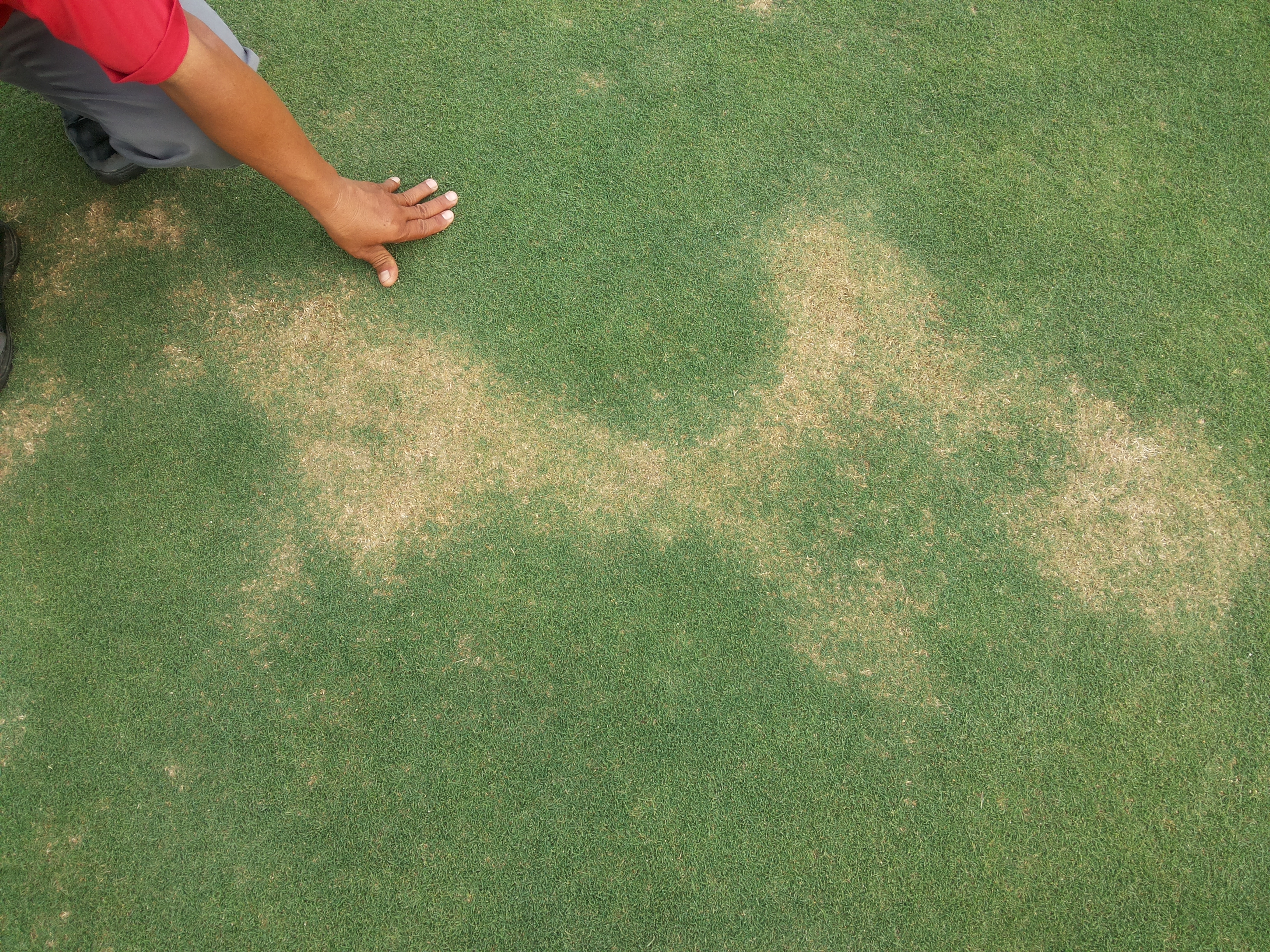
Penyakit apa membuat corak begini? What disease does this?

Penyakit apa membuat corak begini? What disease does this?

Dalam kerja saya sekarang, saya banyak melawat padang golf dan padang bola, dan salah satu masalah yang paling selalu saya jumpa ialah masalah pengenalan kepada penyakit di padang. Kekadang kita confuse di antara penyakit kulat dan serangan serangga. Kekadang masalah yang datang dari pengairan pun kita salahkan kulat. Saya pernah lihat rumput yang mempunyai kesan tayar pun di salahkan kepada kulat juga. Saya pernah lihat rumput yang di salah spray di salahkan penyakit rumput. Saya pernah jumpa padang bola yang di perbuat dengan sempurna dan di jaga dengan baik tetapi bermasalah, saya dapati masalahnya ialah paip outlet membawa air keluar dari padang telah sumbat. Setelah itu di perbaiki, padang tersebut telah berfungsi seperti biasa: tiada penyakit.

Saya telah membuat satu kursus bertajuk “Kursus Asas Aplikasi Racun di Padang” untuk di ajar kepada kakitangan padang dan slaid ini di gunakan sebagai petunjuk kepada mereka untuk membezakan punca penyakit. Ia dalam Bahasa Malaysia. Kursus ini adalah selama dua hari dan termasuk cara kalibrasi mesin. 

Untuk maklumat lanjut tentang kursus ini, sila hubungi saya…

<div style=”margin-bottom:5px”> <strong> <a href=”//www.slideshare.net/normas98/diagnosis-penyakit-rumput” title=”Diagnosis penyakit rumput” target=”_blank”>Diagnosis penyakit rumput</a> </strong> from <strong><a href=”//www.slideshare.net/normas98″ target=”_blank”>Normas Yakin</a></strong> </div>

Posted in Fields, Golf club, Golf Course, Golf Course Superintendents, Greens, Maintenance, Padang, Padang Golf, Taman | Tagged: , , , , , , , | Leave a Comment »

Cowgrass di Bukit Jalil

Posted by mynormas on April 6, 2015

News has it that the National Stadium in Bukit Jalil will soon be using Cowgrass on its field, replacing the current Bermuda grass. That news would not be surprising to most golf course superintendents who by experience, know that Bermuda is not a shade-tolerant species, though for me, when told that it was a new hybrid called “Green Mountain” I thought it may be a new shade-tolerant hybrid which I (and Mr. Google) have never heard of before. Perhaps this is something that just might work. I mean, someone would’ve research it or was given proof or assurance that this new hybrid is shade-tolerant. Right?

Cowgrass: Up Close and Personal

Cowgrass: Up Close and Personal

After all, before choosing a grass, we would need to know the suitability of the grass based on the field’s micro-climate kan? Not just the climate of the country. The use of the field must also be considered, choosing a grass based on its looks (this usually means dark green colour) would just invite… well, disaster. As at now, I am not sure about the effect of a field being below sea level (really? Bukit Jalil is below sea level!?) on grass health. I know that at a high altitude it gets colder and we can use cool season grass like Bentgrass is used on the greens of Cameron Highlands and Kinabalu golf clubs but at ‘lower than sea level’ altitude Bermuda won’t survive? Thats new to me but … but… how come its doing very well at the golf club next door?

Long story short, I still think changing the grass is a good idea. Cowgrass may not be the perfect grass, but in my opinion it is one of the best grass for that particular field, especially if the field is intendend for use with other activities other than football since I believe if the Cowgrass is well-maintained, it would recover faster from a few days of being covered with equipment eg stage or carpeting.

Khabarnya rumput di stadium Bukit Jalil akan di tukar ke Cowgrass. Saya berharap kali ini kita akan bernasib baik dan pemilihan rumput di lakukan dengan mengambilkira semua aspek berkaitan kesesuaian rumput dan stadium. Apa yang sesuai untuk suatu stadium di suatu lokasi tidak semestinya sesuai untuk lokasi lain.

Ia bukan sahaja tentang cuaca tetapi juga tentang micro-climate di sesuatu lokasi, begitu juga kegunaan dan kemampuan tuan punya padang untuk menjaga rumput tersebut. Kemampuan di sini bukan sahaja tentang wang ringgit tetapi juga tentang penjadualan penggunaan padang. Kalau padang itu sentiasa sibuk dengan aktiviti, janganlah guna rumput yang perlukan penjagaan yang tinggi (contohnya Paspalum atau Zoysia).

Saya tidak pasti apa kesan padang berada di bawah paras laut ke atas rumput: ini pertama kali saya dengar. Saya tahu kalau padang berada tinggi di atas paras laut dan cuaca menjadi sejuk kita boleh guna rumput musim sejuk seperti Bentgrass digunakan di padang golf di Cameron Highlands dan Gunung Kinabalu, tetapi tak pernah tahu ada masalah rumput bila padang di bawah paras laut malah, fakta bahawa Bukit Jalil di bawah paras laut pun adalah perkara baru untuk saya. Setahu saya, padang golf di sebelah stadium itu ada menggunakan tiga hybrid Bermuda iaitu Tifway 419, Greenlees Park dan juga Tifdwarf tanpa masalah kesihatan di sebabkan oleh berada di bawah paras laut.

Dari segi sains, kalau terlalu teduh, maka rumput tidak dapat cukup matahari untuk lakukan fotosintesis, tapi apa masalahnya kalau di bawah paras laut ya? Hairan juga saya. Mungkin ada pembaca yang boleh bantu?

Cowgrass bukan rumput yang sempurna ataupun perfect, tetapi pada pendapat saya ia adalah pilihan yang amat baik untuk stadium Bukit Jalil. Cowgrass mempunyai beberapa kelemahan juga, dalam konteks stadium ini, saya hanya mahu cerita tentang dua: ia tidak tahan kemarau dan ia mempunyai karakter/sifat daun yang lebih lembut.

Kalau tak puas hati apa yang saya cakap dan nak lebih selesa dengan mendengar dari pakar orang putih yang di depan nama dia ada pangkat ‘doktor’ boleh rujuk kepada slaid Dr Donald S. Loch dari University of Queensland dalam suatu seminar yang boleh di download dari laman web seorang lagi pakar rumput orang putih dan juga ada pangkat ‘doktor’ dan terus ke muka surat 3 slaid ke empat untuk cerita nya tentang Axonopus compressus atau Broadleaf Carpetgrass (mereka tak panggil Cowgrass, malah di Indonesia mereka panggil Elephantgrass atau rumput gajah).

Memanglah masalah tak tahan kemarau tu boleh di selesaikan dengan menggunakan sistem penyiraman, tetapi awas, terlalu pemurah dengan penyiraman akan menyebabkan rumput ber akar pendek dan mudah tersopak bila di sepak (sedap pulak bunyinya). Kepada tuan-tuan padang yang lain yang tak perlukan pakar berkulit putih dan ada pangkat doktor untuk menerima cadangan, saya cadangkan menyiram hanya di waktu pagi dan jika cuaca terlalu panas: di waktu tengahari untuk menyejukkan kanopi rumput. Jika tuan-tuan (ataupun puan; saya tidak sexist dan mungkin ada person-in-charge padang yang perempuan) mempunyai kemampuan menyiram yang terhad: siram hanya pada kotak penalti dahulu, kawasan padang lain kemudian.

Gambar kesan tine

Contoh kesan pengudaraan tanah.

Satu lagi yang tuan-tuan perlu buat di waktu kering ialah ‘pengudaraan’ secara ringan, iaitu menggunakan besi tajam untuk menyucuk tanah dan membuat lubang-lubang kecil untuk membantu air turun.

Siram juga MENGIKUT KEPERLUAN dan bukan mengikut jadual. Kita kena balance keperluan supaya tidak memanjakan rumput. Jika dia manja, dia akan kurang lasak. pada waktu pagi, sebelum siram, guna paku atau pen (ambik atas meja orang lain) cucuk dan masukkan jari di beberapa tempat; kalau lembab, jangan siram pagi tu, test lagi tengahari nanti.

Tentang kelasakkan rumput; tak banyak yang saya boleh kata kecuali “Jaga pembajaan” iaitu baja ikut jadual. Saya cadangkan baja dua bulan sekali dengan baja yang kurang nitrogen dan mungkin lebih kalium. Baja sedikit tetapi selalu.

Satu lagi sebab saya sokong penggunaan Cowgrass ialah kerana ia adalah rumput yang amat tahan redup, ertinya kalau sekadar beberapa hari di tutup oleh papan plywood atau pentas; dia boleh recover dengan syarat penjagaan nya betul.

Ya, saya tergolong dalam kelompok kecil orang yang percaya bahwa padang bola boleh digunakan untuk tujuan lain. Malah pada pendapat saya, daripada padang itu di gunakan lima hari seminggu untuk bola yang akan merosakkan depan gol dan tempat sepak mula, lebih baik ia digunakan untuk aktiviti lain yang akan menggunakan kawasan lain di padang itu.

Nasihat ini terutamanya untuk padang awam; ingat, walaupun padang tu tak di gunakan, ia bukan lah bangunan stadium yang boleh di tutup lampu dan air hingga bulan depan: ia tetap kena di baja dua bulan sekali dan di potong seminggu dua kali (ya! seminggu dua kali!). Jadi lebih baik ia digunakan untuk konsert atau tarik tali atau apapun asalkan ada jugak duit masuk.

Nak buat perhimpunan pun boleh dengan syarat drainage ataupun sistem saliran berfungsi baik. Kita letak 22 orang atau 22,000 orang atas padang pun, setiap orang akan berada di atas petak peribadi nya sendiri yang mungkin seluas 1 meter persegi atau kurang; jadi apa masalahnya? Berat kolektif semua 22,000 orang tidak boleh berkumpul tertumpu kepada mana-mana titik kelemahan atas padang yang berada di atas tanah di bumi. Jangan gelak, kerana ini berbeza dengan contohnya Dataran Merdeka yang padangnya berada di atas tempat parkir yang mempunyai tiang. Maka berapa banyak beban yang boleh ada di atas padang akan bergantung kepada berapa beban yang boleh di terima oleh tiang-tiang dan palang-palang di antara tiang-tiang tersebut. Itu kena tanya para jurutera yang bertanggungjawab.

Kalau 22,000 orang ini mendatangkan masalah dengan ‘menggaulkan’ tanah dan menyebabkan padang berlumpur atau rumput terkopak, maka percayalah cakap saya, pemain bola pun akan menyebabkan kerosakkan yang sama, malah lebih teruk lagi kerana mereka berlari, menyepak, sliding dan melompat. 

Tapi jika padang itu mempunyai masalah saliran iaitu air sentiasa ada dalam profil tanah atau ia berada pada tahap tepu dengan air, padang itu akan mempunyai masalah; biar 22 orang ataupun 2 orang. Of course kesannya tertumpu pada tempat yang 22 atau 2 orang itu pijak sahaja tapi jangan lupa, 22 orang pemain bola campur 3 orang pegawai akan berada di keseluruhan padang selama 90 minit jadi padang tetap akan rosak secara keseluruhan tetapi lebih lagi di tempat permainan tertumpu. Dimana? Kotak penalti dan tempat sepak mula…

Fikir-fikirkanlah.

Posted in Fields, Padang, Rumput | Tagged: , , , , | 4 Comments »