Turf Matters

The Site To Go To For All Your Turf Matters

  • Facebook Likes

  • The new Brushcutter

    Pengganti Brushcutter

    Increase productivity, cut labour. Try the AM61A

  • Trees Nursery

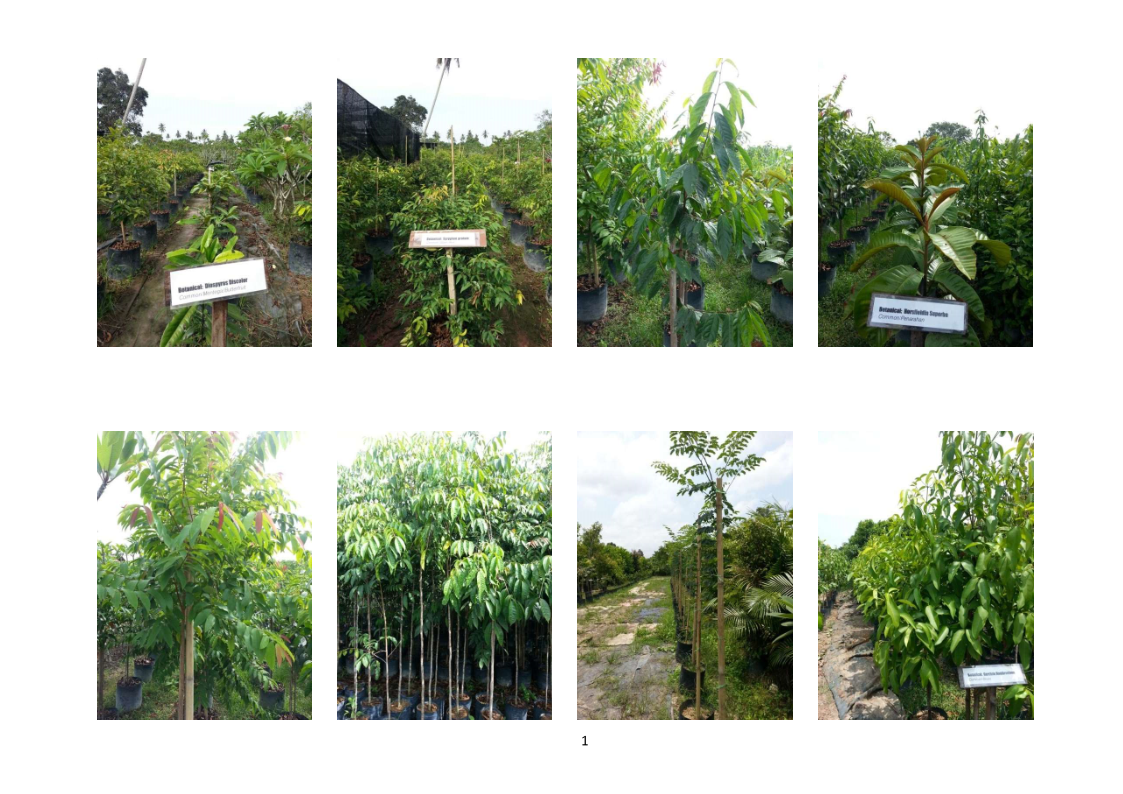
    Forest trees nursery

    Get your Trees from this nursery

Archive for the ‘Padang Golf’ Category

Penjagaan rumput padang golf, bola, stadium dll.

20 year-old greens

Posted by mynormas on January 7, 2014

Some of us in Malaysia seem to make it look like there is an unwritten rule that greens need replacing at a certain age. I decided to explore this at a forum in Pahang, two years ago. These were my slides, some are self-explanatory and some… well you should have been there.

<div style=”margin-bottom:5px”> <strong> <a href=”https://www.slideshare.net/normas98/20-year-old-greens-for-upload&#8221; title=”20 year old greens. A discussion. ” target=”_blank”>20 year old greens. A discussion. </a> </strong> from <strong><a href=”http://www.slideshare.net/normas98&#8243; target=”_blank”>Normas Yakin</a></strong> </div>


Posted in Golf Course, Greens, Padang Golf | Leave a Comment »

Making greens

Posted by mynormas on November 26, 2013

The end of the year is upon us, and there will be many golf courses who are now working on the budget for next year. If the current trend continues, quite a few courses will be (or at least they SHOULD be) renovating their greens. There are a few construction methods for greens and I’d like to share my experience here.

The first cut is the deepest...

The first cut is the deepest…

Firstly, why do I call it ‘construction’ when at the same time, it is about renovations? Well for one, you need to understand the current (or perhaps you would call it ‘previous’) method of construction of your existing green. Because some clubs want to cut corners or are happy with the current design on the greens that all they want to do is to take a few inches off the top and mix in a new root-zone and just plant new grass. Two, some clubs may want to relocate their newly renovated greens slightly nearer to the lake or bunker. Three, some clubs may want to enlarge their existing greens. Or, four, you’re someone who’s curious about greens constructions. Heck, you’ve read this far already; might as well just read all the way through right? At least you’ll have an idea what the Course Superintendents and Club Managers are talking about.

By the way; a caveat; this is not an instruction of a ‘how-to’ build greens manual or suggestions of any kind. Its just a sharing of my experience. Your Superintendent will know the details or you could do your own research at USGA’s site; or you could give me a call O3-5I3I OO66.

“The green is the ‘heart’ of the golf course” said my club manager in 1993, the late Dato’ Benson Lim. The green is the most important part of the golf course. On a price per square foot, it is the most expensive to maintain and the most expensive to construct.

20 years ago, the early part of my golf course maintenance career was spent on a golf course that was still under construction by a Japanese firm. This was one of the first golf courses they build and for most people who supervised them – I included – this was our first golf course too. So you can imagine the pride I felt when I was told, and subsequently read in the marketing brochures that our green was constructed to “USGA standard”.

Imagine my surprise when not many people who work there – including the architect – could tell me exactly what a USGA specification green is. Imagine my bigger surprise when other clubs’ marketing brochures also touted their green as USGA standard specification! Of course the biggest surprise was whenever I brought up the subject of USGA specifications; my peers were vague and changed the subject. Me? I didn’t even know who or what USGA is.

So I did a bit of digging around and found that there are four main types of golf course construction; USGA, California, hybrid of USGA and California, and push-up green. Of course there are many other names, but basically there are about the same things, for example push-up greens are also called as ‘native soil greens’; especially since some people have this thought of a bra whenever the word ‘push-up’ is mentioned. And oh, by the way; USGA is the United States Golf association who, through their ‘Green Section’ does the research and development about stuff on the golf course.

We’ll talk about the other types of construction later. Right now let’s get back to what we shall term loosely as USGA greens, or as some of my foreign staff would say: “Oosgar grins”.

USGA specification for greens was developed way back in the 1960s with one amendment in the 1990s. Yeah it was that long ago. It was basically up to 18 inches deep with several layers of material, each layers has its own specification designed to – not just percolate water – but also to retain water at the same time. The sizes of sand for each layer was calculated and calibrated to not move water, until more water flowed down from the layer above. Genius and confusing for most people; no wonder nobody could explain the concept to me.

This is how a green profile should NOT look like... see the layering?

If your greens’ profile look like this; time to renovate.

It has also been described as ‘inverted water filter’, but very different from my expensive ionizing, hydrogenated, sulfinated, carborated, pH corrected, perforated water filter that only my maid knows how to use, it is about the filters of old where you can see a layer of gravel on top, underneath it is a layer of coarse sand, below it is a layer of slightly smaller diameter sand and below it finally a layer of fine white sand at the bottommost. The theory is that when you pour water from the top, dirt will be trapped in the layers of gravel and sand to give you clean water underneath the filter. Turn the whole filter upside down, and you get the general concept of the USGA green – simplified, of course.

To understand things better I paid a visit to a soil science professor in a local university and told him about how we planted grass. “WHAT!” he said; “Impossible! You can’t plant on sand!” “But Prof, we’ve been doing it for the past 40 years!” said the 20-something-year-old Assistant Golf Course Superintendent to the 50-something-year-old Soil Science Professor.

“But you cannot plant on sand!” he said, standing up. I stood up too; other than the fact that he was raining saliva on me, I was kinda worried just in case he had an axe or pitchfork around just for this occasion; some young upstart spewing out soil science blasphemies.

Well, turns out the good Professor was half-right and I was wrong; you see, the topmost layer is not made up of just pure sand. It is actually a layer called the ‘root-zone’ and it also consists of other organic or synthetic materials that help to retain nutrients and water. I’m sure if I told him that he would understand.

I don’t remember who the Professor was and I don’t think I met him again after that. Maybe that was a good thing too; I’m getting to be a bit too old for these kinds of shock meetings. Imagine my surprise (do you get a déjà vu feeling when you read that? Why am I continually surprised?) when in the next few years, greens constructed not according to USGA standards were doing better than greens following the USGA standard in the same golf course. Remind me to tell you about it. Keep your eyes on this space for the next article soon.

By the way, you could also check out my renovation pictures on Slideshare or look at other websites for more info. And yes, this article came out in a magazine called The Clubhouse about two years ago. It was written by me too and I am a regular contributor. It is also a free magazine you can pick up from your own club so do – you know – pick one up.

Posted in Golf Course Superintendents, Greens, Maintenance, Padang Golf | Tagged: , | Leave a Comment »

Taiping Golf Resort

Posted by mynormas on September 9, 2013

Have you been to Taiping Golf Resort recently? No? You should. The place was formerly known as Bukit Jana Golf and Country Club.

A friend who had just joined Taiping Golf Resort asked me to come over for a visit. As I was in the area visiting a client last week, I dropped by. Having consulted two other golf clubs in the area and trained in one other; I was expecting more of same.

The picture doesn't do it justice. Do go there to judge for yourself.

The picture doesn’t do it justice. Do go there to judge for yourself.

Surprise, surprise. Taiping Golf Resort could put many Klang Valley clubs to shame. The greens are firm and fast. They’re also green. And if you think that is a ‘given’ you need to visit a lot more golf clubs. Or perhaps, I see beyond the colour and look at the health of the green. In any case, the Course Superintendent, one Mr. Huzaine is a firm believer in grooming the greens; a practice which escapes most Malaysian Superintendents.

Get this: he has four walk-behinds for 19 greens (one practice green); two of which are antiquated and have the floating heads designed for undulating greens. This machine has a narrower width of cut than usual and this means his workers has to walk more to cut a green compared to a normal 22-inch wide walk-behinds.

The fairways and roughs are neat and well-maintained. He has one tractor-towed, ground-driven three-gang fairway mower (I was told it used to be five-gang) and one 72-inch rotary rough mower.

Another surprise is that few Klang Valley golfers know about Taiping Golf Resort. It has a comfortable hotel, a decent clubhouse and is just outside of Taiping town. Its about 10-15 minutes away from the North-South highway. By the way, Taiping Golf Resort was formerly known as Bukit Jana Golf and Country Club.

Not many clubs can boast Tifdwarf this tight with a budget that tight...

Not many clubs can boast Tifdwarf this tight with a budget that tight…

TGR has challenging undulating greens, wide but long fairways, tricky dog-legs and well-maintained roughs. Its pretty good for weekend golfers and even those who are looking for something new. The bunkers? You have got to see them. I saw one big deep bunker and a few long ones. I wonder who designed this course. Anybody know?

I’d like to congratulate En. Huzaine and En. Basri for a job well done.

Posted in Golf club, Golf Course, Golf Course Superintendents, Padang Golf, Uncategorized | 2 Comments »

Greens Improvement (kau ada?)

Posted by mynormas on August 16, 2013

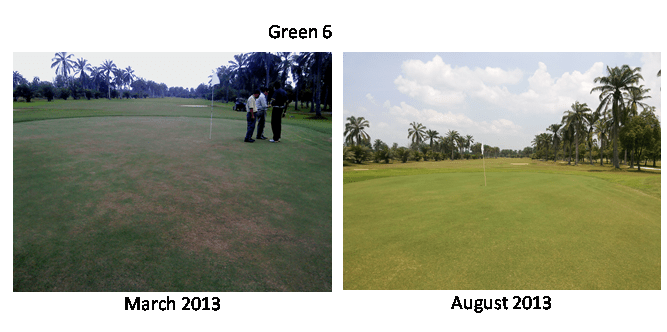
Big change - God willing

In 5 months

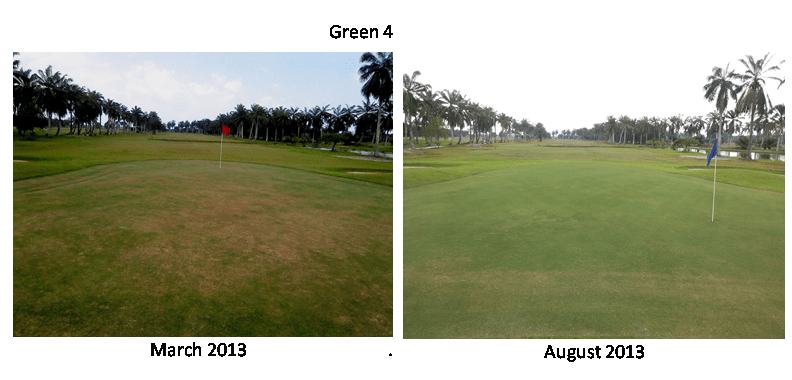
These pictures show 3 greens now and 6 months prior me becoming their consultant.

Last March a club called and asked for help in improving their greens. I visited the club today (August) and the boss and committee chairman were happy.

I told them in March I could try – God willing – to make some changes. I proposed that I come by once a month to check and give them a schedule on what to do for the next one month. They are of course, not really interested if all I were to do is to recommend some magic formula or machinery which they won’t need a consultant for; they can get many suppliers to give them free advice on that.

In fact, just a couple of months before that they had already spent on a few hundred thousands of ringgit to buy machinery – one of which is sitting idle in the workshop because it was too big for them.

What they want was advice on how to improve the greens without having to reconstruct and/or spend too much money. Actually, they thought they’re paying me too much and don’t want to pay for anything else at all.

The Course Supervisor was friendly but defensive. They had a manager in March but he left in April and they have not replaced him to date.

They agreed to my fee (which, considering the small size of the club, did surprise me a bit) but they wanted something extra. They want a PowerPoint Presentation for the Big Boss every time I visit. Once a month? For the fee I charge? Of course I said “yes”.

So once a month I would spend a day going round with the Supervisor, prepare a presentation that night and first thing the next day, do a presentation for Dato’. He was a rags-to-riches businessman who spoke little English so I had to speak plainly with no jargon.

The Supervisor eventually was quite supportive of me because he can see that I was always on his side by giving him credit for whatever good that happened on the course. He also saw that I not only told him what to do and how; but I also told him the whys and the alternatives. I also did not pushed any chemicals or fertilizers on him. I gave him the specs and formulation and he found them himself.

When I met Dato’ today I was imagining that my contract was going to be shortened since I had already met the challenges posed earlier (I need to relook at that escape clause in my agreement); but surprisingly, he asked me to come more often (like, twice a week?!) so that I can help him with the overall management!

That’s nice of him. But I probably will turn that down. Enough club management for me. I love improving greens and managing grass. People and members? Not so much.

Mar to Aug

Mar to Aug

Not just these 3 greens; all greens there show improvement.

Not just these 3 greens; all greens there show improvement.

Posted in Golf club, Golf Course, Golf Course Superintendents, Greens, Maintenance, Padang Golf | 2 Comments »

Cutting grass

Posted by mynormas on May 31, 2013

Jika alasan anda ialah kecerunan; cuba cari mesin "hover mower"

Jika alasan anda ialah kecerunan; cuba cari mesin “hover mower”

The recent case of a child injured by flying debris gave me the impetus to write this letter. I see a lot of people  – from local authorities to homeowners to football associations  – planting grass but the most common method used to cut the grass is by using the backpack mower called the  ‘brush-cutter’; ‘bush-cutter’; ‘whipper-snapper’ or even the ‘helicopter’.

This machine is favoured because it is cheap, portable, simple to use and require almost no maintenance. When the blades are changed to nylon strings heads, there is one added advantage: there is no need for sharpening.

A few observations about this “brush-cutter”:

  1. The business end of this machine consists of naked rotating blades or nylon strings.  These blades/strings would turn at high speed to cut the grass by impact. Needless to say the same impact would fling stones, pebbles, sand particles and other debris on the ground at high speed towards the operator and those around him or her. Its made worse when the operator rests the strings on the ground.

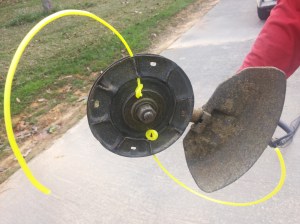
    The nylon string head of a brush-cutter

    The nylon string head of a brush-cutter

  2. Due to the weight and vibration of this machine only the tough and hardy are willing to operate it for long periods. Hence we see this work being ‘monopolized’ by foreign employees. If we really want to reduce our dependency on foreign workers, lets reduce our dependency on this machine first, at least in this context.
  3. This also has the effect of keeping turfgrass and landscape maintenance in the realm of labourers or part-time odd-job workers. This would negate the efforts of the efforts of the Youth and Sports Ministry – among others – that for the past few years has been working on a syllabus to train youths in landscape, stadium and golf course maintenance with the intention of turning this into a career.
  4. In the hands of the untrained – or the tired – operator, the tendency is to rest the blades or the strings on the grass.  This would cause a very low height of cut (think: ground height) Grass needs leaf to do photosynthesis to produce food and cutting at low heights just removes too much leaves. There is a “rule of thumb” of not cutting more than one-third of the grass when mowing. No way can the “brush cutter” maintain a consistent mowing height of one-third of anything.

I call on everyone who has authority over grass cutting (and that includes homeowners) to stop or limit the use of these machines. Homeowners should consider buying their own electric grass mowers (available in most hypermarkets). Local authorities, building and golf course owners should consider renovating their turfed areas so that its more accessible to ride-on mowers. Architects too must design turfed areas with ride-on machines in mind or look at  alternatives other than grass for example ground-covers, wild flowers, weeping lovegrass, pebbles or even artificial turf.

Homeowners should mow their grasses more often than the occasional time when the grass cutter knocks on your gate when he sees your grass long. The grass Malaysians call Carpet grass grows very quickly and should be mown as often as at least once a week. Petrol engined mowers are high maintenance so do consider an electric or ground-driven mowers.

Many land owners, football associations, golf courses and even homeowners dream of striping their grass. This can never be achieved with “brush cutters”. And no; contrary to popular belief, you don’t need golf course priced machinery to stripe your grass, any mower with a heavy roller behind it (and this can be modified with a metal or GI pipe) will stripe a field with enough discipline on the part of the operator.

With a brush cutter? All you need is a sneezy operator and you can kiss your beloved grass goodbye.

These poor grass has been mown with a brush cutter - maybe the operator has the flu.

These poor grass has been mown with a brush cutter – maybe the operator has the flu.

Posted in Fields, Golf Course, Landscape, Lanskap, Padang Golf, Rumput, Rumput halaman rumah, Rumput secara am, Taman | Tagged: , , , | Leave a Comment »

Greens Improvement

Posted by mynormas on April 29, 2013

image

This is green 18 at Kinrara Golf Club. It usually doesn’t look like this.
Read the rest of this entry »

Posted in Golf Course, Golf Course Superintendents, Greens, Padang Golf | Tagged: , , | 6 Comments »

Algae on golf greens

Posted by mynormas on January 2, 2013

In the context of Malaysian weather where heavy and frequent rain is the norm, plus with poorly or compacted greens, shade from surrounding trees; algae is quite common.I found this slideshare article that is very informative and thought that I should share it.

Be advised that even though the title is about golf greens, much of the info are also applicable to other parts of turfed areas (yes your lawn too madam)

If you think most of the slides’ contents are too ‘academic’ jump straight to slide number 53, though you might be searching backwards for background info but at least you know what you are looking for is what you need to know.

This is the first time I am doing this so I hope this turns out alright…

Posted in Fields, Golf club, Golf Course, Golf Course Superintendents, Greens, Padang, Padang Golf, Rumput, Rumput halaman rumah | Tagged: , , , , | 1 Comment »

Zoysia green.

Posted by mynormas on September 3, 2012

image

As I said, its the first time I used this app. Just tilt your head to the right to see the image.

My first ever Zoysia green (and my first ever posting with this app). It was an unused and un maintained roundabout behind the club kitchen and the cooks were dumping their old equipment on it! One pro tournament at the club wanted a practice green and that was the only option available. They gave me two weeks notice to get it done. Managed to do it just in time and maintained it as a green ever since. It may be the ‘wrong grass’ but it sure is easier to maintain than the greens here that have many different types of grasses.

Posted in Golf Course, Golf Course Superintendents, Greens, Maintenance, Padang, Padang Golf | Tagged: , | 1 Comment »

Turf Consultancy Sdn Bhd

Posted by mynormas on July 21, 2012

After a long period of gestation, I’d like to finally announce the formation of my company that specializes in consultancy, training, maintenance and supply of turfgrasses. Yes I do renovations and reconstruction too. As for landscaping, I will be doing joint-ventures with other companies. I will announce that at a later date.

mynormas’ new company.

The name of the company? Turf Consultancy Sdn. Bhd. I don’t have the mission statement, vision or even a tagline yet. Or maybe I won’t ever have one. I know what I what the company is for; it is to leverage on my and my peers knowledge and ability to improve turfgrass maintenance and management in Malaysia.

So for  stadiums, fields and parks that are looking to improve the quality of their grass,  call Normas at O3-5I3I OO66 (and let it ring. Plus be reminded the O=0 and I=1) or email mynormasATconsultant.com (AT=@).

Golf courses that have problems with their greens, or having drainage problems can call me too.

Being a former GM means I can also help out with the business or management side too.

I also specialize in trainings for turfgrass workers; teaching them the basics so that they know their stuff. For senior or long-term staff, I do machinery operation basic training and especially important for golf courses: I do training for chemical and fertilizer application. Hands-on. With a small class.

Well, I’ll do the advertisements and stuff at a later date. This is just the announcement of the company’s name for now (taking advantage of the first day of the month of Ramadhan).

Not forgetting to wish everyone a blessed Ramadhan.

Posted in Fields, Golf club, Golf Course, Padang Golf | Leave a Comment »

Menyiram waktu panas

Posted by mynormas on June 4, 2012

Elakkan dari menyiram air mengikut jadual tertentu. Kita sebagai manusia secara amnya tidak minum air mengikut jadual, tetapi mengikkut kehausan jadi kita menyiram rumput pun sebaiknya mengikut keperluan rumput.  Apa yang saya maksudkan di sini ialah menyiram rumput setiap hari pukul 8 pagi atau pukul 6 petang. Kalau tengah hujan pun kita siram jugak kerana nak ikut jadual.

Siram ikut keperluan.  Jika tanah pada kedalaman satu inci di bawah masih basah; tak perlu siram. Jika ia kering; boleh (bukan mesti) siram.

Ini bermakna ada hari kita siram satu hari sekali, ada hari dua kali dan ada hari tiga kali sehari. Dan kadang-kadang: tak siram berhari-hari.

Tips;

  • untuk kawasan yang redup; elakkan siram di waktu petang. Kawasan yang basah di waktu petang akan menggalakkan rumput.
  • amalkan siram di awal pagi; air akan kekal di dalam tanah di waktu rumput memerlukannya sewaktu terik nanti.
  • Bila siram, siram hingga di anggarkan air akan tembus beberrapa inci ke dalam tanah. Ini akan menggalakkan akar tumbuh panjang mencari air.
  • Menyiram terlalu kerap (untuk kawasan rumput yang dah matang) akan menyebabkan rumput manja dan terlalu mengharapkan air yang di siram dengan tidak berusaha mencari air sendiri.
  • Terik matahari boleh membakar akar rerambut yang berada di berhampiran permukaan tanah.
  • Syringe ialah suatu teknik menyiram yang berfungsi menyejukkan permukaan rumput (dan bukan ‘memberi air’).
  • Rumput yang ditanam di atas pasir lebih memerlukan air di siram daripada rumput yang di tanam di atas tanah.
  • Tidak semua tempat memerlukan jumlah air yang sama. Ada tempat perlu di siram lebih dari tempat yang lain.
  • Jangan siram hingga mencapai tahap tepu tanah; siram dan biar sekejap sebelum siram lagi.
  • Jangan siram di kawasan lereng sehingga air mengalir ke bawah; siram dan biar sekejap sebelum siram lagi.
  • Umumnya; siram jarang-jarang tapi dalam-dalam adalah prinsip menyiram rumput di kawasan matang.
  • Menyejukkan rumput di waktu terik panas akan menyelamatkan akar rumput yang dekat dengan permukaan dan mengurangkan kadar kehilangan air.
  • Jika anda mampu menyiram hanya sekali dalam sehari; siram pagi. Bukan petang; dah terlambat dan akan menyebabkan lumut dan penyakit.
  • Jika anda mengalami localized dry spot (LDS) gunakan ‘wetting agent’ ataupun tebuk tempat tersebut supaya air boleh tembus. LDS biasanya di sebabkan oleh tanah hydrophobic dan air hanya di permukaan.

Selamat mencuba!

Posted in Golf Course, Greens, Landscape, Lanskap, Padang Golf, Rumput halaman rumah, Taman | Tagged: , , | 4 Comments »