Turf Matters

The Site To Go To For All Your Turf Matters

  • Facebook Likes

  • The new Brushcutter

    Pengganti Brushcutter

    Increase productivity, cut labour. Try the AM61A

  • Trees Nursery

    Forest trees nursery

    Get your Trees from this nursery

Posts Tagged ‘golf’

Apa itu ‘Par’

Posted by mynormas on July 22, 2015

Bila kita baca/dengar tentang pertandingan golf kita biasa dengar perkataan ‘par’ contohnya “Tiger Woods memenangi pertandingan tersebut setelah membuat 63 pukulan, 9 di bawah par” dan memandangkan ia menyebut tentang Tiger Woods memenangi pertandingan, jelas sekali ia adalah berita yang sangat-sangat lama dahulu.

Tapi, apakah maksud par dalam context permainan golf? Dan jika kita bukan minat pun tentang golf, apa maksud ‘par’ dalam pepatah Inggeris ‘par for the course’ atau ‘not up to par’?
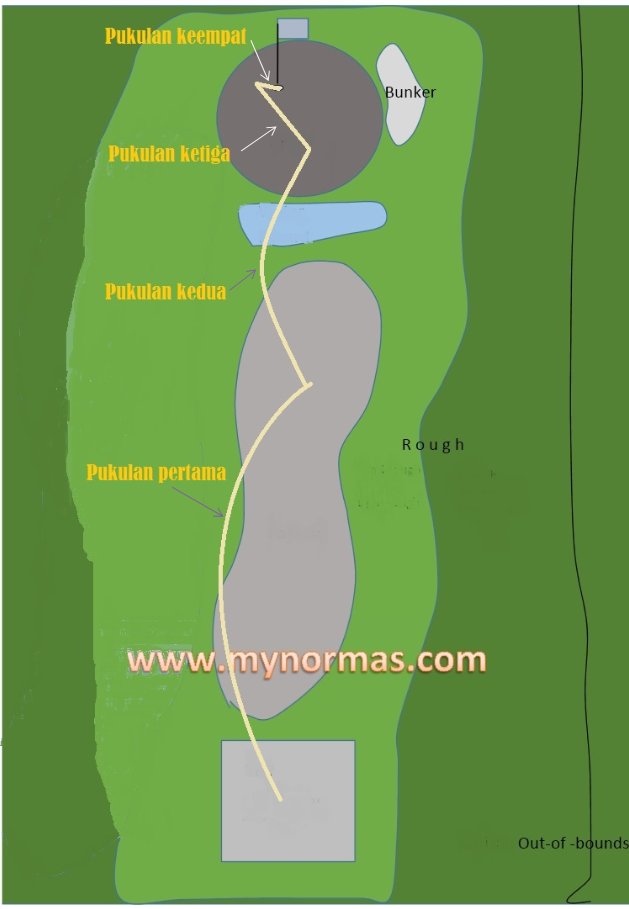
Contoh pukulan di lubang par 4.

Contoh pukulan di lubang par 4.

Dalam golf, ‘par’ adalah bilangan pukulan yang telah di tetapkan oleh arkitek (designer) padang untuk seorang pemain golf scratch (handicap 0) untuk memukul bola dari tee hinggalah ia masuk lubang di green pada suatu Lubang. Contohnya jika lubang itu adalah par 4 maka empat pukulan SEHARUSNYA di perlukan untuk memasukkan bola ke dalam lubang. Untuk makluman, lubang par 4 panjangnya adalah diantara 230 hingga 430 meter.

Terdapat tiga jenis par yang di gunakan secara rasmi di sebuah padang golf; par 3 (90 – 230m), par 4 dan par 5 (430 – 550m). Sebuah padang golf 18 lubang BIASANYA akan ada empat lubang par 3, empat lubang par 5 dan 10 lubang par 4 tetapi gabungan lain juga di benarkan.

Jumlah par kesemua lubang adalah jumlah par untuk padang golf tersebut. Contohnya, Kelab Golf Kota Permai mempunyai par 72, Kelab Golf Mines par 71 dan sebagainya. Padang golf yang digunakan untuk pertandingan akan mempunyai par di antara 69 hingga 73.

Setelah habis bermain golf, seorang pemain akan membandingkan jumlah pukulan nya dengan par padang tersebut. Maka jika par padang tersebut ialah 72 dan dia telah membuat jumlah pukulan sebanyak 70; maka kita kata dia telah membuat 70 pukulan, dua di bawah par. Jika 75: 75 pukulan, tiga di atas par dan sebagainya. Untuk pemain golf profesional seperti Tiger Woods dan lain-lain ataupun untuk sebahagian pertandingan yang tertentu, kiraan mutlak di gunakan, ini di panggil sebagai gross score.

Jika pemain golf itu adalah amatur, maka jumlah pukulannya tadi akan di tolak dengan handicap nya. Contohnya jika seorang pemain yang mempunyai handicap 10 menghabiskan permainan dengan membuat sejumlah 80 pukulan, maka 80 akan di tolak dengan 10 maka jumlah pukulan nya ialah 70; dua di bawah par. Ini di panggil sebagai net score.

Ada pertandingan yang berlangsung lebih dari satu hari maka jumlah par untuk kesemua hari itu akan menentukan pemenang. Setiap pertandingan akan mempunyai peraturan yang berbeza. Contoh yang saya gunakan di sini hanyalah untuk pertandingan yang dipanggil sebagai stroke play.

Tentang pepatah Inggeris ‘par for the course’ pula, ia membawa maksud bahawa sesuatu tabiat, situasi atau kejadian memang boleh di jangka. Ia tidak baik tetapi adalah normal. Contoh ayat:

  1. So he went off and left you? Well that’s about par for the course. He’s no friend. 
  2. I worked for days on this proposal, but it was rejected. That’s par for the course in this company. 
  3. The school budget is going to be cut again this year, but then that’s par for the course.

‘Up to par’ pula ialah bila mereka memberitahu orang bahawa taraf kerja yang di buat berbanding tahap yang tetapkan/biasa. Contoh ayat:

  1. The manager said that the report is not up to par and gave it back to be redone.
  2. Good. Your work is up to par.

https://en.wikipedia.org/wiki/Par_(score)

http://www.quora.com/How-is-par-on-a-golf-course-determined

http://golf.about.com/cs/golfterms/g/bldef_par.htm

http://idioms.thefreedictionary.com/par+for+the+course

http://dictionary.cambridge.org/dictionary/british/be-par-for-the-course

http://idioms.thefreedictionary.com/par

Posted in Golf club | Tagged: , | Leave a Comment »

Handicap dalam Golf

Posted by mynormas on July 2, 2015

Gaya mesti ada.

Gambar hiasan.

Perkataan ‘handicap’ secara terjemahan nya membawa maksud kecacatan atau ‘kelainan upaya’ jika kita menggunakan terma yang lebih baik. Apa maksud ‘handicap’ dalam golf pula? Ia tidak dapat di terjemahkan tanpa di salah ertikan maka perkataan ‘handicap’ juga di gunakan dalam bahasa Malaysia.

Sistem handicap memungkinkan pemain golf dalam pelbagai kebolehan bermain di antara satu sama lain. Bayangkan jika sistem handicap ada dalam permainan badminton, saya boleh bermain dengan pemain profesional (asalkan bukan Dato’ Lee Chong Wei lah) dengan masuk gelanggang sudah mendahului 6-0 jika handicap saya adalah 6. Jika saya berlawan dengan orang yang juga mempunyai handicap, contohnya 3, maka kami akan mula bermain dengan 6-3 atau 3-0.

Dalam golf, handicap ialah bilangan pukulan seorang pemain boleh di tolak dari jumlah pukulan  selepas tamat permainan. Ertinya seorang pemain yang mempunyai handicap 10 boleh tolak 10 dari jumlah pukulan yang dia capai pada hari itu.

Lebih rendah handicap seorang pemain, lebih pandai lah permainannya. Pemain yang baik dan yang sudah mencapai handicap ‘sifar’ atau kosong di panggil ‘scratch golfer’ dan oleh kerana memanggil seorang berusia 50an yang pandai main golf sebagai ‘pemain golf garu’ boleh di anggap sebagai luar batasan, maka kita kekalkan nya sebagai pemain golf scratch.

Lebih tinggi nilai handicap, maka kurang pandailah dia sebagai seorang pemain golf. Kadang-kadang, terdapat pemain yang sengaja ‘membela’ handicapnya pada kadar tinggi supaya dia lebih mudah memenangi pertandingan golf amatur. Orang seperti ini selalunya di gelar sebagai ‘buaya’ di dalam istilah golf tempatan. Ini pula adalah istilah yang tidak dapat di terjemah ke dalam bahasa Inggeris; menuduh kawan Amerika anda sebagai seorang ‘crocodile’ hanya akan mengelirukan nya.

Handicap di kira secara umumnya berdasarkan kepada bagaimana purata permainan kita pada waktu itu. Seorang golfer seharusnya menyerahkan kad skornya kepada pihak pengurusan kelab untuk di masukkan ke dalam sistem handicap kebangsaan tetapi dalam realiti, tidak ramai golfer akan membuatnya.

Siapa yang menjaga handicap? Di Malaysia, ia di kelolakan oleh Persatuan Golf Malaysia atau Malaysian Golf Association (MGA) melalui sistem handicap kebangsaan atau National Handicapping System (NHS).  Kelab golf yang berdaftar dengan NHS akan memasukkan skor pemain kedalam sistem ini yang akan mengira handicap pemain golf tersebut.

Satu lagi cara mengira handicap yang biasa digunakan oleh penganjur pertandingan golf amatur di Malaysia ialah dengan menggunakan sistem pengiraan golf dalam pertandingan yang mana handicap pemain akan di kira berdasarkan prestasi permainan dalam pertandingan tersebut. Sistem yang di gunakan di antaranya ialah System 36, Peoria atau Callaway dan sebagainya.

Handicap sahaja tidak menentukan berapa pukulan anda boleh dapat di tiap-tiap padang. Ingat bahawa setiap padang golf berbeza dari satu sama lain. Dua perkara yang perlu di ambil kira ialah Course rating dan slope rating, kedua dua ini menentukan betapa susahnya padang ini berbanding dengan padang itu. Jadi jika anda mempunyai handicap 20, anda mungkin mendapat tambahan pukulan satu padang (atau pengurangan) di padang lain.

Sila lihat video di USGA.org ini untuk maklumat tambahan.

http://news.bbc.co.uk/sport2/hi/golf/rules_and_equipment/4748865.stm

https://en.wikipedia.org/wiki/Handicap_(golf)

http://www.streetdirectory.com/travel_guide/44812/golf_guide/a_beginners_guide_golf_scoring_and_calculating_a_golf_handicap.html

Homepage

http://www.golf.com.my/handicaps-in-golf/

http://www.leaderboard.com/GLOSSARY_PEORIA

Posted in Golf club | Tagged: | 2 Comments »

Hot and kering

Posted by mynormas on February 23, 2015

The Malaysian Meteorological Department has issued a statement that the current hot and dry spell in Malaysia will last until end of March 2015. 
That’s 30 over days away. Bearing in mind that some parts of Malaysia haven’t had rain since a couple of weeks ago, the question to ask is; do you have enough irrigation water to last for the next 30 days? Or maybe even longer?
It would be good to know early so that you may want to start rationing, look for other sources of water or perhaps look around for other alternatives to making your irrigation more effective and efficient. You know, wetting agent, better sprinklers or even an irrigation audit. I’ve heard of claims that a slight increase in Kalium (thats Potassium to you Americans) will help in retaining water but don’t quote me.

Jabatan Meteorologi Malaysia telah mengeluarkan kenyataan tentang cuaca panas dan kering sekarang akan berlanjutan hingga akhir Mac 2015. Ini adalah lebih dari 30 hari dari hari ini.
Adakah kita mempunyai air yg cukup utk menyiram hingga April?
Jika tidak, kita mungkin perlu mencatu air, mencari sumber lain ataupun alternative lain seperti agen pembasah (wetting agent) audit sistem pengairan dan sebagai nya. 
Selamat Mencuba!

http://www.met.gov.my

image

Posted in Fields, Golf Course, Greens, Landscape, Lanskap, Maintenance, Padang, Padang Golf, Rumput halaman rumah, Rumput secara am | Tagged: , , , | 2 Comments »

A golf club, a legend

Posted by mynormas on December 15, 2014

I was just going through the mail today (Friday the 12th of Dec) when my wife called my attention to one of the letters; “Look, its a golf club” I thought she was referring to a letter I recently received from my club raising the subscription fee for 2015, I was going to say something not nice when I realised she was pointing to a stamp on a different letter.

It turns out the stamp was about The Mines Golf Club and The World Cup of Golf played there in 1999.

image

I don’t know about you but to me, this elevated the club to ‘legend’ status in my eyes. The last time I knew that a golf club was featured on a stamp was when RSGC celebrated their 100 years anniversary.

Did I miss anything? Let me know your thoughts and opinions below.

Posted in Golf club | Tagged: , | Leave a Comment »

A friend in need…

Posted by mynormas on February 4, 2014

Managing a golf club is difficult and expensive. Maintaining a golf course or field is challenging. I’ve been there, done that and would like to share my experiences: hence this website, a couple of books that I’m working on and a consultancy.

Its a pity some clubs practice the saying “a consultant is someone called in at the last minute to share the blame” to the extreme, because though my charges are considered expensive by Malaysian standards, getting it wrong is an even more expensive and embarrassing.  And boy, have I seen some major lessons.

From bad choice of grass (I wouldn’t call it ‘wrong grass’, just ‘bad choice’) to expensive selection of machinery to dead grass, I’ve seen them all.

I don’t do cheap and I rarely give discounts. What I do give, is free service. Yes.  Free. But only one time. Not even transport cost if you are in the Klang Valley or in the general area of where I will be if outside the Klang Valley. One day or one inspection round (I don’t play  during work).

Some days what you or your people need is just a second opinion, or even a third one when there is conflict. I can do that.

Why am I making this offer? Well, a friend faced a major problem today and we communicated. I could feel the relief he felt being able to discuss with someone sincere and

image

not trying to sell him anything.  Did I solve his problem? He did it himself, I just facilitated his reasoning with stuff that he already has in his store.

What’s in it for me? It felt good. It felt good because I helped a friend. It felt good because I had a hand in making one golf course better. It felt good because I learnt a new thing or two.

So go ahead. Give me a call. Or email me. Or if you are embarrassed, get a temporary Yahoo or Gmail email under a fake name and write a question on this website so others can benefit or even contribute. If you email me under a fake name, I may take my time to reply and chances are, I will put it up on this website anyway.

My email for Q&A is mynormasATconsultant.com (replacing the AT with @) and my Malaysian office number is o3 5131 oo66. Do let it ring, we do a lot of field work and the call will be transferred to a mobile phone if no one picks up.

Oh… if you have any special requests for a topic to discuss or write about (because you want to show it to someone) that can work too. Maybe. It depends on the relevance and my time.

So good luck and Happy New Year!

Posted in Golf club, Golf Course, Golf Course Superintendents, Padang, Padang Golf | Tagged: , , , , , , , | 4 Comments »

Making greens

Posted by mynormas on November 26, 2013

The end of the year is upon us, and there will be many golf courses who are now working on the budget for next year. If the current trend continues, quite a few courses will be (or at least they SHOULD be) renovating their greens. There are a few construction methods for greens and I’d like to share my experience here.

The first cut is the deepest...

The first cut is the deepest…

Firstly, why do I call it ‘construction’ when at the same time, it is about renovations? Well for one, you need to understand the current (or perhaps you would call it ‘previous’) method of construction of your existing green. Because some clubs want to cut corners or are happy with the current design on the greens that all they want to do is to take a few inches off the top and mix in a new root-zone and just plant new grass. Two, some clubs may want to relocate their newly renovated greens slightly nearer to the lake or bunker. Three, some clubs may want to enlarge their existing greens. Or, four, you’re someone who’s curious about greens constructions. Heck, you’ve read this far already; might as well just read all the way through right? At least you’ll have an idea what the Course Superintendents and Club Managers are talking about.

By the way; a caveat; this is not an instruction of a ‘how-to’ build greens manual or suggestions of any kind. Its just a sharing of my experience. Your Superintendent will know the details or you could do your own research at USGA’s site; or you could give me a call O3-5I3I OO66.

“The green is the ‘heart’ of the golf course” said my club manager in 1993, the late Dato’ Benson Lim. The green is the most important part of the golf course. On a price per square foot, it is the most expensive to maintain and the most expensive to construct.

20 years ago, the early part of my golf course maintenance career was spent on a golf course that was still under construction by a Japanese firm. This was one of the first golf courses they build and for most people who supervised them – I included – this was our first golf course too. So you can imagine the pride I felt when I was told, and subsequently read in the marketing brochures that our green was constructed to “USGA standard”.

Imagine my surprise when not many people who work there – including the architect – could tell me exactly what a USGA specification green is. Imagine my bigger surprise when other clubs’ marketing brochures also touted their green as USGA standard specification! Of course the biggest surprise was whenever I brought up the subject of USGA specifications; my peers were vague and changed the subject. Me? I didn’t even know who or what USGA is.

So I did a bit of digging around and found that there are four main types of golf course construction; USGA, California, hybrid of USGA and California, and push-up green. Of course there are many other names, but basically there are about the same things, for example push-up greens are also called as ‘native soil greens’; especially since some people have this thought of a bra whenever the word ‘push-up’ is mentioned. And oh, by the way; USGA is the United States Golf association who, through their ‘Green Section’ does the research and development about stuff on the golf course.

We’ll talk about the other types of construction later. Right now let’s get back to what we shall term loosely as USGA greens, or as some of my foreign staff would say: “Oosgar grins”.

USGA specification for greens was developed way back in the 1960s with one amendment in the 1990s. Yeah it was that long ago. It was basically up to 18 inches deep with several layers of material, each layers has its own specification designed to – not just percolate water – but also to retain water at the same time. The sizes of sand for each layer was calculated and calibrated to not move water, until more water flowed down from the layer above. Genius and confusing for most people; no wonder nobody could explain the concept to me.

This is how a green profile should NOT look like... see the layering?

If your greens’ profile look like this; time to renovate.

It has also been described as ‘inverted water filter’, but very different from my expensive ionizing, hydrogenated, sulfinated, carborated, pH corrected, perforated water filter that only my maid knows how to use, it is about the filters of old where you can see a layer of gravel on top, underneath it is a layer of coarse sand, below it is a layer of slightly smaller diameter sand and below it finally a layer of fine white sand at the bottommost. The theory is that when you pour water from the top, dirt will be trapped in the layers of gravel and sand to give you clean water underneath the filter. Turn the whole filter upside down, and you get the general concept of the USGA green – simplified, of course.

To understand things better I paid a visit to a soil science professor in a local university and told him about how we planted grass. “WHAT!” he said; “Impossible! You can’t plant on sand!” “But Prof, we’ve been doing it for the past 40 years!” said the 20-something-year-old Assistant Golf Course Superintendent to the 50-something-year-old Soil Science Professor.

“But you cannot plant on sand!” he said, standing up. I stood up too; other than the fact that he was raining saliva on me, I was kinda worried just in case he had an axe or pitchfork around just for this occasion; some young upstart spewing out soil science blasphemies.

Well, turns out the good Professor was half-right and I was wrong; you see, the topmost layer is not made up of just pure sand. It is actually a layer called the ‘root-zone’ and it also consists of other organic or synthetic materials that help to retain nutrients and water. I’m sure if I told him that he would understand.

I don’t remember who the Professor was and I don’t think I met him again after that. Maybe that was a good thing too; I’m getting to be a bit too old for these kinds of shock meetings. Imagine my surprise (do you get a déjà vu feeling when you read that? Why am I continually surprised?) when in the next few years, greens constructed not according to USGA standards were doing better than greens following the USGA standard in the same golf course. Remind me to tell you about it. Keep your eyes on this space for the next article soon.

By the way, you could also check out my renovation pictures on Slideshare or look at other websites for more info. And yes, this article came out in a magazine called The Clubhouse about two years ago. It was written by me too and I am a regular contributor. It is also a free magazine you can pick up from your own club so do – you know – pick one up.

Posted in Golf Course Superintendents, Greens, Maintenance, Padang Golf | Tagged: , | Leave a Comment »

Zoysia green.

Posted by mynormas on September 3, 2012

image

As I said, its the first time I used this app. Just tilt your head to the right to see the image.

My first ever Zoysia green (and my first ever posting with this app). It was an unused and un maintained roundabout behind the club kitchen and the cooks were dumping their old equipment on it! One pro tournament at the club wanted a practice green and that was the only option available. They gave me two weeks notice to get it done. Managed to do it just in time and maintained it as a green ever since. It may be the ‘wrong grass’ but it sure is easier to maintain than the greens here that have many different types of grasses.

Posted in Golf Course, Golf Course Superintendents, Greens, Maintenance, Padang, Padang Golf | Tagged: , | 1 Comment »

Greens improvement (2): kau ada?

Posted by mynormas on April 17, 2012

Last Saturday I received a text message from a manager in Bukit Beruntung Golf club (I consult them)  saying that a VIP commented that the greens in Bukit Beruntung are now better than those on a well-known public course in Selangor. This course  used to be the bench-mark for the greens in average-budget  clubs in Malaysia. This would make it the third VIP in three weeks to say so.

This is significant because, there was at one point last year when I despaired and actually considered giving up on Bukit Beruntung. But as usual, it does take a long time for changes to take effect. Not having a real budget (try having money in the mind but cannot spend), enough staff/machinery and being on the ground 6 days a week (I go there and to other clubs I consult only 2 days a month) makes it longer than usual.

I’ll give credit to Mr. Lee the Superintendent who is one very hardworking guy.

By the way, I’ve been to the well-known public club last week and they already have a consultant. He knows what he is doing. He just needs time.

As far as marketing myself goes I am limited by the golf course superintendent’s ethics of GCSAM that prevents me from approaching the GM without the knowledge of the Super. There’s also the  “Do unto others what you want others do unto you” professional courtesy kinda thing. And it is a very rare superintendent that will admit he needs outside help. Not with free ‘advice’ he can get from salespeople anyway. And that’s why I go to some golf course stores I find there are stuff the Super don’t quite know how to use (he bought when he was desperate and wasn’t really listening).

I coincidentally do not have pictures taken from the same angle on the same green like in a previous posting. But I hope you will be satisfied with pictures from late 2010 and early 2011 compared to current.

Oh… before I forget, in Bukit Beruntung now, the West Course still has problems. We concentrate most of our limited resources on East course; its the tournament course. They have around 20 workers, four walk-behinds and about 6 mowers for 36 holes. Fortunately, there are plenty of stuff in the store leftover from the previous management. And yeah, it still is soggy when the rainy season starts; we are working on it. And those pesky lovegrass? They’re still there too. By the millions. Bukit Beruntung recently bought two tractor-mounted rotary mowers that should have taken care of the lovegrass problem. Unfortunately, they were cheap tractors and mowers made in C___a and gave problems from day one. There is a lesson to be learnt here people!

Do you need professional, experienced and independent advice for your course or field? Contact me at O3 5I31 OO66 (and let it ring. Plus be reminded the O=0 and I=1).  or mynormasAtconsultant.com. If you are within reasonable distance from me and you actually do have the authority (I know members are concerned about their club but I’m not going to interfere with management; I’ve been there) I’ll give you one visit for free advice.

Pictures  on the left are taken in January to April 2011. On the right are pictures in March 2012.

 Ya! Itu taik lembu!

That brown spot? Cow dung. And ants are making a trail to it. This is green 4 East Course early 2011.Green di serang penyakit.

I think this is green 5.

 Green di East course sekarang.

          Tremendous improvement, kan?

The improvement was so slow and gradual I didn’t even notice.

Green ber penyakit

This should be green 17 East course.

Green berpenyakit

I forgot which green this is. Sorry. But it’s East Course.

This is the green before the tunnel.

cantik kan?

As I said, the staff are inexperienced so the mowing is not perfect.

Posted in Golf club, Golf Course, Greens, Padang, Padang Golf | Tagged: , , | Leave a Comment »