Turf Matters

The Site To Go To For All Your Turf Matters

  • Facebook Likes

  • The new Brushcutter

    Pengganti Brushcutter

    Increase productivity, cut labour. Try the AM61A

  • Trees Nursery

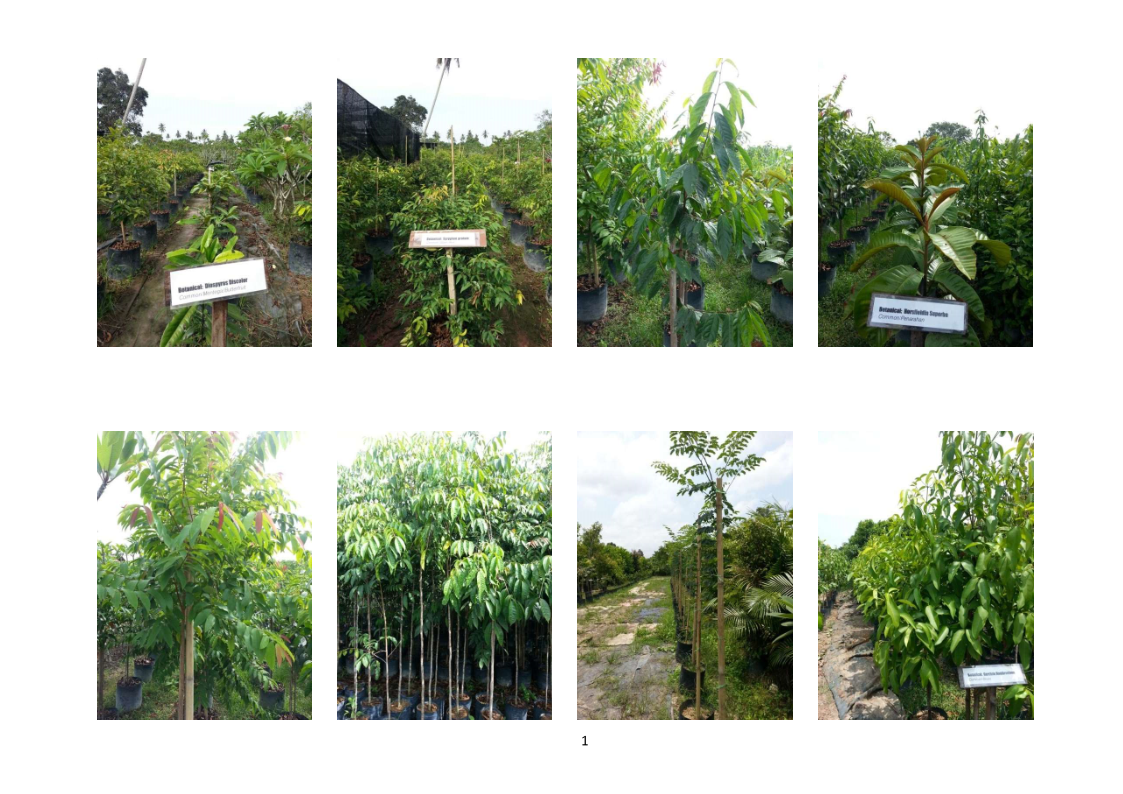
    Forest trees nursery

    Get your Trees from this nursery

Archive for the ‘Maintenance’ Category

Work on how to maintain the grass. Cultural practice.

Making greens

Posted by mynormas on November 26, 2013

The end of the year is upon us, and there will be many golf courses who are now working on the budget for next year. If the current trend continues, quite a few courses will be (or at least they SHOULD be) renovating their greens. There are a few construction methods for greens and I’d like to share my experience here.

The first cut is the deepest...

The first cut is the deepest…

Firstly, why do I call it ‘construction’ when at the same time, it is about renovations? Well for one, you need to understand the current (or perhaps you would call it ‘previous’) method of construction of your existing green. Because some clubs want to cut corners or are happy with the current design on the greens that all they want to do is to take a few inches off the top and mix in a new root-zone and just plant new grass. Two, some clubs may want to relocate their newly renovated greens slightly nearer to the lake or bunker. Three, some clubs may want to enlarge their existing greens. Or, four, you’re someone who’s curious about greens constructions. Heck, you’ve read this far already; might as well just read all the way through right? At least you’ll have an idea what the Course Superintendents and Club Managers are talking about.

By the way; a caveat; this is not an instruction of a ‘how-to’ build greens manual or suggestions of any kind. Its just a sharing of my experience. Your Superintendent will know the details or you could do your own research at USGA’s site; or you could give me a call O3-5I3I OO66.

“The green is the ‘heart’ of the golf course” said my club manager in 1993, the late Dato’ Benson Lim. The green is the most important part of the golf course. On a price per square foot, it is the most expensive to maintain and the most expensive to construct.

20 years ago, the early part of my golf course maintenance career was spent on a golf course that was still under construction by a Japanese firm. This was one of the first golf courses they build and for most people who supervised them – I included – this was our first golf course too. So you can imagine the pride I felt when I was told, and subsequently read in the marketing brochures that our green was constructed to “USGA standard”.

Imagine my surprise when not many people who work there – including the architect – could tell me exactly what a USGA specification green is. Imagine my bigger surprise when other clubs’ marketing brochures also touted their green as USGA standard specification! Of course the biggest surprise was whenever I brought up the subject of USGA specifications; my peers were vague and changed the subject. Me? I didn’t even know who or what USGA is.

So I did a bit of digging around and found that there are four main types of golf course construction; USGA, California, hybrid of USGA and California, and push-up green. Of course there are many other names, but basically there are about the same things, for example push-up greens are also called as ‘native soil greens’; especially since some people have this thought of a bra whenever the word ‘push-up’ is mentioned. And oh, by the way; USGA is the United States Golf association who, through their ‘Green Section’ does the research and development about stuff on the golf course.

We’ll talk about the other types of construction later. Right now let’s get back to what we shall term loosely as USGA greens, or as some of my foreign staff would say: “Oosgar grins”.

USGA specification for greens was developed way back in the 1960s with one amendment in the 1990s. Yeah it was that long ago. It was basically up to 18 inches deep with several layers of material, each layers has its own specification designed to – not just percolate water – but also to retain water at the same time. The sizes of sand for each layer was calculated and calibrated to not move water, until more water flowed down from the layer above. Genius and confusing for most people; no wonder nobody could explain the concept to me.

This is how a green profile should NOT look like... see the layering?

If your greens’ profile look like this; time to renovate.

It has also been described as ‘inverted water filter’, but very different from my expensive ionizing, hydrogenated, sulfinated, carborated, pH corrected, perforated water filter that only my maid knows how to use, it is about the filters of old where you can see a layer of gravel on top, underneath it is a layer of coarse sand, below it is a layer of slightly smaller diameter sand and below it finally a layer of fine white sand at the bottommost. The theory is that when you pour water from the top, dirt will be trapped in the layers of gravel and sand to give you clean water underneath the filter. Turn the whole filter upside down, and you get the general concept of the USGA green – simplified, of course.

To understand things better I paid a visit to a soil science professor in a local university and told him about how we planted grass. “WHAT!” he said; “Impossible! You can’t plant on sand!” “But Prof, we’ve been doing it for the past 40 years!” said the 20-something-year-old Assistant Golf Course Superintendent to the 50-something-year-old Soil Science Professor.

“But you cannot plant on sand!” he said, standing up. I stood up too; other than the fact that he was raining saliva on me, I was kinda worried just in case he had an axe or pitchfork around just for this occasion; some young upstart spewing out soil science blasphemies.

Well, turns out the good Professor was half-right and I was wrong; you see, the topmost layer is not made up of just pure sand. It is actually a layer called the ‘root-zone’ and it also consists of other organic or synthetic materials that help to retain nutrients and water. I’m sure if I told him that he would understand.

I don’t remember who the Professor was and I don’t think I met him again after that. Maybe that was a good thing too; I’m getting to be a bit too old for these kinds of shock meetings. Imagine my surprise (do you get a déjà vu feeling when you read that? Why am I continually surprised?) when in the next few years, greens constructed not according to USGA standards were doing better than greens following the USGA standard in the same golf course. Remind me to tell you about it. Keep your eyes on this space for the next article soon.

By the way, you could also check out my renovation pictures on Slideshare or look at other websites for more info. And yes, this article came out in a magazine called The Clubhouse about two years ago. It was written by me too and I am a regular contributor. It is also a free magazine you can pick up from your own club so do – you know – pick one up.

Posted in Golf Course Superintendents, Greens, Maintenance, Padang Golf | Tagged: , | Leave a Comment »

Concert in stadiums

Posted by mynormas on August 26, 2013

Ok jer? (Nota: bukan di Bukit Jalil ATAUPUN di  Malaysia.

Ok jer?
(Nota: Ini bukan di Bukit Jalil ATAUPUN di Malaysia.

Kenapa tak boleh? Asalkan stadium tu di design untuk itu maka saya tak nampak kenapa tak boleh. Stadium satu kegunaan adalah kemewahan; kalau mampu bagus; kalau tak mampu, lebih baik kita buat dari awal lagi stadium itu pelbagai-guna.

Apa guna buat stadium besar dan hebat tapi tiada duit atau hanya mengharapkan bantuan dana untuk maintenance? Dana yang datang hanya pada tahun ada pilihan raya? Lebih baik spend a little more untuk dapatkan stadium yang boleh di sewakan kepada orang ramai untuk pelbagai guna. Sebahagian (contohnya 10%) dari keuntungan setiap bulan mesti di simpan dalam suatu tabung yang akan di gunakan untuk memperbaik stadium setiap 8-10 tahun.

Kalau kita ada stadium yang hanya akan digunakan untuk bola sahaja; termasuk untuk ‘sesi latihan’ mungkin keseluruhan padang tak rosak tapi saya boleh jamin yang rosak dan lebih susah di baiki ialah depan pintu gol, tengah-tengah bulatan padang dan juga tempat penjaga garisan lari.

I read with interest the views and comments from various quarters with regards to the current state of football field maintenance in the country.

The golf course industry has a head start in the maintenance of turfgrass in Malaysia and perhaps there are some lessons to be learnt; choice of grass, cultural practice, grass cutting and multi-use.

First of all, the type of grass to be planted is important. There are three important criteria to think about when choosing grass: 1. Location; how much sunlight does it get? Is it a water-logged area? 2. What will it be used for; is it for aesthetics? Is it for rough and rugged use? And 3. What is the cost or level of maintenance that can be afforded to be spent on the field in future?

Maintenance of turfgrasses are beyond grass cutting or fertilizing or even just the occasional ‘hollow-tining’. There is a category of work called ‘cultural practice’ which includes aeration, mowing, topdressing, vertical-cutting and irrigation that is often ignored by football fields. There needs to be a regular schedule for these activities.

The Ministry of Youth and Sports started a regular panel discussion on the curriculum for the training of groundskeepers with input from various quarters for the past few years. I’m sure when it is implemented; there will be more people with knowledge about field maintenance. Even grass cutting isn’t as easy as it sounds.

My opinion somewhat differs from most; I do not strongly feel that football stadiums should be limited to football matches. At least not until our football associations actually have enough funds to maintain the fields. Let’s face it; can the authorities financially afford to have single use fields? If we can; well and good. If we can’t; let’s design (or redesign) the field to be multipurpose from the start. I think we’d rather have a well utilized field with enough funds to do proper maintenance than have a field reserved for the occasional football match but no money to maintain it; Barcelona may still refuse to play there.

Seriously, to earn extra income, even if we rent the field for football training or local football games, it will just wreck areas of focus like the penalty spot and in front of the goalmouth. Renting the field for a march past or a ‘demonstration’ will be safer for the field since they would stay away from football’s area of focus. Will 100,000 people damage the field? I’d say not on a well built field. A field will be designed to support the weight of a robust and aggressive person wearing shoes with studs. One person will take up as much space and put the same pressure whether he is a footballer or a demonstrator or marcher. Whether it is a 22-person football match or a 100,000-person show of support; any one person will only step on the one amount of field at any one time.The field is not like a bridge or building where the combined weight will have to be supported by a beam, foundation or certain parts of the building. Concerts? The field must be designed for it. Whats most damaging to the grass is the sunlight denied to it by any equipment put on it for any amount of time longer than one day (depending on types of grass); they can’t do photosynthesis.

A combination of the most suitable grass, scheduled maintenance, regular cultural practice and enough funds for machinery, knowledge and other inputs will ensure our football fields will improve, even if our footballers don’t.

Posted in Fields, Maintenance, Padang | Tagged: , , | Leave a Comment »

Greens Improvement (kau ada?)

Posted by mynormas on August 16, 2013

Big change - God willing

In 5 months

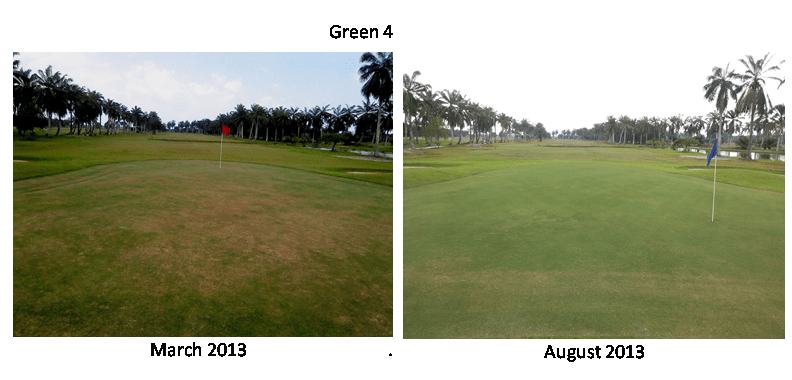
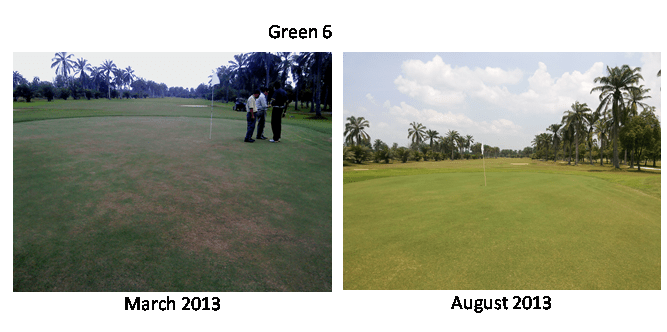
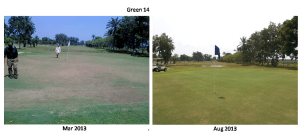
These pictures show 3 greens now and 6 months prior me becoming their consultant.

Last March a club called and asked for help in improving their greens. I visited the club today (August) and the boss and committee chairman were happy.

I told them in March I could try – God willing – to make some changes. I proposed that I come by once a month to check and give them a schedule on what to do for the next one month. They are of course, not really interested if all I were to do is to recommend some magic formula or machinery which they won’t need a consultant for; they can get many suppliers to give them free advice on that.

In fact, just a couple of months before that they had already spent on a few hundred thousands of ringgit to buy machinery – one of which is sitting idle in the workshop because it was too big for them.

What they want was advice on how to improve the greens without having to reconstruct and/or spend too much money. Actually, they thought they’re paying me too much and don’t want to pay for anything else at all.

The Course Supervisor was friendly but defensive. They had a manager in March but he left in April and they have not replaced him to date.

They agreed to my fee (which, considering the small size of the club, did surprise me a bit) but they wanted something extra. They want a PowerPoint Presentation for the Big Boss every time I visit. Once a month? For the fee I charge? Of course I said “yes”.

So once a month I would spend a day going round with the Supervisor, prepare a presentation that night and first thing the next day, do a presentation for Dato’. He was a rags-to-riches businessman who spoke little English so I had to speak plainly with no jargon.

The Supervisor eventually was quite supportive of me because he can see that I was always on his side by giving him credit for whatever good that happened on the course. He also saw that I not only told him what to do and how; but I also told him the whys and the alternatives. I also did not pushed any chemicals or fertilizers on him. I gave him the specs and formulation and he found them himself.

When I met Dato’ today I was imagining that my contract was going to be shortened since I had already met the challenges posed earlier (I need to relook at that escape clause in my agreement); but surprisingly, he asked me to come more often (like, twice a week?!) so that I can help him with the overall management!

That’s nice of him. But I probably will turn that down. Enough club management for me. I love improving greens and managing grass. People and members? Not so much.

Mar to Aug

Mar to Aug

Not just these 3 greens; all greens there show improvement.

Not just these 3 greens; all greens there show improvement.

Posted in Golf club, Golf Course, Golf Course Superintendents, Greens, Maintenance, Padang Golf | 2 Comments »

Zoysia green.

Posted by mynormas on September 3, 2012

image

As I said, its the first time I used this app. Just tilt your head to the right to see the image.

My first ever Zoysia green (and my first ever posting with this app). It was an unused and un maintained roundabout behind the club kitchen and the cooks were dumping their old equipment on it! One pro tournament at the club wanted a practice green and that was the only option available. They gave me two weeks notice to get it done. Managed to do it just in time and maintained it as a green ever since. It may be the ‘wrong grass’ but it sure is easier to maintain than the greens here that have many different types of grasses.

Posted in Golf Course, Golf Course Superintendents, Greens, Maintenance, Padang, Padang Golf | Tagged: , | 1 Comment »

Menanam cara ‘sod’

Posted by mynormas on January 24, 2012

Menanam cara sod adalah cara paling biasa digunakan di Malaysia dan pada pendapat saya, cara paling senang tetapi paling selalu salah.

Nampak jer cantik, tapi silap.

Kebaikan cara sod ialah;

1. boleh ditanam hampir dalam sebarang cuaca; musim hujan atau musim kemarau.

2. kawasan yang di tanam cepat tumbuh dan kelihatan rapat.

3. boleh di tanam di kebanyakan kawasan; rata ataupun di tepi bukit.

4. perlukan penjagaan yang kurang berbanding dengan cara lain.

5. Tidak mudah hanyut.

6. Tidak di makan oleh burung (berbeza dengan bijibenih).

Kesilapan atau keburukan sod:

1. Memerlukan jumlah rumput yang lebih banyak berbanding cara lain.

2. Kecuali rumput cow/pearlgrass, hasil padang akan bertompok kerana rumput tidak sama spesis ataupun di susun tidak mengikut ‘grain’.

3. Akar yang pendek, maka rumput tidak lasak. Terutamanya jika penyediaan tapak tidak betul.

4. Tempat bercantum sod boleh kering dan/atau akan kelihatan lama setelah padang digunakan.

5. Berpotensi membawa bersama masalah dari nursery seperti serangga, spora kulat, benih rumpai, telur dinosaur (ha?!), jin tanah (haa?!), makhluk halus (haaa?!) dan sebagainya.

Secara definasi, sod ialah rumput termasuk akar yang di pegang oleh tanah. Biasanya ia adalah lebih besar atau bersamaan dengan 1 kaki persegi. Cara penanaman ialah dengan menanam rapat-rapat dalam susunan seperti menyusun batu bata. Ia boleh juga di susun jarang-jarang sehingga memenuhi 50% luas kawasan. Kurang dari 50% – kita boleh memberi ia nama ‘spot turfing’ yang mempunyai muka lain di laman web ini.

Langkah-langkah penanaman cara ‘sod’.

1. Mengukur luas kawasan.

Berapa luas kawasan yang perlu ditanam dengan rumput? Untuk kawasan rumah, saya cadangkan membeli jumlah sod sama besar atau 80% luas kawasan tersebut, mengikut kemampuan. Biasanya kalau tanam sendiri, kadang-kadang hampir 10% dari sod tak boleh digunakan kerana pecah atau ada rumput liar. Rumput yang pecah boleh digunakan untuk ditanam di kawasan tepi/sempadan, tapi sod yang ada rumput liar mesti dipecahkan dan di tanam di kawasan tepi atau sebagai ‘spare’ untuk repair.

Walaupun Malaysia dah lama bertukar metrik, tetapi sod biasanya di jual dalam kaki persegi.

Cara untuk mengukur luas kawasan yang tidak geometri boleh di baca di sini

2. Membeli sod.

Berbekal dengan pengetahuan berapa luas kawasan (dan budget dalam poket) maka mulalah bershopping. Pastikan kita tahu rumput apa kita mahu dan tidak terpengaruh dengan apa yang kita lihat di nursery.

Bandingkan harga dan utamakan nursery yang kita boleh pilih rumput dan bawa balik (ataupun kita pilih dan dia terus angkat naik lori). Was-waskan nursery yang kita pilih rumput kat showroom  dan dia akan hantar dari nursery dia yang katanya berada 136.7 km dari situ. Kadang-kadang, rumput yang di hantar ke rumah tak sama dengan rumput yang kita pilih.

Jika tak dapat di elakkan (kerana kawasan kita sangat besar atau kita suka shopping kat showroom yang ada aircon dsb) maka beritahu dia yang kita nak ada kat nursery tu masa dia tuai sod. Ada satu lagi alternatif; bahagikan kawasan kepada beberapa sektor, beli dan tanam mengikut sektor. Dengan cara ini, kita tak perlu risau rumput tak sama bersebelahan, kerana sekurang-kurangnya dalam satu sektor, rumput dari keturunan yang sama.

Sekalli lagi saya ulang, masalah rumput tak sama menjadi masalah utama pada rumput jenis ‘carpetgrass’ dan jarang pada cowgrass atau pearlgrass.

3. Penyediaan tapak.

Saya ada satu muka tentang penyediaan tapak dalam laman web ini. Tapi pendek katanya, di bawah sod itu perlu ada tanah yang agak peroi dan boleh di tembusi oleh akar. Satu masalah ialah bila tanah bawah terlalu mampat dan akar rumput hanya berada di dalam sod. Bila hujan lebat, sod akan ‘terapung’. Bila kering, sod akan mati kerana akar terlalu pendek.

Bagaimanapun, sila baca tentang penyediaan tapak di sini

4. Menyusun sod

Comot tapi betul.

Nampak tak sod di susun air tidak boleh mengalir bebas dari kiri ke kanan?

Kesilapan paling asas yang saya tengok orang buat ialah bila dia tanam sod dia mengikut garisan yang membenarkan air mengalir. Jika kita menyusun sod, susun supaya ia menyerupai orang susun batu bata; bata yang di atas akan melintang di atas sambungan bata di bawah. Dengan cara ini, air tidak mempunyai satu ‘lorong’ untuk mengalir dan membawa baja, pasir dan rumput.

Jika kita membeli 100% sod (ertinya jika luas kawasan anda ialah 120 kaki persegi dan anda beli 120kaki sod) menyusun adalah mudah. Jika kita  membeli hanya 80% atau kurang, mulakan dengan bahagian paling penting kawasan kita contohnya depan rumah, kotak penalti, tengah green dan sebagainya. Saya tahu ada orang yang akan mulakan dengan sempadan dan menanam ketengah, tapi jika kita kehabisan rumput atau salah budget, maka tengah akan lompong/kosong. Mulakan dari satu sisi dan pilih sisi yang paling penting untuk kita (pedulikan apa orang lain kata)dan tanam ke arah yang tak penting. Kalau sod nampak macam tak cukup, maka kawasan yang kurang penting tu kita boleh tanam kemudian ATAU, kita boleh jarakkan lebih sikit baki sod yang ada untuk mencukupkan kawasan yang – ahem – kurang penting tadi. Jadi, kalau di rumah, kita tanam dari depan ke belakang (contohnya) dan di pejabat kita tanam dari depan ofis bos ke luar dan sebagainya.

Untuk padang golf dan padang bola. Ada lagi yang saya tak cerita kat sini. Ada orang yang ciplak kerja saya sebagai kerja mereka. Sekarang ada bahagian untuk orang komersil yang saya simpan. Sorry. Nak tahu? Email saya dan kenalkan diri.

5. Tanam sod.

Menanam dengan rapi. Sod dan luas kawasan 100%

Ada orang tanam dengan cara mengorek tanah dan meletakkan sod ke dalam. Ada orang melakukan dengan cara hanya meletakkan sod ke atas tanah. Kedua-dua cara betul, tapi lazimnya jika menanam 100%, kita boleh hanya letakkan sod atas tanah, dan jika 80% atau kurang, kita akan tanam dia supaya dia tidak ‘lari’ dari kedudukan.

Jika kita meletakkan sahaja sod di atas tanah dan tanah itu sedikit curam, kita mungkin terpaksa menggunakan paku yang diperbuat dari kayu atau bahan mudah-urai lain.

Apapun, pastikan tanah bawah TIDAK keras.

6. Siram.

Siram serta-merta lepas tanam. Siram hingga tanah bawah basah. Untuk seminggu dua lepas itu, pastikan tanah di bahagian bawah sod basah di waktu pagi dan tengahari (perasan tak, saya tak kata ‘siram’?)

Selepas itu, JANGAN siram sehari sekali atau sehari dua kali, siram bila keadaan memerlukan. Ertinya, bila tanah di bawah sod kering; siram. Jangan siram lepas pukul 3 petang. Rumput yang basah hingga ke malam akan mengundang penyakit dan lumut.

Jangan pijak rumput tu untuk lebih kurang sebulan sehinggalah akar rumput dah tumbuh.

Mula potong pada minggu ke lima, jangan potong lebih dari satu pertiga ketinggian rumput. Lepas dua minggu turun kan ketinggian, lepas tu dua minggu lagi, hinggalah mencapai ketinggian yang kita mahu.

Mulai minggu ke empat, topdress seminggu sekali dengan nipis. Tujuan topdress ialah supaya pasir masuk ke kawasan yang tak rata dan meratakan permukaan tanpa melemaskan rumput. Ratakan pasir dengan tangan atau kayu ‘T’ dan siram. Jangan potong sehari lepas topdress, nanti pasir berterbangan.

Mulai minggu ke enam, mulai merumpai. Bahagikan kawasan anda kepada seksyen2 kecil dan merumpai dalam satu seksyen selama satu hari. Esok (atau hari seterusnya) merumpai di seksyen kedua, hari seterusnya di seksyen ketiga dan ulang. Dalam masa tiga bulan kita seharusnya akan dapat laman yang kita idamkan.

insyaAllah.

Selamat mencuba!

Bagaimana sod di tuai di nursery.

Ini adalah permukaan bunker padang golf yang senget dan boleh rosak akibat hujan lebat.

rumput yang pendek akar (dan nyawa) mati dulu.

Rumput dah di tanam tapi tak di siram.

Posted in Fields, Golf Course, Lanskap, Maintenance, Padang, Padang Golf, Rumput, Rumput halaman rumah, Taman | Tagged: , , , , | Leave a Comment »

Good greens: a price to pay

Posted by mynormas on December 7, 2011

Get your copy of Asian Golf Busines


There is a price to pay to being the perfect or keeping a golf course in perfect condition. And it is not just about the money. It is also the cost of using all the extra chemicals, fertilizers and cultural practices to the environment. I guess the next time we hear someone comments about the state of Malaysian golf courses, at least we can say “Our golf courses are safer for our environment”. Yeah. Right.

One article in the latest issue of Asian Golf Business discusses about whether golfers are spoiled in wanting nothing at all to spoil their golf game – in the context of golf course conditions.

I do agree on one thing: most golfers want green speed faster than what they can handle. I never could understand that. Even at 8feet they will be 3-putting and they want the greens to be at 9feet.

Get your copy of Asian Golf Business Nov/Dec 2012 for the full story (about the golf course conditioning, not the golfers).


Posted in Golf Course, Golf Course Superintendents, Maintenance | Leave a Comment »

Mowing during rainy weather

Posted by mynormas on October 26, 2011

Mowing during rainy weather is pretty tricky. But if the machine operator does not have disicipline, he/she could turn a wet situation worse. A wet fairway,  rough or field is bad enough but a mower mowing in a wet patch will churn up the ground. You can end

It could've been worse. But more often than not, this is just the beginning.

up with a muddy patch on your field, fairway or rough that will take ages to be brought back to shape. Not to mention you may end up with tyre marks or compaction below the surface.

Ask your operator to back off from mowing that particular area if he finds that he is leaving tyre marks or churning up the ground. He should report it in so that a solution will have to be found if that area could not be mowed for too long. A lighter machine, a push behind or even a back-pack brush cutter may have to be utilized.

Note: you should look at draining or topdressing that particular area when the weather is better.

In the same vein, for those of us who are into striping our fields, fairways or roughs; now may be a good time to not concentrate too much on them too. Alternate mowing patterns for a couple of months won’t make much difference. Remember mowing in the same place all the time (such as when you are mowing for stripes) will make the tyres stay in the same ‘lanes’ all the time thereby creating compaction or worse: ruts. In fact; I would recommend changing patterns once in a while (say every couple of years?)

The stripes look nice, but don't forget you are putting your mower's tyres (tires?) in the same line everytime you mow.

Stripes on a football field.

Posted in Fields, Golf Course Superintendents, Maintenance, Padang Golf, Taman | Leave a Comment »

Choosing grass

Posted by mynormas on October 18, 2011

One of the most common question I get asked is; what type of grass should I use?

There are actually three important criteria to think about when choosing grass, and I write this in layman terms, mainly:

  1.  The condition of the area – whether it is shaded, it gets too much water (for example it is next to non-porous area e.g. road or pavement or perhaps it is out in the open with poor or no irrigation).
  2. The budget for future maintenance of the grassed area and
  3. The use of the grassed area; simply whether it is more for aesthetics or more as a playing field. In the golf course, this question will also refer to whether that area is a green or a rough.

Now for home-owners (and I get a lot more questions from these people) I usually tell them the order of priority will be 1. The condition of the area; 2. The budget and time they are willing to spend on maintenance and 3. The use; whether the lawn is for impressing passers-by or is it for grandchildren to play on? Stuff like that.

The Bermuda carpetgrass planted at cost under the bamboo? Dead. The Cowgrass that came on its own for free? Nice. Lesson? Use cowgrass under shade.

For golf courses, playing fields, stadiums and large areas like municipal councils, the order of priority is reversed: I ask them to think of what is the use of the area – whether it is for greens, for tees, for out-of-play areas,

football, picnic, or whatever. Then they should think of the budget they are willing to spend for maintenance (and I would like to emphasise FOR MAINTENANCE) and lastly only about the condition of the area. Why is the order reversed? Because, for these kind of construction, the condition can be modified, trees can be moved, or the green can be redesigned away from the large 100 year-old tree, for instance.

Most of these owners, be them developers, local government or large bungalow owners etc, will have a huge budget during construction but when it comes to routine daily maintenance; they scrimp and save.

Zoysia is a nice grass but needs to be cut once a week - at least. If you can't afford to do that, why use it?

So what I advise is: design and pick plants for the place so that it will be cheap and easy to maintain in the future! Naturally,  people want the best and most designers/contractors who are paid by percentage don’t mind at all to oblige.

But I digress. The world of grass is divided into three main areas; warm-season and cool-season. The third area? What is termed as the transition zone area, this area is cold enough in the winter to make it difficult to maintain warm-season grasses and warm enough in the summer to make it difficult to grow cool-season grasses, therefore, no single species of grass is well adapted in this region.

So there are only two types of grasses; warm-season and cool-season grasses. In the transition zone areas, they will use quick growing cool-season grasses in the autumn and early winter and warm-season grasses in spring/summer.

What are the characteristics of warm season grasses? They thrive in air temperatures from 27 – 35 degrees Celsius and soil temperatures of 21 – 32 degrees Celsius. They’ll lose chlorophyll in autumn and turn from green to brown.

Cool-season grasses grow very well when soil temperature is between 10 – 18 degrees Celsius and air temperatures a cool 15 – 24 degrees Celsius.

Tall fescue is a cool-season grass

Other than those, there are of course a few other things that should be taken into consideration too. Soil types, quality of water for irrigation – in fact, quantity of water too; there are a few other things if we want to go into details. But lets leave it at that for now.


Weights and Measures, Metric Conversions Weights and Measures,
Metric Conversions


Posted in Fields, Greens, Landscape, Lanskap, Maintenance, Padang, Padang Golf, Rumput, Rumput halaman rumah, Rumput secara am, Taman | Tagged: , , , | Leave a Comment »

Slicing on fairways/fields/padang bola

Posted by mynormas on June 7, 2011

Many – or maybe I should say all – Malaysian golf courses would do cultural practice on their greens. They would dethatch, they would scarify and they would aerate them by hollowtine at least once a year, more often, twice a year. But rarely do we see the same thing being done on fairways or fields; whether football or municipal.

Why not?

Most of the time it is because the size of the area demands that a lot of resources; machinery and manpower have to be devoted to complete the job. In the case of dethatching or hollowtining, we will have to get rid of the

Many machines needed to just collect the thatch. Not all in picture; the trailer not here.

thatch and cores and over the size of the 18 holes; that is a lot of stuff. Plus the work will also be in the way of the golfers. If the weather is unkind, a sudden downpour halfway through the job may mean a messy fairway for days if not weeks.

should we?

You mean should we actually do these cultural practice on fairways, roughs or fields? Of course lah! For the same reasons that we do the work on the greens. The fairway has thatch, it needs aeration, bla bla bla. We may not need to do it at the same frequency or intensity of the green, but do it we must. In fact, for areas close to the green like approach and collars, perhaps we shuld do it at the same intensity. Because they are played on  with almost the same pressure as on the green.  Plus with too much thatch, there will be less ball roll espcially when wet. Same principal for padang bola too coach. The thatch acts like a sponge holding water.

How?

I would recommend dethatching to be done at least once a year. And hollow-tining too. The thatch will have to be sweeped and disposed. The cores can be flailed or perhaps mown with a rotary to break them up (I’ve never actually tried that though) and then dragged as topdressing.

Really?

I understand, it is tough to do, what with not enough equipment and the pressure of trying to fit in as many golfers as possible during the dry periods and these works can’t be done in the wet season. So what can be done alternatively 1. Do it only at the landing areas (though you may get fairways with different characteristics) 2. Do it only on selective fairways (but do it on whole fairways) or 3. Slice.

A slicer that is used regularly.

Now we get to the punchline for this whole post. Why are some golf courses, football fields, padang bola letting their slicers rust in the workshop? I seen it with my own eyes. The slicer, can be used frequently to help water and air penetrate through to help the micro environments under the thatch to do their stuff. Slice the fairway once every two months alternating with rough; that way, we could create a contrast between rough and fairway more. Some golf courses have this expensive small flags to mark their sprinklers, but I used to have workers who mark the sprinklers with oil palm leaves (not fronds) that they can afford to just leave there after the operation or let the mower run over.

Slicing during dry season tends to leave a dry edge to the sliced turf but it is temporary and I think it is better than the alternative; localized dry spots!

Posted in Fields, Maintenance, Padang, Taman | Leave a Comment »

Senaman = amalan kultura?

Posted by mynormas on May 18, 2011

Samada di kawasan padang bola, taman ataupun padang golf; semua jenis kerja yang mengganggu pelawat atau pemain adalah isu sensitif. Terutamanya bila ia melibatkan wang ‘tak masyuk’ yang di anggap sebagai kerugian. Kerja-kerja yang saya maksudkan ialah kerja-kerja amalan kultura (sila lihat senarai topik sebelah kanan laman web ini untuk lebih terperinci) seperti vertical-cutting, pengudaraan (hollow-tine atau slicing), penyiraman dan seba

Membuang thatch

Adakah dethatch padang  = detox badan? Kenapa tidak?

gainya.

Sebenarnya saya selalu umpamakan kerja-kerja amalan kultura dengan senaman kepada manusia. Kalau kita terlalu sibuk untuk buat duit dan mengabaikan senaman untuk kesihatan badan, suatu hari nanti, kita akan menerima padahnya.

Tiap-tiap awal tahun, penjaga padang akan membuat dan menyusun jadual untuk melakukan kerja-kerja amalan kultura untuk mempastikan kesihatan padang jangka masa panjang. Sama

seperti kebanyakkan kita membuat “Resolusi Tahun Baru” untuk membuat lebih banyak senaman untuk menjaga kesihatan.

Dan tiap-tiap tahun cerita yang sama untuk kebanyakkan dari kita (contohnya saya), akan ada kepentingan lain yang mengganggu. Boss beri kerja tambahan, kita dapat assignment baru, ada orang nak buat appointment, cuaca tak baik dan berbagai lagi alasan.  Kita cuba untuk adjust jadual, kadang-kadang boleh adjust; tapi selalunya kita putus asa dan give up. Untuk jadual amalan kultura; kita akan ada cabaran dari segi jadual perlawanan, sewaan padang, pertandingan private, cuaca, pekerja dan bermacam-macam lagi. Kadang-kadang kita boleh adjust date untuk postpone jadual. Kadang-kadang kita give up.

Satu hari, kita bangun dan rasa pening, jumpa doktor; dia kata tekanan darah naik, kolestrol naik, gula tinggi, lemak banyak dan sebagainya. Masa tu mungkin dah terlambat untuk mengubah keadaan. Kita beli kasut mahal, kita jogging petang; kita beli raket badminton, kita sewa gelanggang. Kita makan vitamin dan sebagainya. Kadang-kadang ada perubahan, kadang-kadang tiada perubahan. Kita perlu mengambil langkah drastik. Mungkin masuk gym cari trainer. Duit habis, badan tak improve, kita salahkan trainer.

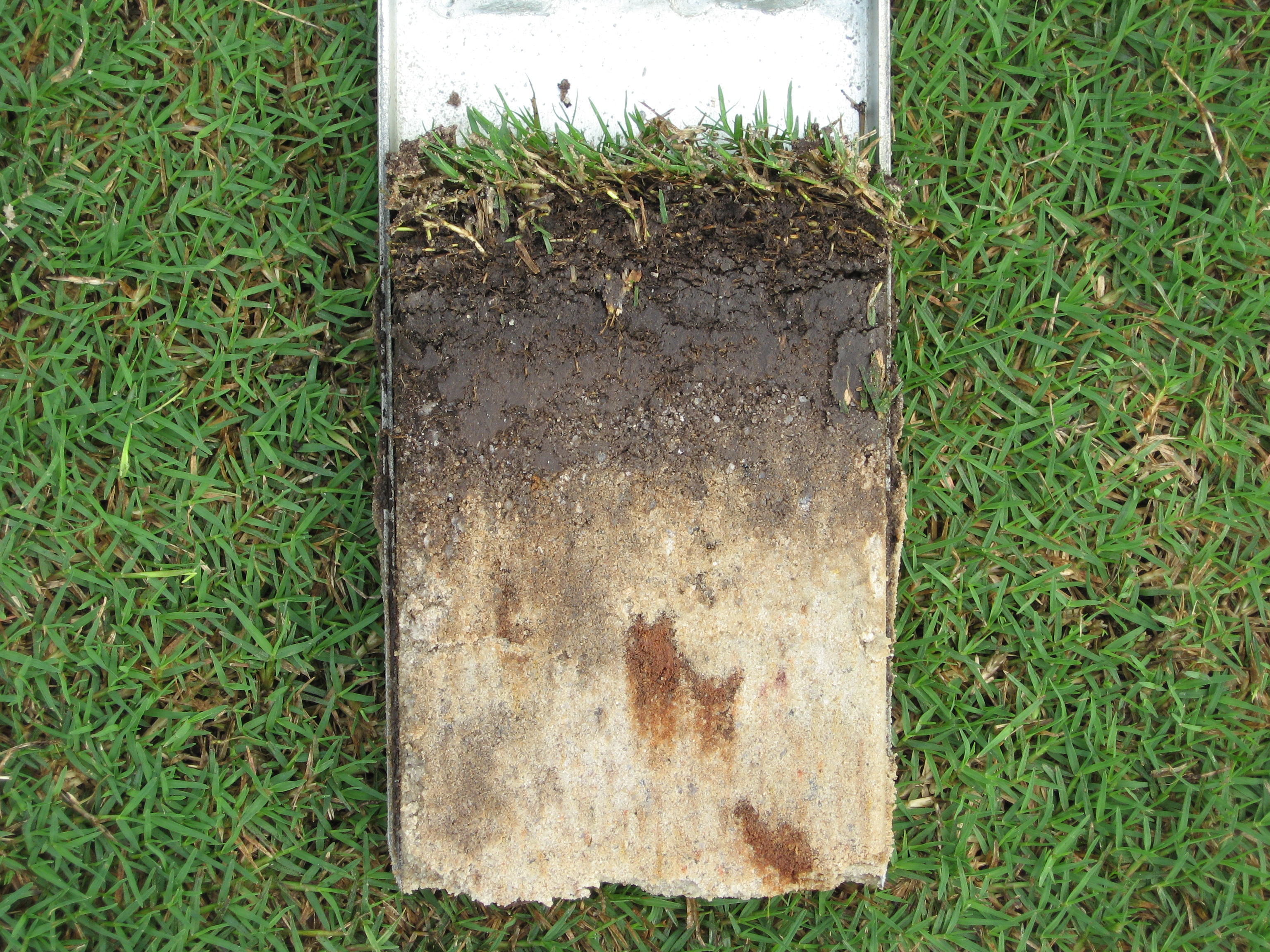
Soil profile 8 inci teratas.

Lihat ini dan ingat salur darah penuh kolestrol dalam badan kita.

Satu hari kita bangun dan kita nampak padang kita layu, lembik, banyak rumput liar dan berpenyakit. Bila kita check dengan soil test dan menggunakan soil profiler; kita dapati pH rendah, sodium tinggi, Calcium berbanding alkali lain rendah, tanah padat, terdapat lapisan hitam mengandungi hidrogen sulfida, air tak tembus dan sebagainya. Masa tu dah terlambat untuk mengubah keadaan. Kita cuba untuk buat pengudaraan, kita hollow-tine, topd

ress, slice, baja dan sebagainya. Kadang-kadang ada perubahan, kadang-kadang tiada perubahan.  Kita perlu mengambil langkah drastik. Mungkin tutup padang dan panggil konsultan. Duit tak masuk, padang tak improve, kita salahkan konsultan.

Hakikatnya, pengurus kelab, pengurus stadium, pengurus padang, tuan punya taman, pelawat, pemain dan juga penganjur pertandingan perlu paham bahwa jadual amalan kultura adalah jadual untuk kesihatan jangka masa panjang.  Sebarang perubahan akan memberi kesan yang perlu ditanggung bersama. Penjaga padang juga perlu memainkan peranan untuk berbincang dengan pengurus umum dan pengurus pertandingan untuk mempastikan jadual amalan kultura tidak mengganggu musim pertandingan atau musim lawatan.


Posted in Maintenance, Padang, Padang Golf, Taman | Leave a Comment »