Turf Matters

The Site To Go To For All Your Turf Matters

  • Facebook Likes

  • The new Brushcutter

    Pengganti Brushcutter

    Increase productivity, cut labour. Try the AM61A

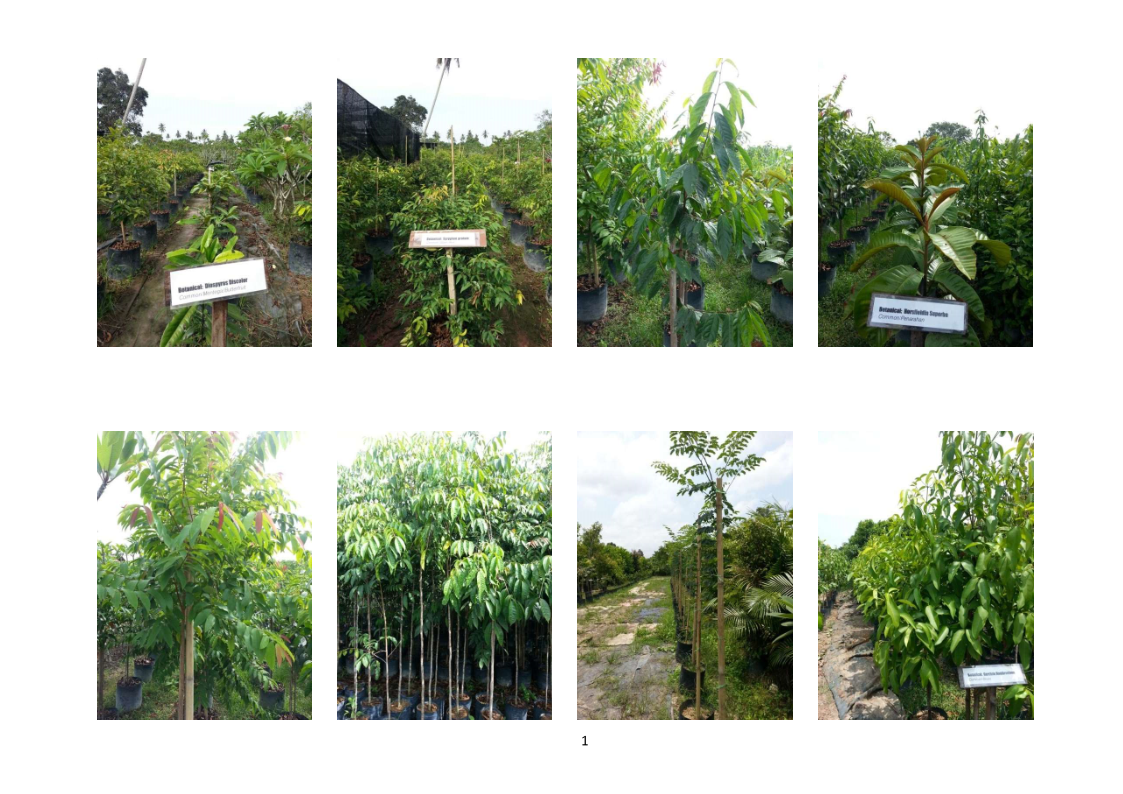
  • Trees Nursery

    Forest trees nursery

    Get your Trees from this nursery

Archive for the ‘Fields’ Category

Stadiums, parks etc.

Penjagaan rumput monsun

Posted by mynormas on November 2, 2012

I’ll be talking about turfgrass maintenance during the rainy season. And I define ‘rainy season’ differently than a ‘rainy spell’. A rainy season is not unexpected,it usually happens at the same time every year whereas a rainy spell is a prolonged period of heavy rainfall occuring almost daily unexpectedly. Not planning for the rainy season is, in my opinion; unforgivable. So how do we plan for the rainy season – in terms of turfgrass management? What should we do? When? Lets share.

Saya dah lama tidak update this website. I apologize. There’s a lot of questions posted here and emailed to me yang belum di jawab. Saya minta maaf.

Apakah langkah penjagaan rumput yang perlu diambil di  waktu musim hujan? Mari kita berkongsi.

1. Fertilizing. Penggunaan baja di musim hujan akan menyebabkan baja larut dan lesap ke dalam sistem saliran yg menyebabkan pembaziran dan pencemaran air. Elakkan menggunakan baja kimia biasa ketika dah tahu hujan lebat setap hari. Try slow release in small quantities or even foliar fertilizer but more frequently.

2. Pesticide use. Menggunakan racun makhluk perosak juga boleh menyebabkan pencemaran di tambah pula air dalam tanah atau air hujan boleh mencairkan racun dan menyebabkan kelalian pest kepada racun. Try using systemic pesticides.

3. Wetting agent. Memang di luar dugaan dan counter intuitive “Kenapa nak guna wetting agent waktu dah basah giler?” Kebanyakkan wetting agent, terutamanya wetting agent generasi kedua (tanya supplier, klau dia tak tau, tanya supplier lain) akan menjadikan tanah lebih ‘mesra-air’ dan memudahkan ia masuk ke dalam tanah. Gunakan ia secara berterusan dari musim kering hinggalah ke musim hujan.

4. Aeration. Kerja hollow-tine is very good but to do it during the rainy season would make it a bad decision. Try spiking or slicing. Do often. Ia akan membantu memecahkan algae dan/atau permukaan keras supaya air masuk ke bawah.

Slicing the field

5. Vertical-cutting. Not really a good idea to do any major dethatching work. But grooming or light dethatching: excellent.

6. Mowing. Potong kenalah potong rumput. Jangan biarkan rumput terlalu panjang kerana alasan tak boleh masuk mesin; gunakan manpower with brush-cutters or push mowers. Jika terlalu lama tidak di potong, ia akan menggalakkan rumput liar membiak dan juga menyebabkan kita memotong terlalu banyak daun bila kita dah boleh masuk mesin nanti. Lepas potong, jangan biar sampah rumput bertaburan untuk di larikan oleh air hujan! Ia akan menjadikan tanah tidak rata dan menjadi masalah di masa akan datang.

7. Growth regulator:  Ia sangat membantu di waktu ini kerana ia melambatkan rumput tumbuh jadi jika kita ada masalah padang atau fairway yang terlalu lecak dan tak boleh potong, sembur dengan Primo (takde jenama lain di Malaysia) supaya kita tidak ada tekanan memotong sewaktu hujan tengah lebat.

8. Tree pruning: Kurangkan dahan pokok yang ada risiko untuk patah dan sekaligus akan mengurangkan daun yang gugur dan terpaksa di kutip.

9. Rubbish and leave collection. Kutip sampah, daun atau clipping yang akan menyumbat longkang dan menjadi masalah di masa akan datang.

10. Drain out the water. Cuba pastikan air tidak bertakung terlalu lama. Buat longkang sementara atau tebuk tanah supaya air mengalir.

11. Jika kawasan anda mempunyai selut (contohnya dalam bunker) buang lapisan selut itu supaya ia tidak menutup permukaan tanah dan air tidak mengalir.


Jika anda mendapati ada tempat yang mempunyai masalah air tidak mengalir atau lecak; tandakan tempat itu di atas peta dan buat rancangan untuk membuat longkang bawah tanah, atau apa cara pun supaya masalah yang sama tidak berulang. Saya dapati, pembetulan dan tindakan jangka masa panjang adalah lebih berkesan dari kerja sementara yang di buat berulang kali.

Selamat mencuba!
Read the rest of this entry »

Posted in Fields, Golf club, Golf Course, Greens, Rumput | 4 Comments »

Turf Consultancy Sdn Bhd

Posted by mynormas on July 21, 2012

After a long period of gestation, I’d like to finally announce the formation of my company that specializes in consultancy, training, maintenance and supply of turfgrasses. Yes I do renovations and reconstruction too. As for landscaping, I will be doing joint-ventures with other companies. I will announce that at a later date.

mynormas’ new company.

The name of the company? Turf Consultancy Sdn. Bhd. I don’t have the mission statement, vision or even a tagline yet. Or maybe I won’t ever have one. I know what I what the company is for; it is to leverage on my and my peers knowledge and ability to improve turfgrass maintenance and management in Malaysia.

So for  stadiums, fields and parks that are looking to improve the quality of their grass,  call Normas at O3-5I3I OO66 (and let it ring. Plus be reminded the O=0 and I=1) or email mynormasATconsultant.com (AT=@).

Golf courses that have problems with their greens, or having drainage problems can call me too.

Being a former GM means I can also help out with the business or management side too.

I also specialize in trainings for turfgrass workers; teaching them the basics so that they know their stuff. For senior or long-term staff, I do machinery operation basic training and especially important for golf courses: I do training for chemical and fertilizer application. Hands-on. With a small class.

Well, I’ll do the advertisements and stuff at a later date. This is just the announcement of the company’s name for now (taking advantage of the first day of the month of Ramadhan).

Not forgetting to wish everyone a blessed Ramadhan.

Posted in Fields, Golf club, Golf Course, Padang Golf | Leave a Comment »

So, Tifdwarf adalah rumput mutant; jadi?

Posted by mynormas on March 20, 2012

Dalam artikel/posting yang sebelum ini, saya menceritakan bagaimana banyak jenis rumput adalah mutan. Tapi apa kesannya pada kita; orang yang membeli, membela atau menjual rumput? Kenapa saya ceritakan tentang isu itu? Adakah ia penting atau signifikan?

Rumput ataupun tumbuhan yang berbeza secara rupa dan sifat dari tumbuhan asalnya tidak di iklan kan sebagai “mutan untuk di jual”. Mereka biasanya di panggil sebagai kultivar atau ‘cultivar’ yang berasal dari perkataan ‘cultivated’ dan ‘variety’.

Tidak semua rumput atau tumbuhan yang berbeza dari rumput atau tumbuhan asal adalah hasil dari perubahan genetik ataupun kacukan. Kadang-kadang, ia hanyalah suatu perubahan sifat yang di sebabkan oleh tindakbalas tumbuhan itu kepada alam sekitar ataupun hanya suatu kebetulan terdapat suatu perbezaan yang amat sedikit dalam molekul DNA nya yang memberi sedikit perbezaan kepada tumbuhan tersebut. Mangga yang lebih manis, durian yang lebih lemak, rambutan yang banyak isi ataupun rumput yang lebih pendek semuanya adalah contoh perbezaan sedikit sahaja dalam rantaian DNA tumbuhan. Terlalu sedikit sehinggakan – saya boleh pastikan hanya tentang rumput Tifdwarf dan bukan mangga, durian atau rambutan tadi – ia tidak muncul dalam ujian DNA.

Oleh kerana ini adalah laman web tentang rumput maka kita akan khusus bercerita tentang rumput sahaja: rumput yang menunjukkan perbezaan ini dikatakan adalah off-type atau pun adalah variety rumput yang berbeza. Jika variety baru rumput itu menunjukkan sifat yang di kehendaki, ia pula akan di bela atau di semai ataupun dalam Bahasa Inggeris ‘cultivated’. Ia adalah ‘cultivated variety’ ataupun di pendekkan menjadi ‘cultivar’ atau dalam bahasa Malaysia ‘kultivar’. Ada juga orang yang menggunakan perkataan ‘off-type’ atau hybrid. Tetapi hybrid seharusnya hanya digunapakai untuk bercerita tentang kacukan di antara dua atau lebih spesis (ingat Toyota Prius atau Honda Insight).

Tanpa pergi terlalu teknikal dan berbincang tentang diploid atau isu-isu genetik lain untuk posting ini, kita terus bercerita tentang bagaimana ia memberi kesan kepada pembeli dan pembela rumput.

Jika kita membeli rumput untuk halaman rumah, cukuplah sekadar kita tahu bahawa rumput yang kita pilih di ‘showroom nursery’ adalah juga rumput yang dia akan hantar ke rumah. Kadang-kadang, kultivar ini sangat sedikit perbezaannya kita hanya perasan ia mempunyai sifat yang berbeza dari apa yang kita lihat di ‘showroom’ selepas berbulan-bulan kemudian. Terbaik: apa yang kita nampak, terus masuk kereta atau lori depan mata. Kalau dia kata nak ambik dari tempat lain, mintak dia jangan bongkar sampai kita datang untuk teliti dulu. Of course ini semua dengan caveat bahawa pembelian itu banyak, mahal ataupun kita seorang ‘perfectionist’.

Jika kita membeli rumput untuk kawasan besar seperti padang bola ataupun taman; konsepnya serupa. Pastikan kita dapat apa yang kita beli. Dia dah tunjuk nursery dan kita puas hati, beritahu dia sebelum dia bongkar untuk hantar, wakil kita mesti ada di tapak nursery itu dahulu. Ada nursery yang tunjuk kat pelanggan sebelah kanan lepas tu bongkar dan hantar sebelah kiri. Esok pelanggan lain datang, dia tunjuk sebelah kanan lagi tapi bongkar dan hantar sebelah belakang. Lusa dia tunjuk sebelah kanan dan bongkar sebelah depan. Kadang-kadang sama; kadang-kadang, tak sama. Kita tak akan nampak perbezaan sewaktu tengah sibuk tanam, topdress dan juga siram.

Bagaimana pula kalau kita nak beli untuk taman seluas 10 ekar dan dia ada rumput cukup untuk 5 ekar tapi bersumpah bahawa pakcik dia punya jiran ada nursery lain lagi besar yang rumput confirm serupa? Of course, kita kenalah pergi tengok nursery tu, tapi saya cadangkan kita tanam rumput tu jangan bersebelahan. Dari nursery pertama, beli cukup untuk tanam di satu lokasi taman kita dan dari nursery kedua, beli cukup untuk lokasi-lokasi lain.

Senario seterusnya, bagaimana jika kita tanam taman atau padang kita dalam fasa atau jadual tertentu dan adalah penting bahawa setiap fasa itu di tanam dengan rumput yang sama? Ini paling relevan untuk pembela rumput di padang golf; terutamanya rumput di atas green. Bulan Mac, tapak green untuk lubang 1, 2 dan 3 siap; bulan Mei, lubang 4, 5 dan 6, dan seterusnya bulan Oktober baru lubang 17 dan 18 siap untuk di tanam. Bagaimana kita nak pastikan bahawa semua lubang di tanam dengan kultivar yang sama? Cara paling baik ialah beli dalam satu atau dua fasa sahaja. Dan semua fasa datang dari satu sumber. Jika di takdirkan sumber itu kecil? Bahagikan sumber itu kepada dua bahagian A dan B. A adalah ‘ibu’  dan B adalah apa yang kita akan bongkar dan tanam. Jika kita nak tanam setiap tiga green dan satu green ialah 500m2 maka kita jadikan B sebesar 1500 – 1600m2. Besar A? Cukup untuk menghasilkan stolon yang boleh cover B tadi. Kalau ruang masa di antara fasa tu terlalu dekat, mungkinperlu ada satu lagi C yang sama besar dengan B. Green 1, 2 dan 3 di tanam dari rumput nursery B, green 4, 5, 6 di tanam dengan rumput dari nursery C, green 7, 8 dan 9 di tanam dengan rumput dari nursery B (2-3 bulan selepas penuaian pertama) dan seterusnya. Ertinya, beza rumput di atas green 1 dan green 8 hanyalah satu generasi.

Kalau nak jimat; beli dari nursery dan tanam di practice green ataupun bina sebuah nursery khusus sebagai sumber. Jangan, jangan, jangan beli dari nursery luar, tanam di green 1, 2 dan 3, lepas tu ambil dari green 1 tanam green 7, dari green 7 tanam green 12, dari green 12 tanam green 16 lepas tu dari green 16 tanam practice green. Setiap kali ia di tanam semula, ia dah berubah satu generasi dan akhirnya selepas beberapa tahun, akan jelas perbezaan di antara generasi-generasi nya. Fakta ini mungkin tidak benar untuk semua kultivar tetapi, fakta dan prosedur inilah yang saya praktikkan dan saya ajar kepada orang. Mana kita tahu rumput mana yang senang berubah? Amalkan satu prosedur yang betul. Tanam di nursery/practice green dan tanam di green 3 (green 1 dan 2 dah di tanam serentak dengan nursery/practice green), bila green 4 dah siap, ambil dari nursery/practice green. Bila green 5 dah siap ambil dari nursery/practice green dan seterusnya.

Banyak padang di Malaysia tidak mempunyai nursery. Jadi bila terpaksa menanam semula, mereka terpaksa beli rumput dari nursery luar dan hope for the best: ia menyerupai rumput sedia-ada. Jangan ambil risiko. Pernahkan anda memasang tile di lantai atau dinding rumah dan beberapa  tahun kemudian terpaksa menggantikan satu sahja tile yang telah pecah? Anda pergi ke kilang yang sama dan beli tile yang anda sangat pasti sama, dan bila bawak balik, ia memang berbeza. Macamtulah rumput nanti.

Tanam lah nursery atau jadikan kawasa latihan anda sangat besar dan tanam rumput yang lebihan  sebagai  benih rumput, Atau jadikan kawasan practice kita sangat besar. Jika green padang golf anda perlu ditanam semula di kawasan kecil; cuba ambil rumput dari green yang sama (sini sikit sana sikit) dan tanam dengan cara plug atau sprig. Jika kawasan besar; ambil dari nursery.

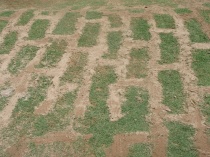
Kedua-dua sod ini di katakan datang dari nursery yang sama. Tapi rumput kedua-duanya nampak sangat berbeza walaupun kedua-duanya di dakwa adalah Tifdwarf. Mungkin ia di ambil dari kawasan yang berbeza?

Pendekkata nya; bila kita menanam rumput di kawasan besar atau banyak kawasan; pastikan kita mengurangkan risiko bahawa kawasan itu di tanam dengan rumput yang pelbagai varieti. Penjagaan rumput dah memang susah, kenapa jadikan ia lebih susah?

Posted in Fields, Golf Course, Greens, Landscape, Lanskap, Padang, Padang Golf, Rumput, Taman | Tagged: , , , , | 1 Comment »

Purchasing a machine?

Posted by mynormas on February 15, 2012

If you are thinking of buying a new machine for your football field, stadium or golf course – be it a mower, a topdresser, a tractor or whatever – a few things should be considered.

  1. Acceptability in performing a specific function

When you consider to buy a certain machine, you know what you want to use it for. Can the machine perform the function well in your field? If you buy the machine as a compromise (cheapest pricing, friendship, package etc) and it cannot perform well in your field, it may mean the machine will be underutilized or partially effective.

To know whether the machine is suitable or not, actual on-site testing is best way. Ask for a demo. Each field will have different conditions (very wet, soft, hard grass, bumpy, hilly, operators etc). It is important that the machine can do the job in the field as you wanted. And remember, demo the machine the way you are going to operate it normally (don’t demo in one area and then use it on another area. Or ask another operator to demo when the real operator is another person etc).

       2. Availability of after sales  parts and service

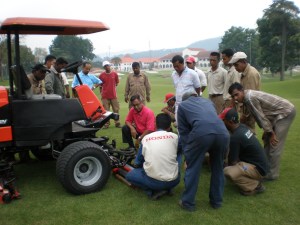
Filepic. Does the supplier support after sales training? Looonnnnng after the sales were done? Or is it difficult to contact them if they think you have no budget? Oh, please disregard the “Honda” t-shirt, it was casual day that day.

Is the machine one of its kind in your area, meaning the supplier do not stock all spare parts? Is the supplier in one part of the country, and you are in another part, so they cannot service you properly? Remember, most people cannot accept long downtime. Not many facilities can afford to have spare machines.

Suppliers must have adequate spare parts and repair facilities. Check out the suppliers track record and reliability from their other customers in your area.
Sometimes there may be little choice but to purchase more expensive units from another supplier who has a better track record of servicing. Or you may have to downgrade and buy a simpler machine, for example a tractor pulled mower. Tractors’ are used extensively in farms and plantations so there are many places to buy spare parts and find mechanics.

         3.  Quality

Some aspects of quality can be seen on the machine, some need to be seen while the machine is operating on the field.

Ask around at other fields that are already using the machine. Ask their mechanic how easy is it to service and repair. Ask their workers how easy is the machine to operate.

         4.  Cost

There is a need to balance performance, quality and serviceability. It is not just about purchase price. Must also include length of operational life and repair costs. What is the point of buying a machine cheaper by 20% but can be used only 50% as long as a more expensive machine? A cheaper machine may last for 3 years before being expensive to maintain while a more expensive machine may last for 7 years. Ask around.

       5.  Staff familiarity

Is the machine similar to what is already in use at your field or is the machine easy to train with? Can the mechanics handle the machine if it breaks down? Some machines uses the same engine or the same gear box as a previous model or another model from a different company. Some machines are very simple and intuitive to operate; especially those with hydrostatic drive. Tractors, are not easy to operate. The big ones are intimidating.

Buying a machine that is too complicated for the staff to operate or the mechanics to repair is just inviting trouble.

        6.  Similar Machinery / Package deals

There are pros and cons to buying machinery from many suppliers or buying a fleet of machine from one supplier. However you decide, all the above factors we talked about should be taken into consideration whether for one machine or for a fleet of machine. Remember some machines may be a compromise so you may have to live with having a sub-standard machine because it is part of a package/fleet.

The good thing about buying in fleet: A supplier may be more motivated to service you if you have been a loyal customer and also, they may not want you to bad-mouth them. The bad: its about putting all your eggs in one basket.

There is also an advantage of buying similiar that can do the same function in another area, for example, buying the same triplex greensmower and tee-mower. Or a machine that has the flexibility of cutting height that can cut both rough and fairway. I’m not saying you should buy less machinery so that you can use one machine for two purpose; I am saying that you can buy two of the same machine to simplify your operator training, spare part inventory and etc. The disadvantage? One of the purpose of the machine may have to be compromised. A machine that can cut fairways very well may not be able to cut roughs in rugged areas.

     7. The company

Should you buy from a big established company that has customers all over the country or do you dare to trust the smaller company that prepared to give you huge discounts? Difficult to say, big companies may have more clout behind them but are you really big enough a customer? Remember to view it from the other side of the fence. What is big money to you may be chicken feed to them.

On the other hand, the small guy may be more desperate to please you (go ahead, tell him to do the chicken dance on the table). Of course, the small company may not last long or have the stamina or even have the focus to be with you for longer than the next customer’s order.

So how should you decide? Try getting a second opinion…

There may be other things that I did remember or I have not experienced before. Please feel free to jot down your thoughts and share your experiences with others or point out other issues.

Posted in Fields, Golf club, Golf Course, Golf Course Superintendents, Padang, Padang Golf, Taman | Tagged: | Leave a Comment »

Penyemburan salah dengan mesin.

Posted by mynormas on January 31, 2012

Lihat Boom kiri dan kanan tinggi di hujung. Ini menyebabkan nozel di hujung akan menyembur tak sama dengan nozel di tengah.

Mesin boom sprayer, secara definasinya ialah sebuah mesin yang mempunyai lebih dari satu nozel spray yang di sangkut kan untuk menyembur kawasan besar. Ada banyak jenis mesin spray. Tetapi oleh kerana laman web ini adalah tentang rumput, maka kita akan khususkan mesin menyembur racun menggunakan boom yang biasa terdapat di padang golf.

Saya bercerita tentang mesin yang mempunyai tiga boom di belakangnya. Boom kiri, boom tengah, dan boom kanan. Setiap satu boom biasanya mempunyai 3 – 5 nozel menyembur. Ada juga mesin yang ada satu boom sahaja, contohnya walking boom.

Pertama sekali, sepatutnya setiap nozel pada boom tersebut mesti mengeluarkan kadar air yang sama. Bukan hampir sama, bukan lebih kurang sama, bukan dekat-dekat sama; Sama. Selepas itu, setiap nozel tersebut mesti berada pada ketinggian dari aras tanah yang sama sewaktu menyembur. Ini semua kita lakukan sewaktu kalibrasi atau penentu-ukuran.

tayar kecil itu digunakan untuk mempastikan boom sentiasa rata, walaupun tanah berbukit.

Semalam sewaktu saya bermain golf (di kelab yang bukan client saya)  saya terjumpa dengan mesin boom yang menyembur dengan nozelnya tidak sama tinggi di antara satu sama lain kerana boom kiri dan kanannya senget. Ini akan menyebabkan nozel yang tinggi akan menyembur kawasan yang lebih luas dan mempunyai peluang yang lebih tinggi untuk di tiup angin.

Tapi perkara kedua yang di lakkukannya yang saaaaangat menyakitkan hati saya ialah mereka menyembur secara berputar. Memusing. Konar. Belok.

Tak Boleh.

Bagilah apa alasan pun; terlalu dekat kolam, kawasan tu kecik sangat, tak nampak garisan, boss tak ajar, boss tak ada dan apa pun, jangan menyembur sewaktu boom tidak lurus.

Jika kita menyembur sewaktu belok, apa akan terjadi, nozel yang di sebelah dalam akan berpusing sedikit sahaja maka air/racun/baja/sirap/oren/apa2pun yang kita spray akan jatuh di kawasan lebih kecil berbanding dengan nozel yang berada di sebelah jauh. Jadi satu kawasan akan dapat lebih banyak dari yang satu kawasan lain.

sejuk mata saya memandang; dia menggunakan buih sabun untuk menanda di mana dia spray dan dia spray dalam garis lurus walau bagaimana bentuk mukabumi.

Ini benar samada kita bercerita tentang padang golf, bola ataupun taman. Asalkan kita cerita tentang boom sprayer, inilah masalahnya.

Sentiasa, sentiasa spray (atau semprot) dalam garis lurus! Gunakan penanda dengan air bercampur pewarna ataupun buih sabun.

Menyembur dengan cara lurus juga mempastikan senang untuk kita sembur bila kita datang balik dari arah bertentangan.

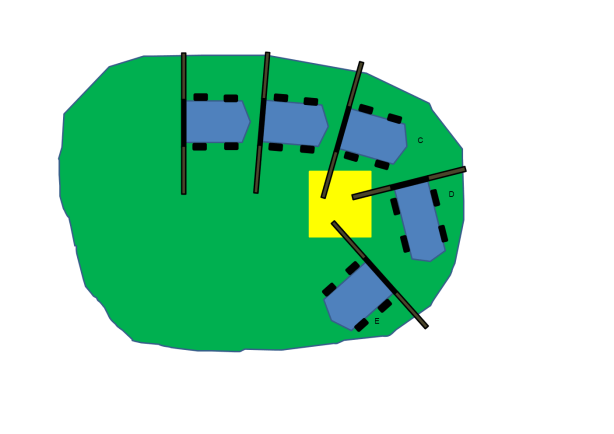
Ini gambar satu sprayer yang sedang menyembur sambil berpusing. Nampak tak bahawa nozel sebelah dalam (kotak kuning imaginasi) menjadi paksi pusingan dan menyembur di kawasan kecil sedangkan di masa sama nozel sebelah sana memusing jauuuuuhhh, dan air keluar dari semua nozel pada kadar yang sama.

Topik ini penting dan panjang, kita akan sambung di post lain lagi.

Posted in Fields, Golf Course, Golf Course Superintendents, Padang, Padang Golf, Taman | Tagged: , | Leave a Comment »

Menanam cara ‘sod’

Posted by mynormas on January 24, 2012

Menanam cara sod adalah cara paling biasa digunakan di Malaysia dan pada pendapat saya, cara paling senang tetapi paling selalu salah.

Nampak jer cantik, tapi silap.

Kebaikan cara sod ialah;

1. boleh ditanam hampir dalam sebarang cuaca; musim hujan atau musim kemarau.

2. kawasan yang di tanam cepat tumbuh dan kelihatan rapat.

3. boleh di tanam di kebanyakan kawasan; rata ataupun di tepi bukit.

4. perlukan penjagaan yang kurang berbanding dengan cara lain.

5. Tidak mudah hanyut.

6. Tidak di makan oleh burung (berbeza dengan bijibenih).

Kesilapan atau keburukan sod:

1. Memerlukan jumlah rumput yang lebih banyak berbanding cara lain.

2. Kecuali rumput cow/pearlgrass, hasil padang akan bertompok kerana rumput tidak sama spesis ataupun di susun tidak mengikut ‘grain’.

3. Akar yang pendek, maka rumput tidak lasak. Terutamanya jika penyediaan tapak tidak betul.

4. Tempat bercantum sod boleh kering dan/atau akan kelihatan lama setelah padang digunakan.

5. Berpotensi membawa bersama masalah dari nursery seperti serangga, spora kulat, benih rumpai, telur dinosaur (ha?!), jin tanah (haa?!), makhluk halus (haaa?!) dan sebagainya.

Secara definasi, sod ialah rumput termasuk akar yang di pegang oleh tanah. Biasanya ia adalah lebih besar atau bersamaan dengan 1 kaki persegi. Cara penanaman ialah dengan menanam rapat-rapat dalam susunan seperti menyusun batu bata. Ia boleh juga di susun jarang-jarang sehingga memenuhi 50% luas kawasan. Kurang dari 50% – kita boleh memberi ia nama ‘spot turfing’ yang mempunyai muka lain di laman web ini.

Langkah-langkah penanaman cara ‘sod’.

1. Mengukur luas kawasan.

Berapa luas kawasan yang perlu ditanam dengan rumput? Untuk kawasan rumah, saya cadangkan membeli jumlah sod sama besar atau 80% luas kawasan tersebut, mengikut kemampuan. Biasanya kalau tanam sendiri, kadang-kadang hampir 10% dari sod tak boleh digunakan kerana pecah atau ada rumput liar. Rumput yang pecah boleh digunakan untuk ditanam di kawasan tepi/sempadan, tapi sod yang ada rumput liar mesti dipecahkan dan di tanam di kawasan tepi atau sebagai ‘spare’ untuk repair.

Walaupun Malaysia dah lama bertukar metrik, tetapi sod biasanya di jual dalam kaki persegi.

Cara untuk mengukur luas kawasan yang tidak geometri boleh di baca di sini

2. Membeli sod.

Berbekal dengan pengetahuan berapa luas kawasan (dan budget dalam poket) maka mulalah bershopping. Pastikan kita tahu rumput apa kita mahu dan tidak terpengaruh dengan apa yang kita lihat di nursery.

Bandingkan harga dan utamakan nursery yang kita boleh pilih rumput dan bawa balik (ataupun kita pilih dan dia terus angkat naik lori). Was-waskan nursery yang kita pilih rumput kat showroom  dan dia akan hantar dari nursery dia yang katanya berada 136.7 km dari situ. Kadang-kadang, rumput yang di hantar ke rumah tak sama dengan rumput yang kita pilih.

Jika tak dapat di elakkan (kerana kawasan kita sangat besar atau kita suka shopping kat showroom yang ada aircon dsb) maka beritahu dia yang kita nak ada kat nursery tu masa dia tuai sod. Ada satu lagi alternatif; bahagikan kawasan kepada beberapa sektor, beli dan tanam mengikut sektor. Dengan cara ini, kita tak perlu risau rumput tak sama bersebelahan, kerana sekurang-kurangnya dalam satu sektor, rumput dari keturunan yang sama.

Sekalli lagi saya ulang, masalah rumput tak sama menjadi masalah utama pada rumput jenis ‘carpetgrass’ dan jarang pada cowgrass atau pearlgrass.

3. Penyediaan tapak.

Saya ada satu muka tentang penyediaan tapak dalam laman web ini. Tapi pendek katanya, di bawah sod itu perlu ada tanah yang agak peroi dan boleh di tembusi oleh akar. Satu masalah ialah bila tanah bawah terlalu mampat dan akar rumput hanya berada di dalam sod. Bila hujan lebat, sod akan ‘terapung’. Bila kering, sod akan mati kerana akar terlalu pendek.

Bagaimanapun, sila baca tentang penyediaan tapak di sini

4. Menyusun sod

Comot tapi betul.

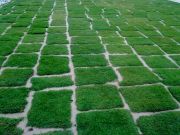
Nampak tak sod di susun air tidak boleh mengalir bebas dari kiri ke kanan?

Kesilapan paling asas yang saya tengok orang buat ialah bila dia tanam sod dia mengikut garisan yang membenarkan air mengalir. Jika kita menyusun sod, susun supaya ia menyerupai orang susun batu bata; bata yang di atas akan melintang di atas sambungan bata di bawah. Dengan cara ini, air tidak mempunyai satu ‘lorong’ untuk mengalir dan membawa baja, pasir dan rumput.

Jika kita membeli 100% sod (ertinya jika luas kawasan anda ialah 120 kaki persegi dan anda beli 120kaki sod) menyusun adalah mudah. Jika kita  membeli hanya 80% atau kurang, mulakan dengan bahagian paling penting kawasan kita contohnya depan rumah, kotak penalti, tengah green dan sebagainya. Saya tahu ada orang yang akan mulakan dengan sempadan dan menanam ketengah, tapi jika kita kehabisan rumput atau salah budget, maka tengah akan lompong/kosong. Mulakan dari satu sisi dan pilih sisi yang paling penting untuk kita (pedulikan apa orang lain kata)dan tanam ke arah yang tak penting. Kalau sod nampak macam tak cukup, maka kawasan yang kurang penting tu kita boleh tanam kemudian ATAU, kita boleh jarakkan lebih sikit baki sod yang ada untuk mencukupkan kawasan yang – ahem – kurang penting tadi. Jadi, kalau di rumah, kita tanam dari depan ke belakang (contohnya) dan di pejabat kita tanam dari depan ofis bos ke luar dan sebagainya.

Untuk padang golf dan padang bola. Ada lagi yang saya tak cerita kat sini. Ada orang yang ciplak kerja saya sebagai kerja mereka. Sekarang ada bahagian untuk orang komersil yang saya simpan. Sorry. Nak tahu? Email saya dan kenalkan diri.

5. Tanam sod.

Menanam dengan rapi. Sod dan luas kawasan 100%

Ada orang tanam dengan cara mengorek tanah dan meletakkan sod ke dalam. Ada orang melakukan dengan cara hanya meletakkan sod ke atas tanah. Kedua-dua cara betul, tapi lazimnya jika menanam 100%, kita boleh hanya letakkan sod atas tanah, dan jika 80% atau kurang, kita akan tanam dia supaya dia tidak ‘lari’ dari kedudukan.

Jika kita meletakkan sahaja sod di atas tanah dan tanah itu sedikit curam, kita mungkin terpaksa menggunakan paku yang diperbuat dari kayu atau bahan mudah-urai lain.

Apapun, pastikan tanah bawah TIDAK keras.

6. Siram.

Siram serta-merta lepas tanam. Siram hingga tanah bawah basah. Untuk seminggu dua lepas itu, pastikan tanah di bahagian bawah sod basah di waktu pagi dan tengahari (perasan tak, saya tak kata ‘siram’?)

Selepas itu, JANGAN siram sehari sekali atau sehari dua kali, siram bila keadaan memerlukan. Ertinya, bila tanah di bawah sod kering; siram. Jangan siram lepas pukul 3 petang. Rumput yang basah hingga ke malam akan mengundang penyakit dan lumut.

Jangan pijak rumput tu untuk lebih kurang sebulan sehinggalah akar rumput dah tumbuh.

Mula potong pada minggu ke lima, jangan potong lebih dari satu pertiga ketinggian rumput. Lepas dua minggu turun kan ketinggian, lepas tu dua minggu lagi, hinggalah mencapai ketinggian yang kita mahu.

Mulai minggu ke empat, topdress seminggu sekali dengan nipis. Tujuan topdress ialah supaya pasir masuk ke kawasan yang tak rata dan meratakan permukaan tanpa melemaskan rumput. Ratakan pasir dengan tangan atau kayu ‘T’ dan siram. Jangan potong sehari lepas topdress, nanti pasir berterbangan.

Mulai minggu ke enam, mulai merumpai. Bahagikan kawasan anda kepada seksyen2 kecil dan merumpai dalam satu seksyen selama satu hari. Esok (atau hari seterusnya) merumpai di seksyen kedua, hari seterusnya di seksyen ketiga dan ulang. Dalam masa tiga bulan kita seharusnya akan dapat laman yang kita idamkan.

insyaAllah.

Selamat mencuba!

Bagaimana sod di tuai di nursery.

Ini adalah permukaan bunker padang golf yang senget dan boleh rosak akibat hujan lebat.

rumput yang pendek akar (dan nyawa) mati dulu.

Rumput dah di tanam tapi tak di siram.

Posted in Fields, Golf Course, Lanskap, Maintenance, Padang, Padang Golf, Rumput, Rumput halaman rumah, Taman | Tagged: , , , , | Leave a Comment »

Preparing a maintenance Schedule

Posted by mynormas on January 13, 2012

Can you play on this grass?

Do you find that your turf maintenance work keep clashing with major events, or that you have to apologize to a customer because he played on turf that is ‘less than perfect’? Do you become irritated when the turf maintenance guy asks for higher expenditure in one month and sometimes it is in the month with the lowest income?  Do you understand why, everyone and their mother, knows that the months of Nov and December of every  year is the rainy season but yet, after all this years, nothing has been done to prepare the turf so that minimal disease and damage happen? Have you ever asked, if everybody is aware of the date of the year’s main event (Club Championship, football final, concert season, school holidays etc) why can’t they prepare the turf to take the extra stress?

Question: do you have a turf maintenance calendar?

In the context of turf maintenance, there are a few maintenance works that fall under the category of ‘Cultural Practice’ that needs to be applied or performed at certain intervals.  Of course, for most turf areas these works disrupt play or enjoyment of customers, clients and guests. At the same time, most golf courses, football fields, or parks cannot afford to be closed wholly for long periods of time.

The best way to overcome this problem is to schedule these works into periods of low activity for example; in between football seasons, during fasting month, major exams week etc. This way, the disruption occurs to the least number of customers, which can be easier to handle.

Other benefits of scheduling work for the whole year includes:

1. Peaking the performance of the playing field/golf course during the period when it will receive the most media or customer attention.

2. Knowing exactly the amount of interval between the maintenance activity; e.g. between aerations or dethatchings; and adjusting accordingly.

3. Informing important guests or big organizers of when to schedule (or reschedule) their event. In my experience, several organizers are grateful  to be informed earlier and especially if we can help to point an alternate site for them.

4. Preparing the grass for the times when it is predicted to receive the most amount of stress. E.g. before the monsoon season, or before the grassed area is turned into a temporary car park for an annual sale or ‘buka puasa buffet’ or concert or lion dance etc.

5. Staggering the purchase of materials and equipment needed for one major work over many months will help in managing the cash-flow better and will help you spread the costs over the year.

6. Keeping staff employed effectivelythrough most of the year.

How do you start?

Start by having two lists:

1. List of events for the year or probable time of the year for the events. This may include, school holidays, public holidays, wedding season, golf season etc.

2. List of maintenance work activities (cultural practices, liming, soil amendment etc). Basically any major work that will disrupt play. Forget regular fertilizing or irrigation or stuff like that that can be manouvered around play.

Also weather pattern for the past few years. Ok, you may ask: what pattern? Did I miss the global warming crisis? Stop making excuses and get a monthly bar chart of rain days or rainfall; at the very least, you can make educated guesses.

Next:

Simple sample of yearly schedule

  1. Take  one of your most important and biggest (messiest) work of the year and consider when you would have that.
  2. Choose the time when traffic is lowest on your site but weather is tolerable. And mark the dates for your work.
  3. Basing on the interval for the same work, set the  dates for the next round (e.g. twice a year: six months later, 4x a year: 3 months later etc)
  4. Then stagger the other works so that it is not too close to the main works as in no 2 and 3 above.

Its not that difficult is it? Well, who said turf maintenance was rocket science? Of course, if you’ve never done it before or if the turf maintenance guys don’t have the support of the event management or marketing or golf management guys/gals; they’ll never get it done and the result is finger pointing the whole year. I’ve seen it done and I’ve seen people lose their jobs too.

Of course its not the end of the story after you actually do the annual calendar. Then you do the monthly calendar. This is especially important to maintenance crews that have limited manpower and resources (tractor, machinery etc.) You plan your work so that you can have enough workers for your projects and enough projects for your workers.

Because of a tournament (in red) extra attention was given to the greens a week prior to the event. Of course lucky Mountan View had an experienced consultant to guide them.

Now that is the easy but yet tricky part. At the same time it is important because this is the time when you should know the exact dates of tournaments, visits, etc so that you can plan your work.

Remember too that a schedule is not set in stone that it cannot be changed. But not having a schedule is as true as the old cliched quote goes: “Failing to plan is like planning to fail”

Posted in Fields, Golf Course, Padang | Tagged: , , | Leave a Comment »

4 Principles I won’t drop in 2012

Posted by mynormas on January 2, 2012

  1. As a paid consultant, I should not take commission from suppliers.
  2. I must follow The Golf Course Superintendents’ ethics of never pitching to the GM without knowledge of Superintendent.
  3. I must teach my clients the details.

1. Commission, a cut or whatever you call it.
I’ve always believed that I should not recommend specific products to clients. I’ve wanted to be known as an independent consultant so I believe that when I am hired I should recommend only the active ingredients,  formulations or specifications that in my opinion will help to solve my client’s problems. I have had suppliers who asked I recommend their products; I couldn’t. Having said that, I have also had clients, who admit their ignorance and gave me instruction to recommend a specific supplier or product. I have done that, giving more than one name, if possible. And in more than one instance, the succesful supplier has offered me a commision; I have always refused, except for one time when a grateful supplier traveled all the way from Ipoh to deliver a hamper, I didn’t have the heart to say no.

Well lately, I have been made to feel stupid for not taking part in this lucrative … ‘trade’. Don’t get me wrong, I feel that for a one-off, pro bono or free work, I should get paid by the supplier who I recommended.  Except that, I didn’t have the heart to do that either when given the chance. After all, the supplier is a friend anyway. Maybe I am not cut out for this business. Should have stuck to taking a salary.

2. The ethical part
Many years ago, as the Vice President of the GCSAM, I wrote a set of ethics. One of the ethics said something that I (or any other superintendent/supplier/member of association) should not offer advice, or service to a golf club without the knowledge of the club’s superintendent.

Honestly, it would have been easy enough to go for a round of golf (or drinks) at a golf club, ask to meet the manager and offer unsolicited advice. That could put me in a good light and maybe do the opposite to the superintendent.

Should I care? I mean, of the 200 golf courses in Malaysia, there are only 40 superintendent who are/were members of the association. Chances are, the superintendent of the club that I could afford to offer free advice are not a member of the association anyway.

3. Hold your knowledge tight
My wife, who has seen me work, feels that I teach too much to the people I work with to the point that those people feel they know enough that they can work without me. She feels that I should just stick to telling them to do something without teaching the ‘whys’ and ‘hows’.

That should be easy enough. Some client’s staff feel that they don’t need to know and some want to find fault anyway. So why bother.

4. The race card
This may sound alien to non-Malaysian readers. I have always considered myself a Malaysian first. I have always thought that I should be considered for the job because I am the best choice due to my skills, my knowledege and my experience.  It hurts when a couple of weeks back, a supplier/competitor suggested that it was easier for me to get clients because of my race.  She promised to meet me to discuss so I did not press the matter further over the phone conversation. But it was a shock, after all, if anything, I thought it was the other way round – that is, the only way I can make it as a consultant in Malaysia was if I was John, Michael or, at least in one instance; Chong.

But no, this is one principle I can’t do without. After all, I left one company because I felt that it had ‘preferred’ race over ability and I convinced a partner to change the company name from Australian Turf Management to Advance Turf Management.

All in all, 2011 has been a disappointing year for me and 1st January 2012 found me in a slightly depressed mood. Perhaps some changes are in order. I’ll have to do more marketing work for sure. Maybe I should drop the ‘halo’, do what other people are doing and stop being such an uptight a$$hole.

Maybe its time to change in 2012.


Posted in Fields, Golf Course, Golf Course Superintendents, Padang, Padang Golf | Tagged: , | Leave a Comment »

Penjagaan rumput musim tengkujuh

Posted by mynormas on December 14, 2011

Di sini saya sertakan beberapa tip yang boleh digunakan di padang golf, padang bola, lain-lain padang rumput turf dan/atau halaman rumah.

  1. Membaja pada waktu ini hampir boleh di ibaratkan mencurah air ke daun keladi. Baja tersebut akan mengalir ke dalam longkang, sungai, parit ataupun tasik di sekeliling. Hentikan guna baja terutamanya jika baja tersebut tidak mempunyai bahan ‘slow-release’. Sebaiknya; gunakan baja foliar yang boleh di serap dengan pantas oleh rumput. Sembur sedikit tetapi selalu.
  2. Elakkan atau kurangkan penyemburan racun serangga. Jika terpaksa; perhatikan cuaca. Jika hujan lewat petang; sembur awal pagi. Cuba untuk gunakan racun serangga jenis sistemik (racun serap) yang akan masuk ke dalam rumput dan menjadikan rumput ‘tak sesuai’ di makan oleh serangga.
  3. Elakkan atau kurangkan penyemburan racun kulat. Jika terdapat masalah penyakit; cuba dahulu untuk mengatasinya dengan menaikkan ketinggian potongan (jangan TAK potong), kurangkan trafik lalu di kawasan berpenyakit (kurangkan sebaran dan stress), pangkas pokok atau alih perabot untuk menambah aliran udara dan cahaya matahari. Jika penyakit berterusan, lihat langkah penggunaan racun serangga di atas.
  4. Jangan benarkan mesin atau alat yang berat untuk masuk ke dalam padang yang basah. Ini akan memburukkan mampatan kerana padang yang basah akan bersifat lembut. Membenarkan mesin masuk akan meninggalkan kesan tayar yang akan berlarutan hingga berbulan-bulan. Ia juga akan menyebabkan lecak atau becak yang memburukkan pandangan. Jika tanah tidak terlalu basah/lembik dan anda terpaksa memotong JANGAN potong mengikut garisan/stripe kerana ini akan meletak tayar di atas garis dan boleh membuat lekuk.
  5. Cuba gunakan plant growth regulator (PGR) seperti Primo untuk melambatkan pertumbuhan.
  6. Tebuk tanah dengan spiker, slicer, solid-tine, hollow-tine kecil dan apa-apa saja (pen lama, garfu lama dan sebagainya)

    Menebuk lubang di kawasan berlumut. Lumut adalah simptom kelembapan tinggi. Bantu air mengalir di kawasan berlumut.

    supaya membantu air dan udara untuk masuk kebawah. Tebuk sekurang-kurangnya setengah inci (asalkan tembus thatch).

  7. Sembur agen pembasah tanah (soil wetting agent) untuk membantu air turun. Sembur pada waktu tanah tidak tepu dengan air.

Sentiasa baca label, gunakan pekera yang terlatih dan gunakan akal sebelum menyembur sebarang jenis bahan kimia ataupun baja. Jika ragu-ragu; hubungi Pakar Rumput.

Posted in Fields, Golf Course, Lanskap, Padang Golf, Rumput halaman rumah, Taman | Tagged: , | Leave a Comment »

Weeds

Posted by mynormas on November 18, 2011

Most people don’t pay too much attention to those grasses that don’t seem to belong to the rest of the grasses surrounding them. The reason being those grasses doesn’t usually impose themselves on people.  Other than aesthetics that is. Even if the grasses seem – at first glance – to be similar, there is that slight difference in colour, texture or something that makes people dislike.

What are these grasses?  How did they come to be where they are?  Why are they left alone?  How do we get rid of them? Should we get rid of them?  What are they called?

They are called – other than the colourful names some people use to describe them – weeds.

A weed is defined as a plant that grows where it is not wanted. So, because of the  definition, a rare black orchid growing in the middle of a fairway would be attacked by changkul-wielding workers before we can finish saying “Rare black orchid is a weed?” Similarly, a banana plant three feet from the pin on a green is a weed, never mind the nutritional qualities of a banana.

These weeds are called ‘sedges’ and they love wet areas.

Weeds are transplanted in many ways. Assuming a particular golf course or field or taman is constructed, planted and maintained to perfection (this would presumably be on Planet Krypton), weeds can be transported by wind, animals, water, humans or machinery.  Sometimes it could also inadvertently be transported by the maintenance staff when they borrow a machine or equipment from another place. This does not only necessarily mean from one golf course to another, but also from one hole to another in the same golf course.

Why Weeds Happen – During Construction.

You would think that no one would plant a weed on their field. No one intentionally would; but sometimes that’s what happens when the owner/manager purchases new planting material like seeds, stolons or sods. To cut cost the planting material might be purchased from the nursery that gave them the lowest quote.  Chances are that these nurseries may not apply the best management practices to ensure weed-free materials. How else can they quote so cheap?

Are they planting pure grass stolons are are there weeds seeds mixed in? Did you check? By now, can anyone check?

What some nurseries do is to regularly mow their plots to keep most weeds down to the same height as the surrounding grasses.  And when they smell a potential sale, they do a hurried manual weeding job before the buyer’s representative arrives for an inspection visit.

For golf courses, this may be the same scenario if we get our planting material – especially in big quantities – from the award-winning golf course that our boss has friendly relations with.  You don’t think they will rip off their best greens and fairways to give us the stolons do you?  You might as well ask for their right arm.  We may get away with getting the stolons during their renovation works like hollow-tining or verti-cutting.  Just be aware that it’s almost impossible to be weed free on all 18 holes (we are not on Planet Krypton) and a verti-cutter machine going on a weed the size of the palm of your hand will create hundreds of tiny baby weeds waiting to sprout on the golf course.

Actually, the story can begin long before the first planting material is purchased.  It starts when the soil is being prepared for planting.  When the earth was pushed to make way for a golf course, or when the soil is expertly shaped waiting for the planting of the seeds or stolons of the chosen species of grass, it contains planting material of many different species of plants. Each and every viable seed is a potential weed waiting for the right time to sprout.

There are, of course ways to treat the soil – from simply turning the soil over to expose the seeds to sunlight to the complex way of covering it with plastic sheets and injecting it with chemicals – which, by the way, should only be done by licensed applicators.

If you are planting your own field/lawn visit the nursery, ask the supplier to show you which part of nursery they want to harvest for you, then on planting day, insist that they do NOT harvest before you or your rep being there. You don’t want them to show you one part of the nursery then harvest from another part to plant in your field/lawn.

Why Weeds Happen – During Maintenance

As so often is the case, an ill-advised attempt at cost reduction is usually the root cause of many evils when aesthetics is one of the performance indicators.  You will hear me repeat this line often: nothing is free in this world; we will pay for it one way or another. Maintain the grass poorly, it will not grow well and, in this instance, will provide an opportunity for weeds to move in.  We will eventually spend money to remove the weeds from the golf course. This paragraph will still hold true when I write about disease or pests in the golf course in future articles.

Poor maintenance can cause weeds, this drainage line was left open. So weed came in.

In short; do not expect the maintenance staff to cut costs to the point the grass’ health suffers.  Starve it if you must. But make it suffer it you mustn’t.

In the quest for being environmentally friendly, some golf courses used organic fertilizers to feed their grasses. Now, these organic fertilizers are good food for the soil as much as it is good for the grass, but if we calculate on the amount of nutrient it can deliver, it may prove to be quite expensive. Fertilizer made from organic products that are not properly treated may contain weed seeds. Chicken dung and other animal waste or even products made from plant waste may be contaminated at source or during the process to turn it into plant food.

There is a legend of how a Superintendent of a golf course placed an order of several tons of processed chicken dung fertilizer.  The purchasing clerk, who with good intentions, believes that all chicken dung are alike proceeded to buy the cheapest one available.  The cost of weeding the golf course in the months afterward probably is much higher than the savings on the purchase of the fertilizer.

Weeds can occur in places where there is compaction, such as high-traffic area. Or wet/damp areas. Or dry sandy areas. Different weeds will thrive and specialise in different areas.

The Cure

So now you know where weeds has its roots (pun intended) and you want to roll up your sleeves and ask your maintenance staff on how you can help fight this scourge on the grass field.

How does the staff take care of the weeds?  He/she has quite a few things in his arsenal. First and foremost are the mechanical means, which includes sending an army of labourers digging up the weeds with small screwdriver-like implements. It works to a certain extent; at the very least it controls the population of the weeds. More often than not, the staff may miss out the small ones or neglect to dig up the roots which may sprout again. But if you have the budget, this would be one of the best ways to get rid of them.

Another option would be to use chemicals. And there are plenty of chemicals; ranging from those to be used before the weed seeds germinate – called pre-emergent – to those designed for use on living weeds – called post emergent. Most weedicides or herbicides, for this is the category the chemicals used to kill weeds is called, belong to the post-emergent type.

More often than not, the staff will choose a ‘selective’ herbicide; these are the chemicals that may spare the original grass and kill a certain type or family of weeds. The danger is that if the wrong mixture or rate is used, it may kill the original grass itself.  You might also note that even if it doesn’t kill the original grass, there may be a slight discoloration that will be visible for a week or two.  The opposite of a ‘selective’ herbicide will be a ‘kill-all’ herbicide, for want of a better word.

The staff can also choose to use either a contact herbicide that will kill the weeds it is supposed to on contact or he can choose to use a systemic one, which will be absorbed through the plant and start to kill from within. If he chooses a contact, he may need to use a reliable sprayer so that full coverage can be effected. Otherwise, the herbicide may only kill parts of a grass instead of all of it.

Please be reminded that all the above information is only a fraction of a branch of knowledge used by maintenance staff.  For more information regarding herbicides in particular or weeds in general; get in touch with me.

Posted in Fields, Golf Course, Greens, Landscape, Lanskap, Taman, Topdress | 12 Comments »