Turf Matters

The Site To Go To For All Your Turf Matters

  • Facebook Likes

  • The new Brushcutter

    Pengganti Brushcutter

    Increase productivity, cut labour. Try the AM61A

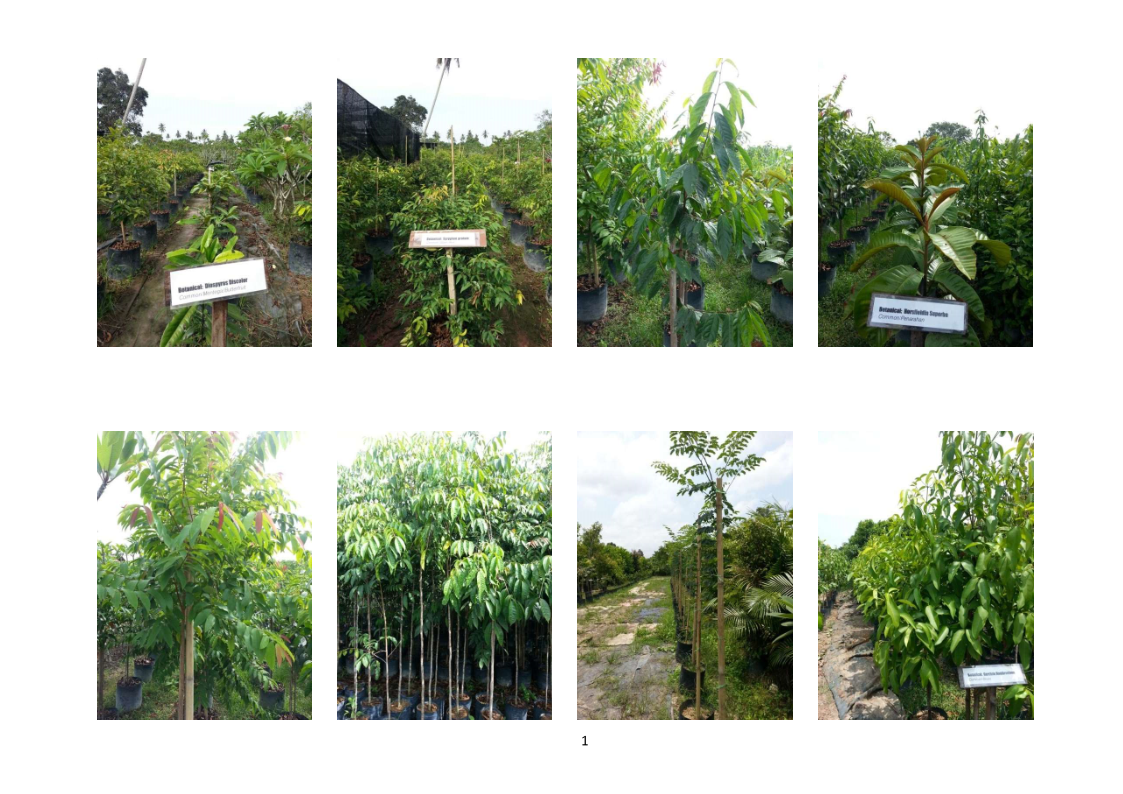
  • Trees Nursery

    Forest trees nursery

    Get your Trees from this nursery

Archive for the ‘Greens’ Category

Making greens cheaper

Posted by mynormas on December 4, 2013

Continuing my previous post about golf green’s construction, there are more than one way to construct a green, other than the USGA way.

Back in 1994, when I was still a young, new, beginner, trainee, novice, rookie (you get the idea) Assistant Superintendent, a new Superintendent from Australia joined the club I was working at and – to keep a long story short – after a few months, both of us were summoned into the Boss’ office. He asked us to sit down and after a few moments of dramatic silence while he rearranges stuff on his table; the Boss said “I need you two to build a green. It is for someone with a big house on top of a hill”

I got two problems with that statement. One; it ain’t a ‘house’ as we know it. Two; it’s not big, it’s humongous! If I were in the front lawn and needed to go to the toilet at the back of the house, I’d probably wet my pants by the time I reach it. Three; fresh from studying the USGA method of greens construction, I thought that’s going to cost a lot of time, money and effort. Four; will I be paid extra for this work? Five; just in case you were wondering – mathematics is not my strong point.

But Martin – the Superintendent – was cool about it. He brought me and a few workers to the site and told us to dig a hole in the ground. It was about 200 – 300 m2 big and about half a meter deep. “Great” I thought “Now I’m going to have a hands-on experience on green construction; this is going to look good on my CV”. Yeah. Really. Ok… maybe it’s more like: “Yahoo! Martin is going back to the club, the workers are going to be ones working, and I’m going to sit under that tree till 4pm for the next 30 days”

In USGA greens, one problem is material selection; it has criterias for gravel and various sand layers. Some clubs with strict construction superintendents have been known to reject enough lorry loads of sand to make a mountain out of one green. Other issues are the procedures and methods of construction. So I thought, while we wait for the right material, and while Martin fusses over the depth of each layer and stuff, I’ll have time to hone my poker skills.

That wasn’t the case, we dug the (big) hole, installed a network of herringbone drains, dumped sand on top of it, shaped the top a bit and then planted it. What?! That was it? What about the particle size? The bridging criteria? Hydraulic conductivity tests and stuff? My poker game?

Before we go any further, let’s be clear that this is not a golf course superintendent’s technical support manual. I write for the layman and for fun.
File pic.  Gambar hiasan.

File pic.
Gambar hiasan.

We talked about USGA greens in a previous post. But there is more than one way to build a green. There’s a few. Why are there many ways to build a green if the USGA method is supposed to be ‘the’ way? As always, the limiting factor for most golf courses, even in the US, is cost.

In the mid-1970s, two turfgrass scientists; Dr. John Madison and Mr Bill Davis from the University of California did some tests and concluded that using normal sand could produce acceptable golf greens. Their basis? Straight sand (and by that I mean just pure sand) placed over conventional drained basement. Unlike USGA greens, there is no gravel layer so California greens are cheaper and easier to install.

In 1998, the California greens method was further refined with some improvements; to use USGA criteria for selection of materials, consideration of local climate data and rootzone permeability to calculate sub-basement drain spacing and to use a much faster hydraulic conductivity than USGA greens. Some people think this then should be put under a third category of greens construction method: the hybrid California-USGA method.

But anyway, I also mentioned in a paragraph of the previous post that at least in one golf course I worked in; the greens not constructed in the USGA method were doing much better than the ones reportedly built as per USGA specs:

It was early this century (actually, this millenia) and I was then working in a golf course that had 18 holes of ordinary golf and 9 holes of par-3s. Every time rainy season comes, I will be fighting diseases and algae on the 18 and yet the  9-hole par-3 course were just humming along with no attention needed. I asked an old-time staff and from his description I could tell that the 18 holes were supposedly built according to USGA specs and the 9 holes were just… built. Upon close inspection, I could see that the sand material on the par-3 course were of coarser sand and pretty non-standard. Of course, when dry season comes and there were two days of no irrigation; the par-3 course would have dry patches.

So, the million-dollar question; should you use the USGA method or the California method or the hybrid method for your golf course reconstruction? And that sir/lady, would fall under the “time to ask the real expert” category.

Posted in Golf club, Golf Course, Golf Course Superintendents, Greens | Leave a Comment »

Making greens

Posted by mynormas on November 26, 2013

The end of the year is upon us, and there will be many golf courses who are now working on the budget for next year. If the current trend continues, quite a few courses will be (or at least they SHOULD be) renovating their greens. There are a few construction methods for greens and I’d like to share my experience here.

The first cut is the deepest...

The first cut is the deepest…

Firstly, why do I call it ‘construction’ when at the same time, it is about renovations? Well for one, you need to understand the current (or perhaps you would call it ‘previous’) method of construction of your existing green. Because some clubs want to cut corners or are happy with the current design on the greens that all they want to do is to take a few inches off the top and mix in a new root-zone and just plant new grass. Two, some clubs may want to relocate their newly renovated greens slightly nearer to the lake or bunker. Three, some clubs may want to enlarge their existing greens. Or, four, you’re someone who’s curious about greens constructions. Heck, you’ve read this far already; might as well just read all the way through right? At least you’ll have an idea what the Course Superintendents and Club Managers are talking about.

By the way; a caveat; this is not an instruction of a ‘how-to’ build greens manual or suggestions of any kind. Its just a sharing of my experience. Your Superintendent will know the details or you could do your own research at USGA’s site; or you could give me a call O3-5I3I OO66.

“The green is the ‘heart’ of the golf course” said my club manager in 1993, the late Dato’ Benson Lim. The green is the most important part of the golf course. On a price per square foot, it is the most expensive to maintain and the most expensive to construct.

20 years ago, the early part of my golf course maintenance career was spent on a golf course that was still under construction by a Japanese firm. This was one of the first golf courses they build and for most people who supervised them – I included – this was our first golf course too. So you can imagine the pride I felt when I was told, and subsequently read in the marketing brochures that our green was constructed to “USGA standard”.

Imagine my surprise when not many people who work there – including the architect – could tell me exactly what a USGA specification green is. Imagine my bigger surprise when other clubs’ marketing brochures also touted their green as USGA standard specification! Of course the biggest surprise was whenever I brought up the subject of USGA specifications; my peers were vague and changed the subject. Me? I didn’t even know who or what USGA is.

So I did a bit of digging around and found that there are four main types of golf course construction; USGA, California, hybrid of USGA and California, and push-up green. Of course there are many other names, but basically there are about the same things, for example push-up greens are also called as ‘native soil greens’; especially since some people have this thought of a bra whenever the word ‘push-up’ is mentioned. And oh, by the way; USGA is the United States Golf association who, through their ‘Green Section’ does the research and development about stuff on the golf course.

We’ll talk about the other types of construction later. Right now let’s get back to what we shall term loosely as USGA greens, or as some of my foreign staff would say: “Oosgar grins”.

USGA specification for greens was developed way back in the 1960s with one amendment in the 1990s. Yeah it was that long ago. It was basically up to 18 inches deep with several layers of material, each layers has its own specification designed to – not just percolate water – but also to retain water at the same time. The sizes of sand for each layer was calculated and calibrated to not move water, until more water flowed down from the layer above. Genius and confusing for most people; no wonder nobody could explain the concept to me.

This is how a green profile should NOT look like... see the layering?

If your greens’ profile look like this; time to renovate.

It has also been described as ‘inverted water filter’, but very different from my expensive ionizing, hydrogenated, sulfinated, carborated, pH corrected, perforated water filter that only my maid knows how to use, it is about the filters of old where you can see a layer of gravel on top, underneath it is a layer of coarse sand, below it is a layer of slightly smaller diameter sand and below it finally a layer of fine white sand at the bottommost. The theory is that when you pour water from the top, dirt will be trapped in the layers of gravel and sand to give you clean water underneath the filter. Turn the whole filter upside down, and you get the general concept of the USGA green – simplified, of course.

To understand things better I paid a visit to a soil science professor in a local university and told him about how we planted grass. “WHAT!” he said; “Impossible! You can’t plant on sand!” “But Prof, we’ve been doing it for the past 40 years!” said the 20-something-year-old Assistant Golf Course Superintendent to the 50-something-year-old Soil Science Professor.

“But you cannot plant on sand!” he said, standing up. I stood up too; other than the fact that he was raining saliva on me, I was kinda worried just in case he had an axe or pitchfork around just for this occasion; some young upstart spewing out soil science blasphemies.

Well, turns out the good Professor was half-right and I was wrong; you see, the topmost layer is not made up of just pure sand. It is actually a layer called the ‘root-zone’ and it also consists of other organic or synthetic materials that help to retain nutrients and water. I’m sure if I told him that he would understand.

I don’t remember who the Professor was and I don’t think I met him again after that. Maybe that was a good thing too; I’m getting to be a bit too old for these kinds of shock meetings. Imagine my surprise (do you get a déjà vu feeling when you read that? Why am I continually surprised?) when in the next few years, greens constructed not according to USGA standards were doing better than greens following the USGA standard in the same golf course. Remind me to tell you about it. Keep your eyes on this space for the next article soon.

By the way, you could also check out my renovation pictures on Slideshare or look at other websites for more info. And yes, this article came out in a magazine called The Clubhouse about two years ago. It was written by me too and I am a regular contributor. It is also a free magazine you can pick up from your own club so do – you know – pick one up.

Posted in Golf Course Superintendents, Greens, Maintenance, Padang Golf | Tagged: , | Leave a Comment »

Greens Improvement (kau ada?)

Posted by mynormas on August 16, 2013

Big change - God willing

In 5 months

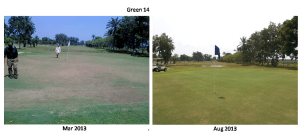
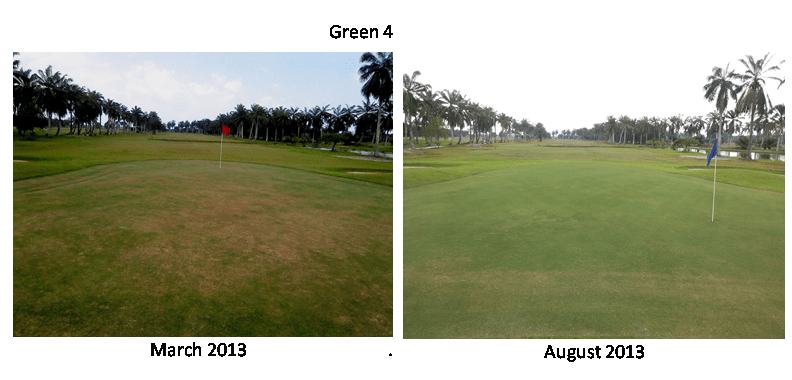
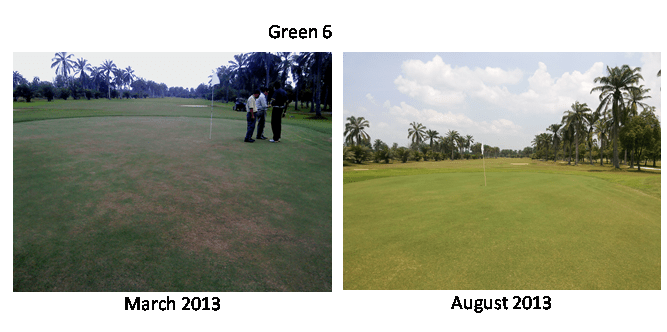
These pictures show 3 greens now and 6 months prior me becoming their consultant.

Last March a club called and asked for help in improving their greens. I visited the club today (August) and the boss and committee chairman were happy.

I told them in March I could try – God willing – to make some changes. I proposed that I come by once a month to check and give them a schedule on what to do for the next one month. They are of course, not really interested if all I were to do is to recommend some magic formula or machinery which they won’t need a consultant for; they can get many suppliers to give them free advice on that.

In fact, just a couple of months before that they had already spent on a few hundred thousands of ringgit to buy machinery – one of which is sitting idle in the workshop because it was too big for them.

What they want was advice on how to improve the greens without having to reconstruct and/or spend too much money. Actually, they thought they’re paying me too much and don’t want to pay for anything else at all.

The Course Supervisor was friendly but defensive. They had a manager in March but he left in April and they have not replaced him to date.

They agreed to my fee (which, considering the small size of the club, did surprise me a bit) but they wanted something extra. They want a PowerPoint Presentation for the Big Boss every time I visit. Once a month? For the fee I charge? Of course I said “yes”.

So once a month I would spend a day going round with the Supervisor, prepare a presentation that night and first thing the next day, do a presentation for Dato’. He was a rags-to-riches businessman who spoke little English so I had to speak plainly with no jargon.

The Supervisor eventually was quite supportive of me because he can see that I was always on his side by giving him credit for whatever good that happened on the course. He also saw that I not only told him what to do and how; but I also told him the whys and the alternatives. I also did not pushed any chemicals or fertilizers on him. I gave him the specs and formulation and he found them himself.

When I met Dato’ today I was imagining that my contract was going to be shortened since I had already met the challenges posed earlier (I need to relook at that escape clause in my agreement); but surprisingly, he asked me to come more often (like, twice a week?!) so that I can help him with the overall management!

That’s nice of him. But I probably will turn that down. Enough club management for me. I love improving greens and managing grass. People and members? Not so much.

Mar to Aug

Mar to Aug

Not just these 3 greens; all greens there show improvement.

Not just these 3 greens; all greens there show improvement.

Posted in Golf club, Golf Course, Golf Course Superintendents, Greens, Maintenance, Padang Golf | 2 Comments »

Greens Improvement

Posted by mynormas on April 29, 2013

image

This is green 18 at Kinrara Golf Club. It usually doesn’t look like this.
Read the rest of this entry »

Posted in Golf Course, Golf Course Superintendents, Greens, Padang Golf | Tagged: , , | 6 Comments »

Algae on golf greens

Posted by mynormas on January 2, 2013

In the context of Malaysian weather where heavy and frequent rain is the norm, plus with poorly or compacted greens, shade from surrounding trees; algae is quite common.I found this slideshare article that is very informative and thought that I should share it.

Be advised that even though the title is about golf greens, much of the info are also applicable to other parts of turfed areas (yes your lawn too madam)

If you think most of the slides’ contents are too ‘academic’ jump straight to slide number 53, though you might be searching backwards for background info but at least you know what you are looking for is what you need to know.

This is the first time I am doing this so I hope this turns out alright…

Posted in Fields, Golf club, Golf Course, Golf Course Superintendents, Greens, Padang, Padang Golf, Rumput, Rumput halaman rumah | Tagged: , , , , | 1 Comment »

Penjagaan rumput monsun

Posted by mynormas on November 2, 2012

I’ll be talking about turfgrass maintenance during the rainy season. And I define ‘rainy season’ differently than a ‘rainy spell’. A rainy season is not unexpected,it usually happens at the same time every year whereas a rainy spell is a prolonged period of heavy rainfall occuring almost daily unexpectedly. Not planning for the rainy season is, in my opinion; unforgivable. So how do we plan for the rainy season – in terms of turfgrass management? What should we do? When? Lets share.

Saya dah lama tidak update this website. I apologize. There’s a lot of questions posted here and emailed to me yang belum di jawab. Saya minta maaf.

Apakah langkah penjagaan rumput yang perlu diambil di  waktu musim hujan? Mari kita berkongsi.

1. Fertilizing. Penggunaan baja di musim hujan akan menyebabkan baja larut dan lesap ke dalam sistem saliran yg menyebabkan pembaziran dan pencemaran air. Elakkan menggunakan baja kimia biasa ketika dah tahu hujan lebat setap hari. Try slow release in small quantities or even foliar fertilizer but more frequently.

2. Pesticide use. Menggunakan racun makhluk perosak juga boleh menyebabkan pencemaran di tambah pula air dalam tanah atau air hujan boleh mencairkan racun dan menyebabkan kelalian pest kepada racun. Try using systemic pesticides.

3. Wetting agent. Memang di luar dugaan dan counter intuitive “Kenapa nak guna wetting agent waktu dah basah giler?” Kebanyakkan wetting agent, terutamanya wetting agent generasi kedua (tanya supplier, klau dia tak tau, tanya supplier lain) akan menjadikan tanah lebih ‘mesra-air’ dan memudahkan ia masuk ke dalam tanah. Gunakan ia secara berterusan dari musim kering hinggalah ke musim hujan.

4. Aeration. Kerja hollow-tine is very good but to do it during the rainy season would make it a bad decision. Try spiking or slicing. Do often. Ia akan membantu memecahkan algae dan/atau permukaan keras supaya air masuk ke bawah.

Slicing the field

5. Vertical-cutting. Not really a good idea to do any major dethatching work. But grooming or light dethatching: excellent.

6. Mowing. Potong kenalah potong rumput. Jangan biarkan rumput terlalu panjang kerana alasan tak boleh masuk mesin; gunakan manpower with brush-cutters or push mowers. Jika terlalu lama tidak di potong, ia akan menggalakkan rumput liar membiak dan juga menyebabkan kita memotong terlalu banyak daun bila kita dah boleh masuk mesin nanti. Lepas potong, jangan biar sampah rumput bertaburan untuk di larikan oleh air hujan! Ia akan menjadikan tanah tidak rata dan menjadi masalah di masa akan datang.

7. Growth regulator:  Ia sangat membantu di waktu ini kerana ia melambatkan rumput tumbuh jadi jika kita ada masalah padang atau fairway yang terlalu lecak dan tak boleh potong, sembur dengan Primo (takde jenama lain di Malaysia) supaya kita tidak ada tekanan memotong sewaktu hujan tengah lebat.

8. Tree pruning: Kurangkan dahan pokok yang ada risiko untuk patah dan sekaligus akan mengurangkan daun yang gugur dan terpaksa di kutip.

9. Rubbish and leave collection. Kutip sampah, daun atau clipping yang akan menyumbat longkang dan menjadi masalah di masa akan datang.

10. Drain out the water. Cuba pastikan air tidak bertakung terlalu lama. Buat longkang sementara atau tebuk tanah supaya air mengalir.

11. Jika kawasan anda mempunyai selut (contohnya dalam bunker) buang lapisan selut itu supaya ia tidak menutup permukaan tanah dan air tidak mengalir.


Jika anda mendapati ada tempat yang mempunyai masalah air tidak mengalir atau lecak; tandakan tempat itu di atas peta dan buat rancangan untuk membuat longkang bawah tanah, atau apa cara pun supaya masalah yang sama tidak berulang. Saya dapati, pembetulan dan tindakan jangka masa panjang adalah lebih berkesan dari kerja sementara yang di buat berulang kali.

Selamat mencuba!
Read the rest of this entry »

Posted in Fields, Golf club, Golf Course, Greens, Rumput | 4 Comments »

Zoysia green.

Posted by mynormas on September 3, 2012

image

As I said, its the first time I used this app. Just tilt your head to the right to see the image.

My first ever Zoysia green (and my first ever posting with this app). It was an unused and un maintained roundabout behind the club kitchen and the cooks were dumping their old equipment on it! One pro tournament at the club wanted a practice green and that was the only option available. They gave me two weeks notice to get it done. Managed to do it just in time and maintained it as a green ever since. It may be the ‘wrong grass’ but it sure is easier to maintain than the greens here that have many different types of grasses.

Posted in Golf Course, Golf Course Superintendents, Greens, Maintenance, Padang, Padang Golf | Tagged: , | 1 Comment »

Menyiram waktu panas

Posted by mynormas on June 4, 2012

Elakkan dari menyiram air mengikut jadual tertentu. Kita sebagai manusia secara amnya tidak minum air mengikut jadual, tetapi mengikkut kehausan jadi kita menyiram rumput pun sebaiknya mengikut keperluan rumput.  Apa yang saya maksudkan di sini ialah menyiram rumput setiap hari pukul 8 pagi atau pukul 6 petang. Kalau tengah hujan pun kita siram jugak kerana nak ikut jadual.

Siram ikut keperluan.  Jika tanah pada kedalaman satu inci di bawah masih basah; tak perlu siram. Jika ia kering; boleh (bukan mesti) siram.

Ini bermakna ada hari kita siram satu hari sekali, ada hari dua kali dan ada hari tiga kali sehari. Dan kadang-kadang: tak siram berhari-hari.

Tips;

  • untuk kawasan yang redup; elakkan siram di waktu petang. Kawasan yang basah di waktu petang akan menggalakkan rumput.
  • amalkan siram di awal pagi; air akan kekal di dalam tanah di waktu rumput memerlukannya sewaktu terik nanti.
  • Bila siram, siram hingga di anggarkan air akan tembus beberrapa inci ke dalam tanah. Ini akan menggalakkan akar tumbuh panjang mencari air.
  • Menyiram terlalu kerap (untuk kawasan rumput yang dah matang) akan menyebabkan rumput manja dan terlalu mengharapkan air yang di siram dengan tidak berusaha mencari air sendiri.
  • Terik matahari boleh membakar akar rerambut yang berada di berhampiran permukaan tanah.
  • Syringe ialah suatu teknik menyiram yang berfungsi menyejukkan permukaan rumput (dan bukan ‘memberi air’).
  • Rumput yang ditanam di atas pasir lebih memerlukan air di siram daripada rumput yang di tanam di atas tanah.
  • Tidak semua tempat memerlukan jumlah air yang sama. Ada tempat perlu di siram lebih dari tempat yang lain.
  • Jangan siram hingga mencapai tahap tepu tanah; siram dan biar sekejap sebelum siram lagi.
  • Jangan siram di kawasan lereng sehingga air mengalir ke bawah; siram dan biar sekejap sebelum siram lagi.
  • Umumnya; siram jarang-jarang tapi dalam-dalam adalah prinsip menyiram rumput di kawasan matang.
  • Menyejukkan rumput di waktu terik panas akan menyelamatkan akar rumput yang dekat dengan permukaan dan mengurangkan kadar kehilangan air.
  • Jika anda mampu menyiram hanya sekali dalam sehari; siram pagi. Bukan petang; dah terlambat dan akan menyebabkan lumut dan penyakit.
  • Jika anda mengalami localized dry spot (LDS) gunakan ‘wetting agent’ ataupun tebuk tempat tersebut supaya air boleh tembus. LDS biasanya di sebabkan oleh tanah hydrophobic dan air hanya di permukaan.

Selamat mencuba!

Posted in Golf Course, Greens, Landscape, Lanskap, Padang Golf, Rumput halaman rumah, Taman | Tagged: , , | 4 Comments »

Serangoon in Royal Pahang GC

Posted by mynormas on May 2, 2012

Right after I finished my talk at MGA’s Roundtable Discussion and Seminar in Royal Pahang Golf Club, the Course Supt; En. Ishairol Ismail met me and wondered if I have the time to pay his course a visit “But don’t expect too much lah” he said. I told him I’m free for the rest of the day and no, I don’t mind at all; in fact, I’d look forward to it.

I must say that the greens are in very good condition. As I was standing on his 10th green which was near the sea, I was thinking to myself ‘pretty good green; smooth surface, good cover etc but I wonder why it is light green in color. I’ve never seen good Tifdwarf greens in this shade of color before’. I was taken aback when he told me it was Serangoon. I have seen Serangoon before and in general, they are a bit more thick and big-leaved compared to most Tifdwarf. But not the ones there: the leaves are fine, the green is smooth and has pretty good cover. His greens would put many Klang Valley golf course greens to shame.

And that is not the only surprising fact. When he told me how much he spent a year on maintaining his golf course; I was very surprised. It was less than what some clubs in Klang Valley would spend in 3-4 months! Hell, it is less than what I used to spent in one club previously in 1 month! That would have some effect too though. I gave him some tips on how to speed up the greens (not that they’re slow) but I doubt he can afford plant growth regulator or greens brushes on his current budget (no offence intended Hairol) .

One feature of Serangoon green is that it has a small margin of error. Example; too much or too little of fertilizer and it would affect the grass. Going round with En. Ishairol, it is evident to me that he knows his golf course intimately (not sure whether that is the right description but you know what I mean) and can specify what each individual green needs or don’t want. And that; ladies and gentlemen is the hallmark of a good superintendent.

I say again; Serangoon has a place in Malaysian golf courses. You dont agree with me? Check out Kelab Golf Diraja Pahang near Kuantan in the east coast of Malaysia. They will be hosting the golf part of SUKMA games in July 2012. It is better than going there now because admittedly, the golf course is a bit messy due to upgrading works being carried out on fairways, irrigation and drainage among others.They have to finish work and tidy up by June.

ImageI forgot to bring my camera. I only had my old phone and perhaps it would not show the true colours. But it’ll have to do.

I should also add, because En. Hairol stressed this fact many times, that his management and committee has been supportive of him and his work on the golf course. That too is another common trait of a good golf course.

I’d like to wish En. Ishairol, En Jaafari the Captain, the vice-captain and Royal Pahang Golf Club in general the best of luck in the coming SUKMA event and in future.

Posted in Golf Course, Golf Course Superintendents, Greens, Padang Golf | Tagged: , , , | 4 Comments »

Greens improvement (2): kau ada?

Posted by mynormas on April 17, 2012

Last Saturday I received a text message from a manager in Bukit Beruntung Golf club (I consult them)  saying that a VIP commented that the greens in Bukit Beruntung are now better than those on a well-known public course in Selangor. This course  used to be the bench-mark for the greens in average-budget  clubs in Malaysia. This would make it the third VIP in three weeks to say so.

This is significant because, there was at one point last year when I despaired and actually considered giving up on Bukit Beruntung. But as usual, it does take a long time for changes to take effect. Not having a real budget (try having money in the mind but cannot spend), enough staff/machinery and being on the ground 6 days a week (I go there and to other clubs I consult only 2 days a month) makes it longer than usual.

I’ll give credit to Mr. Lee the Superintendent who is one very hardworking guy.

By the way, I’ve been to the well-known public club last week and they already have a consultant. He knows what he is doing. He just needs time.

As far as marketing myself goes I am limited by the golf course superintendent’s ethics of GCSAM that prevents me from approaching the GM without the knowledge of the Super. There’s also the  “Do unto others what you want others do unto you” professional courtesy kinda thing. And it is a very rare superintendent that will admit he needs outside help. Not with free ‘advice’ he can get from salespeople anyway. And that’s why I go to some golf course stores I find there are stuff the Super don’t quite know how to use (he bought when he was desperate and wasn’t really listening).

I coincidentally do not have pictures taken from the same angle on the same green like in a previous posting. But I hope you will be satisfied with pictures from late 2010 and early 2011 compared to current.

Oh… before I forget, in Bukit Beruntung now, the West Course still has problems. We concentrate most of our limited resources on East course; its the tournament course. They have around 20 workers, four walk-behinds and about 6 mowers for 36 holes. Fortunately, there are plenty of stuff in the store leftover from the previous management. And yeah, it still is soggy when the rainy season starts; we are working on it. And those pesky lovegrass? They’re still there too. By the millions. Bukit Beruntung recently bought two tractor-mounted rotary mowers that should have taken care of the lovegrass problem. Unfortunately, they were cheap tractors and mowers made in C___a and gave problems from day one. There is a lesson to be learnt here people!

Do you need professional, experienced and independent advice for your course or field? Contact me at O3 5I31 OO66 (and let it ring. Plus be reminded the O=0 and I=1).  or mynormasAtconsultant.com. If you are within reasonable distance from me and you actually do have the authority (I know members are concerned about their club but I’m not going to interfere with management; I’ve been there) I’ll give you one visit for free advice.

Pictures  on the left are taken in January to April 2011. On the right are pictures in March 2012.

 Ya! Itu taik lembu!

That brown spot? Cow dung. And ants are making a trail to it. This is green 4 East Course early 2011.Green di serang penyakit.

I think this is green 5.

 Green di East course sekarang.

          Tremendous improvement, kan?

The improvement was so slow and gradual I didn’t even notice.

Green ber penyakit

This should be green 17 East course.

Green berpenyakit

I forgot which green this is. Sorry. But it’s East Course.

This is the green before the tunnel.

cantik kan?

As I said, the staff are inexperienced so the mowing is not perfect.

Posted in Golf club, Golf Course, Greens, Padang, Padang Golf | Tagged: , , | Leave a Comment »