Turf Matters

The Site To Go To For All Your Turf Matters

  • Facebook Likes

  • The new Brushcutter

    Pengganti Brushcutter

    Increase productivity, cut labour. Try the AM61A

  • Trees Nursery

    Forest trees nursery

    Get your Trees from this nursery

Archive for the ‘Golf Course’ Category

Preparing a maintenance Schedule

Posted by mynormas on January 13, 2012

Can you play on this grass?

Do you find that your turf maintenance work keep clashing with major events, or that you have to apologize to a customer because he played on turf that is ‘less than perfect’? Do you become irritated when the turf maintenance guy asks for higher expenditure in one month and sometimes it is in the month with the lowest income?  Do you understand why, everyone and their mother, knows that the months of Nov and December of every  year is the rainy season but yet, after all this years, nothing has been done to prepare the turf so that minimal disease and damage happen? Have you ever asked, if everybody is aware of the date of the year’s main event (Club Championship, football final, concert season, school holidays etc) why can’t they prepare the turf to take the extra stress?

Question: do you have a turf maintenance calendar?

In the context of turf maintenance, there are a few maintenance works that fall under the category of ‘Cultural Practice’ that needs to be applied or performed at certain intervals.  Of course, for most turf areas these works disrupt play or enjoyment of customers, clients and guests. At the same time, most golf courses, football fields, or parks cannot afford to be closed wholly for long periods of time.

The best way to overcome this problem is to schedule these works into periods of low activity for example; in between football seasons, during fasting month, major exams week etc. This way, the disruption occurs to the least number of customers, which can be easier to handle.

Other benefits of scheduling work for the whole year includes:

1. Peaking the performance of the playing field/golf course during the period when it will receive the most media or customer attention.

2. Knowing exactly the amount of interval between the maintenance activity; e.g. between aerations or dethatchings; and adjusting accordingly.

3. Informing important guests or big organizers of when to schedule (or reschedule) their event. In my experience, several organizers are grateful  to be informed earlier and especially if we can help to point an alternate site for them.

4. Preparing the grass for the times when it is predicted to receive the most amount of stress. E.g. before the monsoon season, or before the grassed area is turned into a temporary car park for an annual sale or ‘buka puasa buffet’ or concert or lion dance etc.

5. Staggering the purchase of materials and equipment needed for one major work over many months will help in managing the cash-flow better and will help you spread the costs over the year.

6. Keeping staff employed effectivelythrough most of the year.

How do you start?

Start by having two lists:

1. List of events for the year or probable time of the year for the events. This may include, school holidays, public holidays, wedding season, golf season etc.

2. List of maintenance work activities (cultural practices, liming, soil amendment etc). Basically any major work that will disrupt play. Forget regular fertilizing or irrigation or stuff like that that can be manouvered around play.

Also weather pattern for the past few years. Ok, you may ask: what pattern? Did I miss the global warming crisis? Stop making excuses and get a monthly bar chart of rain days or rainfall; at the very least, you can make educated guesses.

Next:

Simple sample of yearly schedule

  1. Take  one of your most important and biggest (messiest) work of the year and consider when you would have that.
  2. Choose the time when traffic is lowest on your site but weather is tolerable. And mark the dates for your work.
  3. Basing on the interval for the same work, set the  dates for the next round (e.g. twice a year: six months later, 4x a year: 3 months later etc)
  4. Then stagger the other works so that it is not too close to the main works as in no 2 and 3 above.

Its not that difficult is it? Well, who said turf maintenance was rocket science? Of course, if you’ve never done it before or if the turf maintenance guys don’t have the support of the event management or marketing or golf management guys/gals; they’ll never get it done and the result is finger pointing the whole year. I’ve seen it done and I’ve seen people lose their jobs too.

Of course its not the end of the story after you actually do the annual calendar. Then you do the monthly calendar. This is especially important to maintenance crews that have limited manpower and resources (tractor, machinery etc.) You plan your work so that you can have enough workers for your projects and enough projects for your workers.

Because of a tournament (in red) extra attention was given to the greens a week prior to the event. Of course lucky Mountan View had an experienced consultant to guide them.

Now that is the easy but yet tricky part. At the same time it is important because this is the time when you should know the exact dates of tournaments, visits, etc so that you can plan your work.

Remember too that a schedule is not set in stone that it cannot be changed. But not having a schedule is as true as the old cliched quote goes: “Failing to plan is like planning to fail”


Posted in Fields, Golf Course, Padang | Tagged: , , | Leave a Comment »

4 Principles I won’t drop in 2012

Posted by mynormas on January 2, 2012

  1. As a paid consultant, I should not take commission from suppliers.
  2. I must follow The Golf Course Superintendents’ ethics of never pitching to the GM without knowledge of Superintendent.
  3. I must teach my clients the details.

1. Commission, a cut or whatever you call it.
I’ve always believed that I should not recommend specific products to clients. I’ve wanted to be known as an independent consultant so I believe that when I am hired I should recommend only the active ingredients,  formulations or specifications that in my opinion will help to solve my client’s problems. I have had suppliers who asked I recommend their products; I couldn’t. Having said that, I have also had clients, who admit their ignorance and gave me instruction to recommend a specific supplier or product. I have done that, giving more than one name, if possible. And in more than one instance, the succesful supplier has offered me a commision; I have always refused, except for one time when a grateful supplier traveled all the way from Ipoh to deliver a hamper, I didn’t have the heart to say no.

Well lately, I have been made to feel stupid for not taking part in this lucrative … ‘trade’. Don’t get me wrong, I feel that for a one-off, pro bono or free work, I should get paid by the supplier who I recommended.  Except that, I didn’t have the heart to do that either when given the chance. After all, the supplier is a friend anyway. Maybe I am not cut out for this business. Should have stuck to taking a salary.

2. The ethical part
Many years ago, as the Vice President of the GCSAM, I wrote a set of ethics. One of the ethics said something that I (or any other superintendent/supplier/member of association) should not offer advice, or service to a golf club without the knowledge of the club’s superintendent.

Honestly, it would have been easy enough to go for a round of golf (or drinks) at a golf club, ask to meet the manager and offer unsolicited advice. That could put me in a good light and maybe do the opposite to the superintendent.

Should I care? I mean, of the 200 golf courses in Malaysia, there are only 40 superintendent who are/were members of the association. Chances are, the superintendent of the club that I could afford to offer free advice are not a member of the association anyway.

3. Hold your knowledge tight
My wife, who has seen me work, feels that I teach too much to the people I work with to the point that those people feel they know enough that they can work without me. She feels that I should just stick to telling them to do something without teaching the ‘whys’ and ‘hows’.

That should be easy enough. Some client’s staff feel that they don’t need to know and some want to find fault anyway. So why bother.

4. The race card
This may sound alien to non-Malaysian readers. I have always considered myself a Malaysian first. I have always thought that I should be considered for the job because I am the best choice due to my skills, my knowledege and my experience.  It hurts when a couple of weeks back, a supplier/competitor suggested that it was easier for me to get clients because of my race.  She promised to meet me to discuss so I did not press the matter further over the phone conversation. But it was a shock, after all, if anything, I thought it was the other way round – that is, the only way I can make it as a consultant in Malaysia was if I was John, Michael or, at least in one instance; Chong.

But no, this is one principle I can’t do without. After all, I left one company because I felt that it had ‘preferred’ race over ability and I convinced a partner to change the company name from Australian Turf Management to Advance Turf Management.

All in all, 2011 has been a disappointing year for me and 1st January 2012 found me in a slightly depressed mood. Perhaps some changes are in order. I’ll have to do more marketing work for sure. Maybe I should drop the ‘halo’, do what other people are doing and stop being such an uptight a$$hole.

Maybe its time to change in 2012.


Posted in Fields, Golf Course, Golf Course Superintendents, Padang, Padang Golf | Tagged: , | Leave a Comment »

Penjagaan rumput musim tengkujuh

Posted by mynormas on December 14, 2011

Di sini saya sertakan beberapa tip yang boleh digunakan di padang golf, padang bola, lain-lain padang rumput turf dan/atau halaman rumah.

  1. Membaja pada waktu ini hampir boleh di ibaratkan mencurah air ke daun keladi. Baja tersebut akan mengalir ke dalam longkang, sungai, parit ataupun tasik di sekeliling. Hentikan guna baja terutamanya jika baja tersebut tidak mempunyai bahan ‘slow-release’. Sebaiknya; gunakan baja foliar yang boleh di serap dengan pantas oleh rumput. Sembur sedikit tetapi selalu.
  2. Elakkan atau kurangkan penyemburan racun serangga. Jika terpaksa; perhatikan cuaca. Jika hujan lewat petang; sembur awal pagi. Cuba untuk gunakan racun serangga jenis sistemik (racun serap) yang akan masuk ke dalam rumput dan menjadikan rumput ‘tak sesuai’ di makan oleh serangga.
  3. Elakkan atau kurangkan penyemburan racun kulat. Jika terdapat masalah penyakit; cuba dahulu untuk mengatasinya dengan menaikkan ketinggian potongan (jangan TAK potong), kurangkan trafik lalu di kawasan berpenyakit (kurangkan sebaran dan stress), pangkas pokok atau alih perabot untuk menambah aliran udara dan cahaya matahari. Jika penyakit berterusan, lihat langkah penggunaan racun serangga di atas.
  4. Jangan benarkan mesin atau alat yang berat untuk masuk ke dalam padang yang basah. Ini akan memburukkan mampatan kerana padang yang basah akan bersifat lembut. Membenarkan mesin masuk akan meninggalkan kesan tayar yang akan berlarutan hingga berbulan-bulan. Ia juga akan menyebabkan lecak atau becak yang memburukkan pandangan. Jika tanah tidak terlalu basah/lembik dan anda terpaksa memotong JANGAN potong mengikut garisan/stripe kerana ini akan meletak tayar di atas garis dan boleh membuat lekuk.
  5. Cuba gunakan plant growth regulator (PGR) seperti Primo untuk melambatkan pertumbuhan.
  6. Tebuk tanah dengan spiker, slicer, solid-tine, hollow-tine kecil dan apa-apa saja (pen lama, garfu lama dan sebagainya)

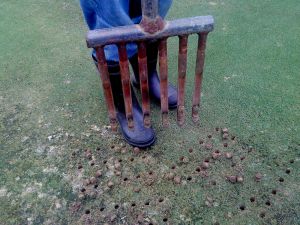
    Menebuk lubang di kawasan berlumut. Lumut adalah simptom kelembapan tinggi. Bantu air mengalir di kawasan berlumut.

    supaya membantu air dan udara untuk masuk kebawah. Tebuk sekurang-kurangnya setengah inci (asalkan tembus thatch).

  7. Sembur agen pembasah tanah (soil wetting agent) untuk membantu air turun. Sembur pada waktu tanah tidak tepu dengan air.

Sentiasa baca label, gunakan pekera yang terlatih dan gunakan akal sebelum menyembur sebarang jenis bahan kimia ataupun baja. Jika ragu-ragu; hubungi Pakar Rumput.

Posted in Fields, Golf Course, Lanskap, Padang Golf, Rumput halaman rumah, Taman | Tagged: , | Leave a Comment »

Good greens: a price to pay

Posted by mynormas on December 7, 2011

Get your copy of Asian Golf Busines


There is a price to pay to being the perfect or keeping a golf course in perfect condition. And it is not just about the money. It is also the cost of using all the extra chemicals, fertilizers and cultural practices to the environment. I guess the next time we hear someone comments about the state of Malaysian golf courses, at least we can say “Our golf courses are safer for our environment”. Yeah. Right.

One article in the latest issue of Asian Golf Business discusses about whether golfers are spoiled in wanting nothing at all to spoil their golf game – in the context of golf course conditions.

I do agree on one thing: most golfers want green speed faster than what they can handle. I never could understand that. Even at 8feet they will be 3-putting and they want the greens to be at 9feet.

Get your copy of Asian Golf Business Nov/Dec 2012 for the full story (about the golf course conditioning, not the golfers).


Posted in Golf Course, Golf Course Superintendents, Maintenance | Leave a Comment »

Golf Malaysia: An interview.

Posted by mynormas on November 25, 2011

In November 2011 issue of Golf Malaysia, I talked about why golf courses (this applies to homeowners too) who don’t think they can’t afford high maintenance cost in the future, should stick to local grasses.  Why bother spending so much money buying and growing in imported grasses during the initial construction – or renovation – and then let it all go to waste in the next five years due to poor maintenance? I know:- some people will argue that “the grasses are actually not imported, we bought/got them from a neighbour” but it is still grasses that came from overseas and require high maintenance.

But why not plant local grasses or grasses that have adapted to local conditions that will require cheaper maintenance? After all, the first part of Integrated Pest Management is about selecting the right plant for the location.

It is a long interview. What you see here is only the 1st page. Get your copy at the newsstand and most respectable golf clubs or Pro-shop. Or go to http://www.golfmalaysia.com.my to subscribe.

Posted in Golf Course, Golf Course Superintendents, Padang, Padang Golf, Rumput secara am, Taman | Tagged: , , , , | Leave a Comment »

Weeds

Posted by mynormas on November 18, 2011

Most people don’t pay too much attention to those grasses that don’t seem to belong to the rest of the grasses surrounding them. The reason being those grasses doesn’t usually impose themselves on people.  Other than aesthetics that is. Even if the grasses seem – at first glance – to be similar, there is that slight difference in colour, texture or something that makes people dislike.

What are these grasses?  How did they come to be where they are?  Why are they left alone?  How do we get rid of them? Should we get rid of them?  What are they called?

They are called – other than the colourful names some people use to describe them – weeds.

A weed is defined as a plant that grows where it is not wanted. So, because of the  definition, a rare black orchid growing in the middle of a fairway would be attacked by changkul-wielding workers before we can finish saying “Rare black orchid is a weed?” Similarly, a banana plant three feet from the pin on a green is a weed, never mind the nutritional qualities of a banana.

These weeds are called ‘sedges’ and they love wet areas.

Weeds are transplanted in many ways. Assuming a particular golf course or field or taman is constructed, planted and maintained to perfection (this would presumably be on Planet Krypton), weeds can be transported by wind, animals, water, humans or machinery.  Sometimes it could also inadvertently be transported by the maintenance staff when they borrow a machine or equipment from another place. This does not only necessarily mean from one golf course to another, but also from one hole to another in the same golf course.

Why Weeds Happen – During Construction.

You would think that no one would plant a weed on their field. No one intentionally would; but sometimes that’s what happens when the owner/manager purchases new planting material like seeds, stolons or sods. To cut cost the planting material might be purchased from the nursery that gave them the lowest quote.  Chances are that these nurseries may not apply the best management practices to ensure weed-free materials. How else can they quote so cheap?

Are they planting pure grass stolons are are there weeds seeds mixed in? Did you check? By now, can anyone check?

What some nurseries do is to regularly mow their plots to keep most weeds down to the same height as the surrounding grasses.  And when they smell a potential sale, they do a hurried manual weeding job before the buyer’s representative arrives for an inspection visit.

For golf courses, this may be the same scenario if we get our planting material – especially in big quantities – from the award-winning golf course that our boss has friendly relations with.  You don’t think they will rip off their best greens and fairways to give us the stolons do you?  You might as well ask for their right arm.  We may get away with getting the stolons during their renovation works like hollow-tining or verti-cutting.  Just be aware that it’s almost impossible to be weed free on all 18 holes (we are not on Planet Krypton) and a verti-cutter machine going on a weed the size of the palm of your hand will create hundreds of tiny baby weeds waiting to sprout on the golf course.

Actually, the story can begin long before the first planting material is purchased.  It starts when the soil is being prepared for planting.  When the earth was pushed to make way for a golf course, or when the soil is expertly shaped waiting for the planting of the seeds or stolons of the chosen species of grass, it contains planting material of many different species of plants. Each and every viable seed is a potential weed waiting for the right time to sprout.

There are, of course ways to treat the soil – from simply turning the soil over to expose the seeds to sunlight to the complex way of covering it with plastic sheets and injecting it with chemicals – which, by the way, should only be done by licensed applicators.

If you are planting your own field/lawn visit the nursery, ask the supplier to show you which part of nursery they want to harvest for you, then on planting day, insist that they do NOT harvest before you or your rep being there. You don’t want them to show you one part of the nursery then harvest from another part to plant in your field/lawn.

Why Weeds Happen – During Maintenance

As so often is the case, an ill-advised attempt at cost reduction is usually the root cause of many evils when aesthetics is one of the performance indicators.  You will hear me repeat this line often: nothing is free in this world; we will pay for it one way or another. Maintain the grass poorly, it will not grow well and, in this instance, will provide an opportunity for weeds to move in.  We will eventually spend money to remove the weeds from the golf course. This paragraph will still hold true when I write about disease or pests in the golf course in future articles.

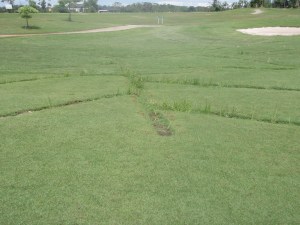
Poor maintenance can cause weeds, this drainage line was left open. So weed came in.

In short; do not expect the maintenance staff to cut costs to the point the grass’ health suffers.  Starve it if you must. But make it suffer it you mustn’t.

In the quest for being environmentally friendly, some golf courses used organic fertilizers to feed their grasses. Now, these organic fertilizers are good food for the soil as much as it is good for the grass, but if we calculate on the amount of nutrient it can deliver, it may prove to be quite expensive. Fertilizer made from organic products that are not properly treated may contain weed seeds. Chicken dung and other animal waste or even products made from plant waste may be contaminated at source or during the process to turn it into plant food.

There is a legend of how a Superintendent of a golf course placed an order of several tons of processed chicken dung fertilizer.  The purchasing clerk, who with good intentions, believes that all chicken dung are alike proceeded to buy the cheapest one available.  The cost of weeding the golf course in the months afterward probably is much higher than the savings on the purchase of the fertilizer.

Weeds can occur in places where there is compaction, such as high-traffic area. Or wet/damp areas. Or dry sandy areas. Different weeds will thrive and specialise in different areas.

The Cure

So now you know where weeds has its roots (pun intended) and you want to roll up your sleeves and ask your maintenance staff on how you can help fight this scourge on the grass field.

How does the staff take care of the weeds?  He/she has quite a few things in his arsenal. First and foremost are the mechanical means, which includes sending an army of labourers digging up the weeds with small screwdriver-like implements. It works to a certain extent; at the very least it controls the population of the weeds. More often than not, the staff may miss out the small ones or neglect to dig up the roots which may sprout again. But if you have the budget, this would be one of the best ways to get rid of them.

Another option would be to use chemicals. And there are plenty of chemicals; ranging from those to be used before the weed seeds germinate – called pre-emergent – to those designed for use on living weeds – called post emergent. Most weedicides or herbicides, for this is the category the chemicals used to kill weeds is called, belong to the post-emergent type.

More often than not, the staff will choose a ‘selective’ herbicide; these are the chemicals that may spare the original grass and kill a certain type or family of weeds. The danger is that if the wrong mixture or rate is used, it may kill the original grass itself.  You might also note that even if it doesn’t kill the original grass, there may be a slight discoloration that will be visible for a week or two.  The opposite of a ‘selective’ herbicide will be a ‘kill-all’ herbicide, for want of a better word.

The staff can also choose to use either a contact herbicide that will kill the weeds it is supposed to on contact or he can choose to use a systemic one, which will be absorbed through the plant and start to kill from within. If he chooses a contact, he may need to use a reliable sprayer so that full coverage can be effected. Otherwise, the herbicide may only kill parts of a grass instead of all of it.

Please be reminded that all the above information is only a fraction of a branch of knowledge used by maintenance staff.  For more information regarding herbicides in particular or weeds in general; get in touch with me.

Posted in Fields, Golf Course, Greens, Landscape, Lanskap, Taman, Topdress | 12 Comments »