Turf Matters

The Site To Go To For All Your Turf Matters

  • Facebook Likes

  • The new Brushcutter

    Pengganti Brushcutter

    Increase productivity, cut labour. Try the AM61A

  • Trees Nursery

    Forest trees nursery

    Get your Trees from this nursery

Archive for the ‘Golf Course’ Category

Tournaments

Posted by mynormas on September 23, 2015

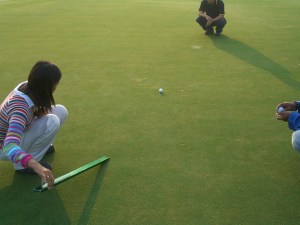
Stimpmeter

Measuring green speed

What are the odds of two clients having big tournaments at the same time? Both tournaments are a month away and both courses have yet to reach their top potential.
The most important issue that springs to mind when its about tournaments is green speed.

When it comes to green speed the knee-jerk reaction is of course to reduce the cutting height. Even when the greens are vulnerable and the weather is hazy.

So I told one Superintendent “Raise your cutting height” and I swear I could see his face change colour. When he starts to fiddle with his phone and his body turns away from me, I knew I may not get the cooperation we needed.

“Raise the cutting height TEMPORARILY by only 0.5mm” I added quickly “then about ten days before the tournament, we can reduce it again”. I detected relief and a nod of agreement.

“In the meantime, we’ll do light dusting, light dethatching, systemic fungicide and insecticide, measure the speed of all greens once a week for the next month, reduce the amount of fertiliser and change the frequency, and do spot topdressing on those areas we discussed. And manual aeration on those newly sodded areas”

In my experience, usually the bigger challenge is not about increasing the greens speed but in ensuring the consistency of the speed on all 19 greens (don’t forget the practice green has to be of the same consistency as the greens on the course).

Firstly, in the context of Malaysian golf courses, not all greens are of the same grass and different grasses (and we could be talking REALLY different grasses here) will respond differently to what you do, whether cutting down on the height or applying growth regulator and/or potassium silicate. Or whatever else and whyever.

The greens too are constructed to different standards by different people at different times who usually claim them to have built them to  the same specification. So you roll the greens or double roll them and some greens will have a faster speed than others and some greens will just harden.

The trick is to do what you are going to do during the tournament before the actual tournament and see what happens to the end result.

Yeah, there is plenty of stuff to tell about preparing the course for tournaments and somehow, I lost the plot somewhere in the middle of this post. Oh well, my target is to publish one post a week, so I might as well put this up anyway.

Do feel free to share your experiences. Take your time. Not everyone all at once now…

Posted in Golf Course, Golf Course Superintendents | Leave a Comment »

Tercabar.

Posted by mynormas on September 14, 2015

“Anda tidak layak untuk bekerja di padang golf”. Saya dengar ayat itu dua kali dalam dua bentuk pada tahun 1993. Kali pertama adalah dari Course Superintendent bangsa Malaysia yang memberitahu seorang pelawat – di depan saya – dan kali kedua ialah dari pengganti beliau, seorang warga Australia yang memberitahu saya di depan muka saya di tee lubang 2 Valley Course.

Maksud mereka mungkin sama, tetapi cara mereka menghadapi nya adalah berbeza; Orang pertama telah mengambil tindakan untuk tidak mengendahkan saya dan terus memberi arahan kepada para pekerja melalui dua orang supervisor. Tugas yang di beri kepada saya hanyalah semata-mata untuk pusing padang selepas hujan dan check bunker mana yang bertakung air.

Manakala, Course Superintendent dari Australia itu telah mengarah saya dan seorang lagi Asisten Superintenden untuk membawa mesin padang golf sebagai operator biasa. Rakan saya itu, saya akan panggil dia sebagai Mr. T, telah mengambil tindakan untuk berhenti kerja dengan berkata “Aku ada ijazah, kenapa mesti buat kerja ini?”.

Saya telah menerimanya sebagai satu cabaran. Sebelum masuk kerja di industri golf, saya bekerja di industri perladangan dengan jawatan Penolong Pengurus Ladang yang selau di panggil ‘Tuan’ oleh pekerja biasa dan sekarang saya akan membuat kerja sebagai pekerja biasa.

Bukan saja saya bawak mesin, saya juga di beri tugas untuk ‘cuci’ spinkler di 18 lubang. Saya kena buka sprinkler dari atas, keluarkan internal (isi) nya, pecahkan saringan (filter) di bawah sprinkler, seluk tangan sampai ke siku untuk keluarkan sisa saringan, bukak air supaya apa yang sumbat akan keluar dari bawah sprinkler, kemudian pasang balik semua. Ulang beratus kali lagi. Ada satu hari tu, seorang pekerja tak sampai hati tengok tangan saya luka dan ambil screwdriver dari tangan saya untuk ambilalih tugas. Ego saya nak ambil balik, tapi akhirnya saya mengalah…

Yang paling mencabar ialah kerja menyembur racun menggunakan boom-sprayer dan menabur baja menggunakan spreader Vicon di belakang tractor. Saya pernah masuk hospital enam hari kerana keracunan. Satu hari, sedang saya baja fairway berlaku hujan lebat, saya pun balik ke pejabat. Course Superintendent jumpa saya dan tanya “Why are you back?”, saya kata “Its raining”. Dia ambil plastik tarpaulin, tutup Vicon supaya hujan tidak masuk ke dalam spreader dan suruh saya sambung. Waktu itu petir dah mula, boleh saja saya lepak di driving range atau poolside cafe atau starter hut tetapi saya habiskan juga baja fairway lubang 12 dalam hujan lebat dan petir. Bila saya balik dalam basah kuyup, dia tunggu saya di depan pejabat. Dia kata, “I know its raining and all, but I need you to do this”. Masa tu, Tuhan saja yang tahu dalam hati, tapi kemudian, saya tahu ketahanan saya menghadapi kesukaran kerja, antaranya datang dari situ. Itu hakikat kerja di padang golf; cuaca yang tidak menentu. Kalau hujan sikit kita yang lari dulu, apa cerita pekerja kita?

Bukan niat post ini untuk saya bangga diri, tapi saya ingin menekankan bahawa untuk kerja di padang golf sebagai supervisor atau superintenden dan sebagainya, kita perlu tahu pengoperasian, penggunaan dan penjagaan mesin yang ada di padang dan buat kerja di padang.

Jangan nanti anda di cabar secara langsung oleh pekerja (tidak akan selamanya pekerja anda adalah orang asing) dengan dia kata “Cuba kau buat! Aku nak tengok!” ataupun secara tidak langsung bila mereka mogok atau tidak datang kerja dan anda sendiri kena bawak mesin. Jangan juga di perbodohkan pekerja. Saya masih teringat ketawa pekerja kerana Mr. T tidak jumpa cari kunci untuk hidupkan mesin ‘sweeper’; mesin itu sebenarnya tidak menggunakan kunci, ia gunakan sistem push-start seperti yang ada pada banyak kereta moden sekarang. Mereka sengaja tak beritahu dia kerana dia tidak tanya mereka dengan baik.

Kalau anda boleh buat apa yang mereka boleh buat, bukan sahaja hormat mereka akan meningkat, tetapi keyakinan diri anda juga akan meningkat.

Di masa yang sama, mereka tidak boleh lagi memberitahu anda tentang kerja sewenang-wenangnya. BIla saya masuk kerja sebagai Superintenden di kelab baru, pekerja memberitahu saya bahawa mereka mengambil masa dua hari untuk potong fairway di 9 lubang. Selepas sebulan, saya ajar mereka macamana nak potong dengan betul dan dalam masa singkat, mereka boleh siap 9 lubang dalam sehari dan fairway lebih cantik dari dahulu. Mereka bukan pekerja baru; seorang pemotong fairway dah ada pengalaman 7 tahun. Samada mereka sengaja menduga saya atau mereka tidak di latih dengan betul. Kedua dua itu dapat saya atasi kerana saya sendiri boleh bawak mesin.

Saya juga akan bawa multi-use tool yang ada pisau, screwdriver, plier dan sebagainya di pinggang untuk membuat pembaikan kecil di padang. Saya tiada masalah untuk baring di bawah mesin (selepas ambil langkah keselamatan) untuk lihat apa yang rosak.

Kita tidak perlu boleh bawak mesin sehebat pekerja yang sepanjang hari bawak mesin. Kita tidak perlu se’terror’ operator yang dah 20 tahun bawak mesin green. Tapi kita tidak boleh tidak tahu bawak. Itu saja. Kita mesti boleh nampak yakin untuk duduk di kerusi operator dan hidupkan engine dan potong bila perlu. Saya selalu kata “Bagi saya dua minggu, saya boleh buat apa yang awak buat”. Dah cukup. Mungkin bunyi macam cakap besar, tapi saya yakin boleh.

Ini semua, saya berterima kasih kepada apa yang di buat oleh Martin Greenwood, Superintenden dari Australia yang memberi saya pilihan; bawak mesin masuk padang atau bawak kereta keluar kelab.

Jangan takut di cabar. Cabaran mental kerja ini lebih penting untuk anda hadapi dan harungi dari cabaran yang anda ‘perasan’ . Kita boleh ada kelulusan tinggi, kita boleh ada pengalaman banyak, kita boleh cakap besar. Tapi, kita boleh buat ke? Cabar diri sendiri. Test and exceed your own limits. Push yourself if no one else does. When someone else push you; take the challenge.

#nevergiveup

Asalnya, artikel ini sampai ini saja dan ia di bangkitkan oleh perbualan saya dengan seorang rakan yang bercerita tentang rakan lain yang merasa tertekan bila di suruh untuk bawa mesin sedangkan mereka sudah berpengalaman dan berpelajaran. Lepas tu, terdengar cerita lain pula yang juga saya rasa mencabar, jadi sebelum artikel ni auto-publish; saya tambah sikit di bawah. Sometimes people forget that what’s posted or commented on Facebook can be seen by other people that was not the target.

Beberapa tahun kemudian, bila ada peluang untuk naik pangkat; saya telah di beritahu “You are not ready”. Memandangkan usia saya dah pertengahan 30an, saya tak pasti samada ia adalah isu perkauman ataupun kerana tiada kelulusan. Kalau ia tentang perkauman, tiada apa yang saya boleh buat, tetapi jika kelulusan, saya mau berubah.

Saya telah mengambil kelas malam Diploma in Accountancy mengikut syllabus LCCI. Saya ada tiga atau empat guru dan rasanya semua mereka lebih muda dari saya. Tapi saya takkan biarkan saya di cabar tanpa sebarang tentangan. Tiga malam seminggu akan memandu 20km ke bandar utk kelas malam dari pukul 7 sampai pukul 9 atau 10 malam. Pada bulan puasa saya terpaksa buka puasa dalam kelas, walaupun ia melibatkan hanya saya seorang, semua kawan dan guru sangat supportive.

BIla saya lulus periksa, saya bawa sijil ke kelab. Kelab itu dengan baik nya telah membayar kos belajar saya; memang saya terkejut tetapi sangat lah saya berterima kasih. Bukan itu saja, saya juga telah di naikkan pangkat. Tapi kena share: dua orang di naikkan pangkat, saya jaga ‘back room’ departments dan sorang lagi rakan yang hampir 10 tahun lebih muda dari saya akan jaga front office departments (Oh? Dia ready pulak?). Ok lah… saya terima. Kerja beberapa bulan, dapat tawaran lain. Saya pun pergi.

Di kelab baru, saya pegang satu jawatan tapi buat dua kerja. Kerja kedua adalah kerja yang saya suka dan kerja pertama adalah cabaran baru untuk saya. Oleh itu, saya terima.

Bila tiba akan ada kekosongan jawatan atasan akibat persaraan saya telah bersuara bahawa saya tidak berminat tapi saya mencadangkan bahawa kerja saya di perbesarkan untuk merangkumi kawasan lain. Saya tak kisah dan saya tahu saya tiada peluang pun tapi saya tidak suka kelemahan saya di jadikan alasan. Saya tahu apa orang cakap belakang saya tapi saya yakin dengan kekuatan saya dan saya kenali kelemahan saya. Saya terima satu panggilan talipon dari kawan yang telah di ‘headhunt’ untuk jawatan tersebut . Kawan saya tidak mahu jawatan itu kerana faktor usia tetapi dia merasa sangat marah kerana dia dapat tahu saya, dan orang-orang seperti saya tidak akan ada peluang untuk naik jawatan itu (headhunter minta dia beri cadangan calon lain yang ‘preferably’ serupa dengan dia). Saya tidak terkejut tapi saya terharu dia lebih marah dari saya. Saya masih ingat ayat dia “Eh. What’s wrong with your club ha?”

Saya ambil kelas malam lagi, belajar bahasa. Mahal untuk saya kerana ia adalah one-on-one. Tapi saya dapati ia sangat susah dan saya tahu juga ia tidak akan membawa apa apa perubahan di tempat kerja. Ia bukan tentang bahasa. So? Kenapa buang masa? Saya dapatkan kerja lain lah.

I refuse to be a victim. Fight it, or walk away. I choose to walk away. It will not be a battle I can win or make a difference. Why bother?

Saya dapat kerja di kelab yang lebih besar dan selepas itu, dapat kerja dari sebuah kelab yang terkenal tapi saya merasakan dah jemu dengan ini semua dan ingin kembali kerja di padang supaya saya boleh buat apa yang saya suka buat: jaga rumput dan jadi bos sendiri.

Saya jadi consultant. Tapi saya perlukan kelainan. Saya tak boleh tukar warna kulit tapi saya boleh tambah kelulusan dan kecekapan saya. Saya ambil periksa Pengendali Racun Makhluk Perosak dari Kementerian Pertanian, Kursus Penulisan di atas talian (http://suzannedoyleingram.com/) dan juga Masters in Environmental Science dari Universiti Terbuka Malaysia (oum.edu.my).

Will it make a difference? Honestly? Rezeki dari Tuhan. Bukan dari orang dan bukan dari kepingan kertas. But it makes me feel good to improve myself and prove other people wrong. I am not lazy. I am not stupid.

Bila saya rasa tercabar, saya akan periksa diri saya dan lihat di mana kelemahan saya dan perbaikinya. Complaining or whining won’t help. It will just make you feel like a victim and then you will feel helpless. And angry.

Never be a victim. Fight it or walk away. And when I say ‘Fight it’ I do not mean it ine literal sense. I mean that you find out what’s wrong and how you can be better or if there is a misunderstanding. Kita cari apa masalahnya dan bagaimana kita boleh jadi lebih baik atau mungkin ada salahfaham. If it is based on prejudice; trust me, any amount of fighting will only make the other party dig in and say they are right. Kalau ia berdasarkan prejudis, sebarang pergaduhan atau pertengkaran tidak akan membantu anda; ia hanya akan membuat pihak satu lagi kata mereka yang betul.

Walk away. Bila saya walk away, saya jimat tenaga dan saya kekal kawan dengan orang itu. Saya tidak rugi dan mereka tidak menang apa-apa. Saya berdoa satu hari nanti hati mereka akan terbuka dan boleh terima sesiapa sahaja berdasarkan pengetahuan dan kebolehan. Saya percaya lebih mudah untuk kita capai itu jika ia di buat secara damai dan menerima kelemahan dan memperbaiki diri.

Insya Allah.

Posted in Golf Course | Tagged: , | Leave a Comment »

Pekerja Mahir

Posted by mynormas on September 7, 2015

In my experience and from what I’ve seen; very few Malaysian golf course staff are actually formally trained. I define ‘formally trained’ as a period of time be it 10 minutes or 10 days or more where a staff is taught on what he does, where he does it, why and the machinery by a qualified or suitably experienced staff.

More often than not, a staff that stands out will be selected to operate a small machine, fo example, a bunker rake or a mini tractor. He would then gradually be told to use a bigger machine over time. This actually is good practice, except for the fact that for some of them, this would be the first machine (and for some foreign workers, they have never operatted a motorbike before) they have ever used.

How does he learn how to operate the machines? An operator who has previously operated the machine. Nothing wrong with that. Except that the same thing happened with that operator too a few years ago (sometimes a few weeks ago).

So he does not know about safety protocols whether about the machine or the areas he will be mowing. He is ignorant about machinery maintenance and the finer points of mowing. Not for long of course, remember the staff member selected is usually relatively the brightest of them there and so he does not take long to adapt and to learn from his mistakes. Yet I still see ‘experienced’ operators that mow muddy fairways, making a bad situation worse. Ok maybe that is not bad training per se but also shows a lack of common sense and/or a bad attitude.

20, 15 years ago I used to hire staff from the agriculture institute of Malaysia or IPM where they graduated with a certificate in agriculture. This used to be a three-year course where they learnt about plants agronomy, nutrition and also agriculture machinery and engines. The best part is that they are able to operate a tractor and change a tractor’s implements. It may not be that much relevant on a golf course but by the time they are on my golf course, the bunker rake is not the first machine they operate. Get it?

Unfortunately, by now their sylllabus has been changed to a two year course with the final semester being ‘practical training’ off-campus. The syllabus is now more modern with enterpreneurial and computer skils added. Good for them, but of not much use for me.

In a recent talk I gave to a group of people interested in setting up a training facility, I outlined the importance of skilled workers in the field mantenance industry (note I did not say ‘golf course maintenance industry’) where the best reason is that there is a better possibility of improving the golf course quality with skilled workers. The least important reason, I suppose, is reducing the number of foreign workers in Malaysia.

However, there are hindrances that I foresee. Big hindrances. This project of training skilled workers will not work if the employers; the golf courses, the fields, the contractors are not supportive of it. There will be plenty of reasons or excuses; those can be overcome. High turnover, high mobility, cannot work hard (read: cannot work long hours), unreliable etc, can be overcome. What will be more difficult is overcoming the notion that field maintenance is just ‘cutting grass’.

Its hard enough convincing club owners to improve the pay scale for golf course superintendents and/or hire better quality people to justify the better pay scale. It would be harder, I imagine, to convince them to hire skilled field workers AND to introduce a career path for the said workers.

But I have seen it work and the people that want to do this may have some ideas of their own to do this; retraining existing workers, for example. I wish them luck. At least some one is doing something different other than hiring more foreign workers at a problem. “Doing the same thing over and over again and expecting a different result is insanity” Remember? That Einstein guy’s quote?


Posted in Golf Course, Golf Course Superintendents, Maintenance, Padang | Tagged: , , | Leave a Comment »

This machine is mine.

Posted by mynormas on August 19, 2015

In a recent previous post and even in a magazine article, I wrote that in the month of August, turf machinery be washed extra clean, polished even, and a national flag tied to the machine; not merely as a show of patriotism but more so that the machine operators take a little bit more care for their machine instead of just hosing it down at the end of the day, every day.

Why August? Because coincidentally, the National Day of Singapore, Indonesia and Malaysia fall in this month and many of my readers are from this region (WordPress allows me to trace the country of origin of readers).

Yesterday I happened to visit one of those golf courses that did this. The superintendent told me how he picked a Saturday afternoon when most of the machinery were back at the workshop and called for a staff meeting. After the usual briefing, he told them about the programme and gave them time to wash their machines.

One operator, after vigorously washing his machine, found that he could not tie the flagpole to the machines’ roll-over bar because the roof was wider than the bar and there wasn’t any other place to tie the flag. Guess what he did? He dismantled the roof and tied the flag to the roll-over protective structure. He was willing to not have a roof for a month (the superintendent will take the flags back after Malaysia Day on 16th Sept) just for the flag. And he’s not even a Malaysian.

He took off the roof so he can tie the flag.

He took off the roof so he can tie the flag.

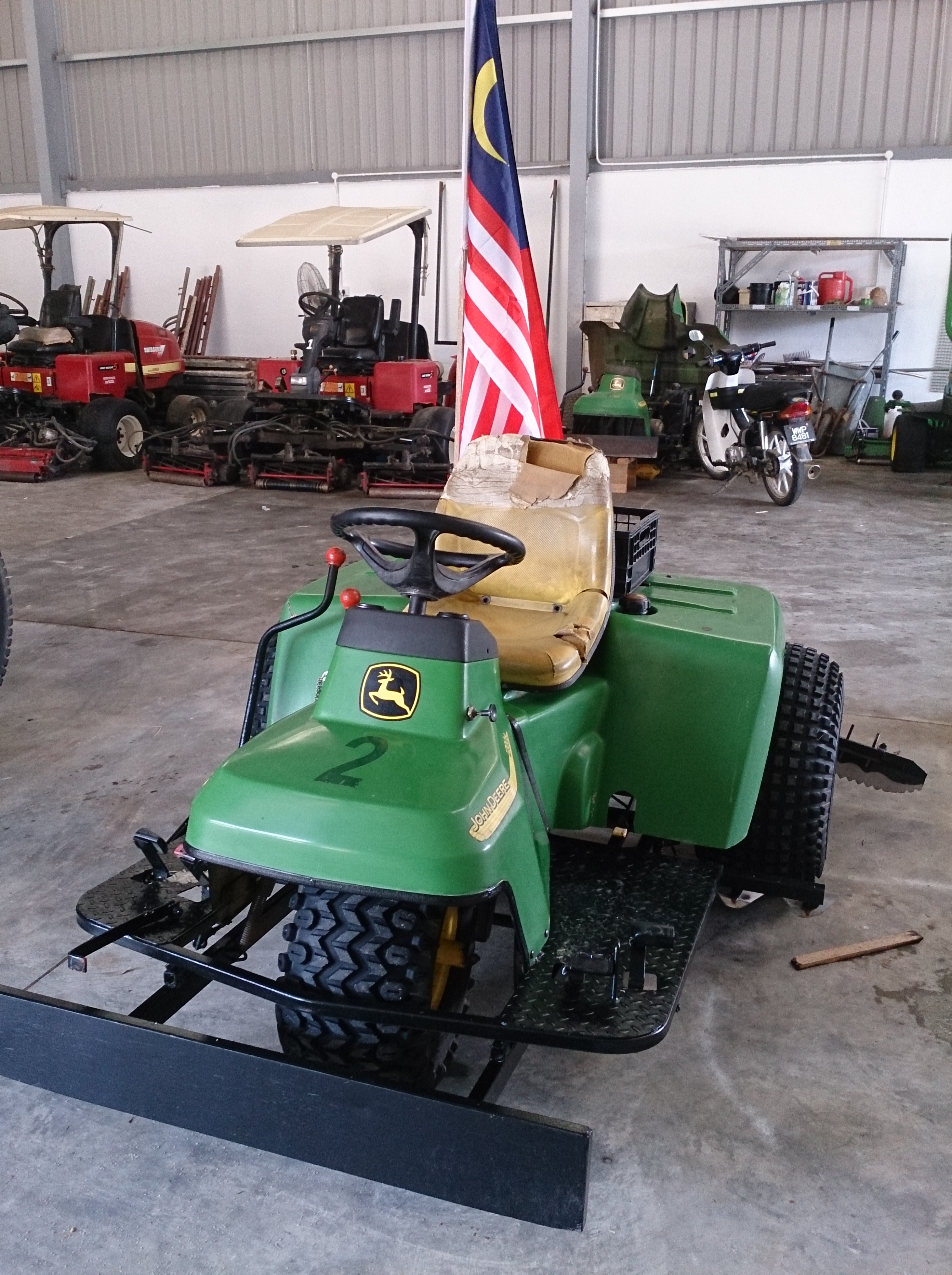
The superintendent told the bunker-rake machine operator that he need not worry about his machine because it was too small and too old to clean up. The staff member protested, not only did he wash his machine extra clean, he took some paint and painted all the metal parts of the machine – dozer blade included, black. The superintendent gave him a flag which he proudly displayed on his machine. And he’s not even a Malaysian.

He painted the metal parts black so that he can be allowed to put the flag.

He painted the metal parts black so that he can be allowed to put the flag.

The point is not about the flag but the effect that the programme had on the workers: they owned the machines. Suddenly it is ‘my’ machine and I want my machine to be the cleanest it can be because I want to put on a flag. Follow up this with a training on how to look after the machine and I’m sure the machine will last a little bit longer with less maintenance stress as compared to a machine that did not ‘belong’ to anybody. I mean, “who washes a rented car”?

I got that quote from a book I read about 25 years ago titled ‘In Search of Excellence’ written by – if I am not mistaken – Tom Peters. An example he gave was the ground crew chief of a squadron of jet fighters that had the best maintained planes compared to other squadrons. The crew chief’s secret was, instead of a crew looking after the right wing, another one looked after the left wing, one looking after the cockpit and so on, he gave them all each a plane to look after. One crew, one plane. “How did that work in creating excellence?” he was asked. His answer was that because each one of them now ‘owns’ a plane, they had a greater sense of pride and responsibility to that particular plane of theirs. “After all” he said “who washes a rented car?” I might be paraphrasing because hey, it has been about 25 years ago but I believe the gist is there.

I also believe the credit should also go to the crew chief for his innovativeness and in this context, the superintendent for his role in firing up the workers. I mean, if he had sat in his office and gave the flags to the supervisor who would give the flags to the mechanic who then gave the flags to the operators; the effect would not be the same. So what worked? Maybe it was his speech, maybe it was the look in his eyes, maybe it was because he helped wash a few machines, maybe he held a big stick, maybe he promised them a reward or maybe it was already a culture in that place, whatever it was, it got the result that he wanted. It was actually more than I imagined, I can tell you that.

Its still not too late for Malaysians, at least, because the flags can remain on the machines till 16th September which is Malaysia Day. The cheapest flags I found was at Mr. DIY (biar kami rugi asal anda puas hati) at RM2.50 each. Or we can try and do something else. Or we can try finding one excuse or another to not do anything and complain about everything. It is a choice. Up to us.

Posted in Golf Course | Tagged: , , , , | Leave a Comment »

Ogos

Posted by mynormas on August 3, 2015

Kita ada 12 bulan dalam setahun. Kepada kita yang menjaga padang rumput; bulan yang mempunyai signifikan hanyalah bulan puasa iaitu bulan yang kita lakukan kerja-kerja penyelenggaraan lebih dari biasa dan bulan Disember yang kita anggap sebagai bulan ‘puaka’ kepada mereka yang negatif ataupun kepada mereka yang positif; bulan cuti kerana ini adalah bulan monsun yang mana tak banyak kerja yang kita boleh buat. Malahan kerja rutin biasa seperti potong atau baja (pupuk) juga menjadi masalah.

Saya ingin mencadangkan supaya bulan Ogos di jadikan sebagai ‘bulan mesin’ untuk kita di Malaysia, Indonesia dan juga Singapura yang menyambut hari kemerdekaan pada bulan Ogos ini. Saya cadangkan supaya bulan ini adalah bulan di mana kita bukan sekadar guna water-jet untuk tembak air cuci mesin, tetapi di bulan ini kita akan menggunakan berus dan shampoo kereta untuk mencuci minyak lama, rumput di celah-celah mesin dan tempat duduk dan sebagainya.

Setelah puas hati bahawa mesin adalah bersih sebersih-bersihnya, maka kita pasangkan bendera negara kepada mesin itu untuk menandakan secara simbolik bahawa mesin itu sudah termasuk ke dalam kategori paling bersih.

Kita bukan mahu membuat kenyataan politik (kalau mahu pun peduli apa sama orang lain?) ataupun mahu menunjukkan berapa patriotiknya kita (kalau mahu pun apa salahnya?) tapi untuk kebanyakkan kita yang mahu tahu whats-in-it-for-me maka ia adalah untuk melanjutkan usia mesin kita dan menambah kebanggan pekerja tentang mesin mereka dan juga untuk kita menunjukkan kepada pelanggan dan kepada boss kita bahawa kita bersifat innovatif dan mempunyai inisiatif. Bukan kah nanti lebih senang untuk kita nak minta beli mesin baru satu hari nanti bila kita boleh beritahu dia secara tidak langsung bahawa kita MEMANG penjaga mesin yang berwibawa? Mesin baru tu MEMANG di perlukan, bukan kita tak tahu jaga mesin lama…

Bila boss atau pelanggan datang dan lihat mesin mengibarkan bendera, dia akan tanya; apa hal? Kita beritahu dia bahawa ini adalah ‘bulan mesin’ dan bendera itu hanyalah simbolik kepada pencucian dan kebersihan mesin di kalangan mesin lain.

Hanya untuk shampoo kereta/mobil yang berharga USD1 -2 sebotol, bendera dan batang penyapu pada harga yang sama serta cable tie  yang berapa cents untuk ikat tiang bendera itu. Kalau bulan Ogos mesin itu sangat bersih, saya yakin ia akan berterusan sehingga bulan Oktober ataupun November utk tahun ini. Dan jika ini di buat bertahun tahun, siapa tahu ia akan jadi satu tabiat?

Kepada anda yang tersenyum sinis dan berkata “Tak payah. Mesin aku memang tiap-tiap hari bersih”. Maka, kalau ikut hati saya nak menaikkan pandangan mata ke atas (roll my eyes), ketap bibir dan kata “Ya lah tu. Dah berapa lama tak masuk worsyop sendiri? Kau pukul 5 dah balik/tee-off kan?” tapi tak nak lah buat musuh kan so saya akan tersenyum dengan merendah kan diri dan kata “Ya?! Bagusnya. Teruslah pasang bendera!”

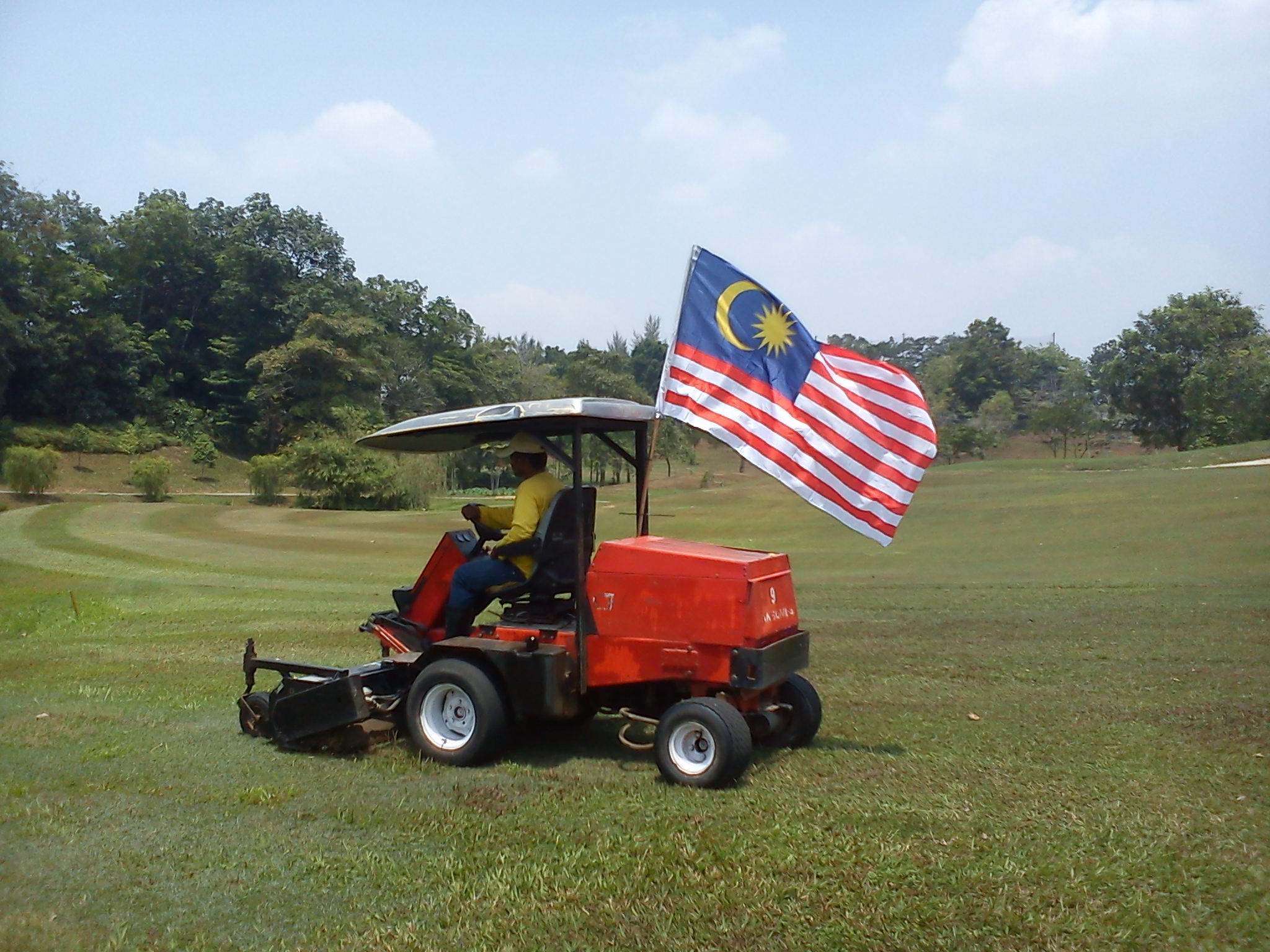
Sebuah mesin yang telah di bersihkan di pasang dengan bendera

An extra clean mower with a flag.

Nota:
Untuk menjadikan ini lebih efektif, pembersihan dan pencucian mesin mestilah di lakukan secara asing dan bukan pada lewat petang masa nak cuci mesin lepas potong tetapi pada Sabtu atau Ahad tengahari atau mungkin Jumaat petang. Jadikan ia operasi pencucian lengkap dengan ambil gambar sebelum dan selepas. Jadikan pengadilan untuk tentukan mesin itu bersih atau tidak sebagai suatu benda yang rasmi samada oleh kawan kawan pekerja ataupun anda sendiri. Tepuk tangan masa bagi bendera. Timbulkan kebanggaan. Begitu juga pembukaan/pembubaran bendera (jangan biarkan bendera koyak/kotor/lusuh di mesin; magic nya akan hilang) pada hari atau minggu selepas hari Kemerdekaan. Simpan balik supaya boleh di gunakan pada tahun berikut nya. 

Posted in Fields, Golf Course, Padang, Padang Bola, Padang Golf, stadium | Tagged: , , , , | 1 Comment »

Low Budget Success

Posted by mynormas on July 31, 2015

I attended a  meeting with a local district council and their golf club operator last month. I have worked with that operator for the past two years and was expecting to be ignored or be a scapegoat. Yet I was first praised by a club official who said “The golf course has improved a lot in the past two years; thanks to Normas”. and later on, the chairman, when talking about club’s finances also said something about how the golf course “…is now good and very different from how it was two, three years ago”. I was humbled.

If you go to the club, you – the seasoned golfer – may not be impressed but to me, it was incredible: they had only one greensmower; their main greens fertiliser, was plain quick-release fertiliser bought from the contractor who harvested the oil palm in the golf course by deducting the cost from the tonnage (that means they didn’t actually ‘buy’ the fertiliser); their pesticides were bought from the local hardware or stores that cater to the local farmers; they have five foreign workers and three or four local workers . The club had one tractor-towed-ground-driven fairway mower and two rough mowers, one of which spends more time in the workshop than in the field (note: do not buy refurbished machinery if your club is FAR from the supplier, unless its cheap enough you can buy two when you need one). It has one topdresser that is too big for the greens and too small for the fairways (note: get a third opinion before spending so much money on machinery) and until recently – and by recently I mean two months ago – no working greens’ aerator.

The toughest part of it all for me was that the person in charge; the superintendent, was someone who worked his way up almost 20 years ago in the club, not a golfer and has never been on another golf course. Ever. This made him a hard worker with good discipline and very loyal. However, it also means he sees things in one dimension and tend to drift back to old habits. I concentrated on being friends and not on being a consultant and managed to get things done. Though I suspect I won his respect because when things go bad; I took the blame even when he knew it wasn’t my fault.

You see, the boss took an interest in the golf course and after every visit I made, I have to do a presentation to him the following day and he wants to know what went on, what went wrong and what comes next. So when there were an insect attack and I had already instructed what chemical to be applied at what rates and in which order, he would assume it would be the end of it. Once or twice, that wasn’t the case and I can trace it back to wrong application or even no application but I would explain it away as a new attack or when a wrong chemical was bought, applied and the grass died, I said that I had misjudged something.  I do have a different way of doing things compared to most Superintendents and adding that to this Superintendent’s experience would give him a steep learning curve.

The operator was a rags-to-riches kind of guy and quitting wasn’t in his vocabulary, he chose to want to succeed and I suppose, that was the main driver for the improvement in the golf course. Its not the best golf course in the country yet and is at a precarious balance so I wouldn’t recommend the kind of knife-edge work to any other club, but for it to come from greens with no grass to healthy grass shows what a willingness to improve can do even at low budgets. If they can, you can. Call me.

Posted in Golf club, Golf Course, Golf Course Superintendents | Tagged: , , | 1 Comment »

Lubang Golf

Posted by mynormas on June 24, 2015

Di antara pembaca laman web ini adalah pelajar yang sedang belajar tentang penjagaan padang golf dan saya cuba mengisi kekosongan rujukan dalam Bahasa Malaysia. Kebanyakkan terma yang digunapakai adalah dalam Bahasa Inggeris dan terjemahan yang di gunakan biasanya tidak di terima secara meluas oleh umum.

Kadang-kadang kekeliruan timbul contohnya dalam perkataan ‘lubang’ yang membawa maksud satu daripada 18 lubang di padang golf itu ataupun lubang di mana bola golf itu di masukkan. Kekeliruan ini pun biasa wujud dalam bahasa Inggeris dan mudah di selesaikan berdasarkan konteks ayat. Tapi saya cadangkan untuk mengelakkan kekeliruan di kalangan pelajar ataupun orang yang tidak bermain golf (dan tidak faham konteks) kita gunakan ‘L’ besar untul lubang yang menunjukkan nombor (Lubang 1 atau Lubang 7) dan ‘l’ kecil untuk lubang yang di masukkan dengan bola golf di setiap Lubang.

Satu lagi ialah perkataan “tee box”. Saya faham perasaan Dr. James Beard dalam satu seminarnya yang saya  hadiri 20 tahun dulu bila dia cuba menceritakan bahawa asal perkataan ‘tee box’ ialah pada zaman dahulu, tempat bermula pukulan suatu Lubang ialah sebaik sahaja selepas green Lubang sebelumnya dan tempat bermula pukulan (sekarang di panggil tee) hanya terdiri dari sebuah kotak berisi pasir. Pemain golf akan mengambil pasir dari kotak tersebut, membuat suatu busut kecil, meletakkan bola golf di atasnya sebelum pukul. Kotak pasir itu ialah ‘tee box’.

Sekarang, tee di sediakan khas untuk pemain maka perkataan yang di gunakan seharusnya ialah ‘teeing ground’ (seperti dalam buku undang-undang golf) atau di pendekkan kepada ‘tee’ sahaja. Saya kira terlalu ramai orang menggunakan perkataan ‘tee box’ yang ia kini telah di masukkan ke dalam kamus golf harian.

Ambil perhatian bahawa setiap padang golf akan mempunyai polisi nya sendiri tentang bahagian bahagian di setiap Lubang nya; samada dari segi ketinggian rumput ataupun memberi mereka perincian lagi seperti contohnya mempunyai collar untuk green, mempunyai apron di hadapan green ataupun mempunyai collar di fairway. Tapi apa yang saya berikan berikutnya adalah bahagian asas suatu Lubang di padang golf.

Untuk rujukan perbezaan di antara water hazard dan lateral water hazard; sila lihat di sini. Atau di Youtube jika perlu gambaran lebih jelas.

Tertakluk kepada polisi, kemahuan kelab dan kadang-kadang, keperluan pertandingan.

Tertakluk kepada polisi, kemampuan kelab, kemahuan pemain dan kadang-kadang, keperluan pertandingan.

Posted in Golf Course | Leave a Comment »

Licence to Kill

Posted by mynormas on June 8, 2015

Very few turfgrass professionals in Malaysia realise that there is such a thing as a licence to apply pesticides. Except perhaps suppliers who have to have a licence to keep pesticides in their stores; they would be aware because it is given by the same body which is the Department of Agriculture.

Wait. What? You’re a supplier and you don’t have a licence to store pesticides? Oops. Well, perhaps because nobody checks so nobody knows. Except that recently a client who was worried about using pesticides that are irresistably cheap they actually kill – not only the target pests – but the grass as well, have asked me to narrow down specifications for pesticides and the three things that I can think of were to find chemicals that are registered with the LRMP (Pesticide Board), have MSDS (Material Safety Data Sheet) and buy from suppliers that have licences from DOA. So maybe one day, your customers will ask for your licence, then maybe you have to have one.

Pesticides, which includes herbicides by the way and not just insecticides and fungicides, are often used in relatively large quantities on a golf course. I say relatively because in Malaysia, it is rare to find them being used on fairways which is about 50% of a golf course never mind roughs (30%?) so for most of Malaysian golf courses; pesticides are restricted only on greens which constitutes about 5 – 10% of the golf course – ditto fertiliser (does that solve the mystery of Malaysian golf course quality for you?) – and because of Malaysia’s rainfall and humidity, the greens’ grass are quite often infected so we are still talking about a big amount of pesticides; though not as big as if it is also applied to fairways and rough hence the word ‘relatively’. Get my drift? Pun intended.

Despite applying mostly on greens, pesticides can consume up to 10 – 20% of the material cost on the golf course maintenance budget.

Even though the greens constitute only about 5 – 10% of the golf course area, golfers spend about 75% of their game on the greens so the greens are considered as the most important part of the golf course and the most highly maintained. It also means that golfers spend a lot of time on the most pesticide-applied area of the golf course. Constant exposure to pesticides can cause a multitude of reactions to different people; some are harmless and some can be dangerous. Of course a low level of exposure to a very toxic pesticide may be no more dangerous than a high level of exposure to a relatively low toxicity pesticide; so most of the risk is assumed by the applicators themselves. But still, I feel that golfers must beware the grass they are playing on is applied with chemicals that are potentially toxic. Then there’s also the risk of pesticide ‘drifting’ when applied at the neighbouring holes.

So we would expect that because of the risks to the applicators, to the greens, to the golfers and to the environment; most golf courses have applicators that are specially trained in this area with special equipment; right?

Not really…

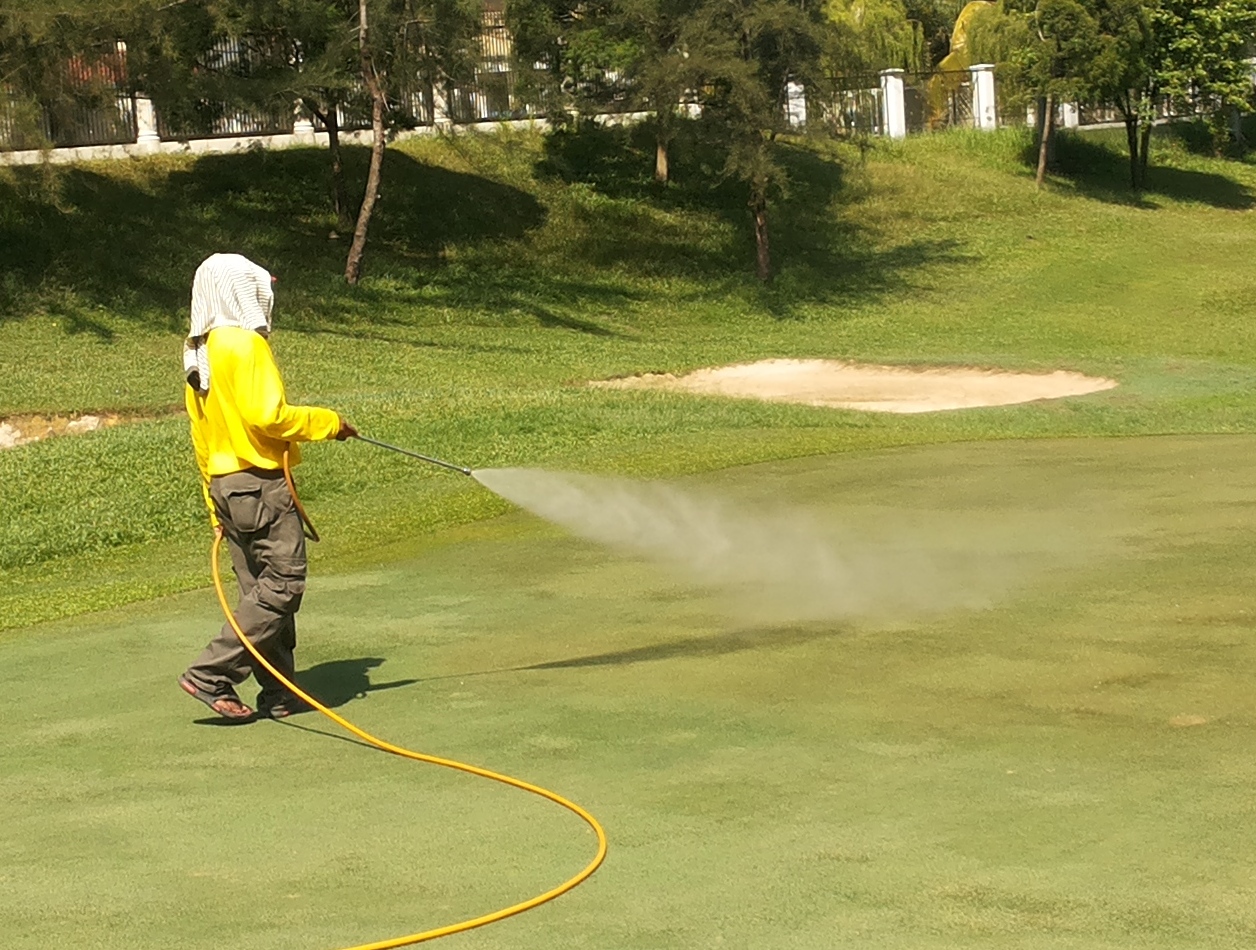
Spraying greens with knapsack sprayer

Spraying greens with knapsack sprayer

Spraying iwth walking boom.

Spraying with walking boom.

Manual spray in progress

Manual spray in progress. Note the amount of spray coming out. How to know how much was sprayed in one area?

I’ve always find it strange and slightly worrying that the concept of ‘calibrating’ of sprayers are not common among Malaysian pesticide applicators, be them golf courses or even football fields. How do you know how much pesticide you are using or have applied? How do you know you have sprayed once or overlapped?

I suppose most of us have seen the application of chemicals so often that we are immune to what is wrong or right.

Unfortunately, the applicators licence issued by DoA are not compulsory on golf courses because they are considered as private property and the licence are compulsory for applicators in public property such as houses (for pest-control companies) but wouldn’t it be nice if ALL golf courses and football fields in Malaysia have trained pesticide applicators? Wouldn’t we feel safer?

I conduct a two-day hands-on training limited to six person to a class at your golf course with your current equipment (which means I can evaluate it too) so if you want to make sure that your grass gets the right amount of pesticide to treat the disease/insects/weeds, I assure you, the cost of using too much or the wrong chemicals is much, much higher than the cost of training. Call O3-5I3I OO66 or email mynormasATconsultant (AT=@) now.

I had to brag (liar) but I'm probably one of the few in the industry in Malaysia that has an applicators licence.

I hate to brag (liar) but I’m probably one of the few in the turf industry in Malaysia that has a pesticide applicator’s licence.

Posted in Golf club, Golf Course, Golf Course Superintendents, Greens, Lanskap | Tagged: , , , | Leave a Comment »

The Biggest Office

Posted by mynormas on June 3, 2015

This picture? The

This picture? The “Golf Course Superintendent” sign? Totally not photoshopped or tricked out in any way.
To be fair, the super has moved to new facilities; thanks to new management and they went on be one of the top clubs in Malaysia.

Reading or writing by squinting through one eye is a bummer; I’ve had to go through a minor operation on one eye due to cataract yet I really felt the need to say something about this issue. This past week I’ve had four discussions about Malaysian golf course conditions  (I know thats what you go through in a day but bear with me) and all of it relates to the man in charge, commonly called as the golf course superintendent. In Malaysia, they are also referred to as the golf course manager, supervisor, director or assistant superintendent but the fact remains, they are in charge. I divide them into a few categories:

  1. Superintendents who don’t know what to do
  2. Superintendents who won’t do
  3. Superintendents who can’t do
  4. Superintendents who’s knowledgeable, can and will do.
  5. The corrupt.

It has been said that the golf course superintendent (or whatever the designation) has the biggest office in a golf club; anything between 120 to 300 acres. He, other than the club manager, should be the highest paid person in the club. Such privileges do not come easy; on his shoulder rest the reputation and prestige of the club and he is responsible for the highest expense department, not to mention taking care of the item with the highest construction cost; the golf course.

Right about now I can hear the cliché already; “it is a team effort”. Of course it is, but the team would have to be led by someone that needs to know agronomy, plant pathology, soil science, entomology, agriculture engineering, hydrology, not to mention golf rules and even golf itself. No? Then how is he (or she) to know about plant health, fertility, insects, drainage, machinery, irrigation and how to set up the golf course?

Cliché alert: “It’s not rocket science”, “it’s just growing grass”, anyone can do it bla bla bla. For these managers/owners, I say good luck in managing your clubs but actually, these are the minority. The majority of clubs know that maintaining a golf course takes a knowledgable person with skills. Here’s the tricky part, many clubs know that and want to hire them, but most clubs do not seem to recognise or respect what they already have and I mean this as recognition to both sides of the argument: some superintendents are lacking in knowledge but are still retained, some superintendents are in their comfort zone (and still retained) and some superintendents know what to do but do not get the support and respect they deserve. Of course, there are some who are knowledgable and are supported.

I’d love to comment about the superintendents who are lacking in knowledge but I won’t. Sometimes I can’t help but pity them; for the most part they were thrown into the deep end because of their good work in a previous position or loyalty (or they can’t find jobs elsewhere) and really don’t know what to do except repeating what their predecessor have done or what they think what their predecessor have done and what the suppliers advise. Somehow I can’t find in my heart to blame these people, they were examples of the Peter Principle: people who were promoted and promoted until they reach the level of their incompetence. To these clubs, there is hope because these people in general have good attitudes and are hardworking (hence the promotions), so send them to seminars, courses or pay for them to attend classes (I had a club willing to pay for my Diploma in Accountancy which was of no use to them at all!) or send them to a neighbouring club once a week or month to learn from the superintendent there; or pay the superintendent to come over to teach – just make sure you know the superintendent’s background too.

I’ve also met superintendents who are – on paper – knowledgeable but have voluntarily capped their limits at a certain level. They would not do more than that level, never mind the condition of the golf course. There are of course, justifications and reasons for it: no budget, interference, not enough workers, the weather, poor construction bla bla bla. Have a chat with them and you realise that it is easier to play the victim’s role in a blame game. You get told the idea that this is a hopeless situation even if you know of other clubs who faced similiar circumstances yet are in better condition. This also means that the golf course’s potential is also capped at that level and would not rise any time soon. To the clubs that hired these superintendents; tough luck. No seminar I know will change your golf course. No consultant or adviser too, unless the reports are discussed with the bosses; then maybe there is a chance. I’ve seen that happen, then again, I’ve also seen where the report was discussed with the boss; and the little that was done was to cover the bigger things that was supposed to be done but not, and after listening to the old story of “why it can’t be done”, the bosses gave up (thats part of the problem anyway) and things go back to what it was. To these clubs: good luck. Some superintendents in this category have been … wait: no… a MAJORITY of these superintendents have been in the same club for a very very long time.

What? You don’t know what I’m talking about, but yet your heart rate is increasing, temperature rising and you are upset? That, sonny, means you DO know what I am talking about; you’re just in denial. Okay fine, there are some superintendents who are in one place for too long with their golf course is in good condition. Happy? I’m talking about other clubs where the condition is poor and it is always someone else’s fault. But now that we’re at it, how about taking your club up another notch? Perhaps the weeds on the fairways? The greenspeed? No you can’t? Because of (insert excuse here) right? I rest my case.

The third category of superintendents is the one I pity most. He (or she, I know of one lady super) can usually get a job elsewhere but to him (or her) this job is a challenge to his/her ability and they just want to give it a try. These superintendents are usually  young or relatively new at the club and usually are up against a culture or a bureaucracy that has dug in, fortified and willing to fight to not change. Buying a fungicide that the superintendent needs to apply by the end of the week will take three weeks to process because it has to be justified, three quotations have to be searched and that one form needs to have three (or five!) signatures from three or five levels up and those people are usually not at their desks because of course they are in charge of other projects too. Or the superintendent is regarded as an outsider, an alien, an aberration even. Or a club that can only make decision after a committee meets which is usually at the end of the month… maybe three. Then there are clubs with real issues, for example; a non-responsive workforce – for want of a better description – they have the numbers but they can only work certain hours and at certain limits, never mind clubs with a small work force. Or a club that really tie their superintendents down with a very low budget. Just in case you think I am contradicting myself with superintendents in the second category, be advised that superintendents in this here third category, are still putting up a good show despite their restrictions.

Clubs with these two challenges (1. the non-performing superintendent as well as workforce – because it permeates into the department’s work culture, I promise you – and 2. the club with plodding bureaucracy or work culture – because it permeates into the club’s work culture, I promise you) are good candidates for the golf course maintenance contractor. No kidding. Hire one company to maintain your golf course and you will rid yourself of non-performers and plodders; and consign your golf course to forever be average. What? You think these companies were set up to serve golfdom and golferkind while turning your golf club into the best? No, they were set up to make a profit, so they think fast on their feet and are super-efficient for their own good but it will translate into comparatively better golf courses for you, at least for the first year and the final year of the contract. After which you are ‘doomed’ to appoint a contractor again because you don’t have the know-how and lets face it, you don’t know what went on the past five years anyway.

Someone is upset reading this is it? Lets be realistic, to look for the ‘right’ contractor, you are going to call for a tender exercise which will primarily focus on the cheapest tender after which you will negotiate again until the guy with the cheapest price hurt his knee begging you to stop: so of course lah the contractor will work his a$$ off to beautify your golf course without cutting any corners. Right? Unless – dare I say it? Oh heck, there are some people who will thank me – the contracting company is orang putih/gwailo/angmoh; then we will be the one on our knees begging. And the golf course will be better than average while some of us wonder why the expats do a better job than locals. No, not really about skin colour or just about the budget too. Find out why in the next category of superintendents.

I would be remiss in my ranting to not talk about the fourth category of lucky superintendents and their clubs. The superintendent who knows what to do or if they don’t; they find out, they are willing to do what it takes and they are allowed to do what it takes as they see fit. They are working for clubs who say things like “What? You need a new RM180K fairway mower? We don’t have the budget now but can we talk about it and see if we can postpone or perhaps look for a reconditioned mower or repair what you have now?” Or “So you need to hollow-tine the greens next month eh? Let me talk to the tournament organiser and see how he feels or if he wants to postpone or if he is willing to continue if you use smaller tines/do half of the greens”. In the world of management it is called ‘discussion’.

Did you notice that the two top clubs in Malaysia routinely get their superintendents on stage during award presentation ceremonies? Even if its held overseas? You think that’s because of gratitude to the superintendents’ efforts? No, that’s the mark of the attitude of the clubs to the superintendents’ office. It started long before that walk up the stage. It causes the walk. Not the budget. Not the machinery. Not the skin colour.  Its the attitude. The respect. The clubs respected the superintendents work, decision and opinion.

Ya, ya, ya… here comes the cliche: “Respect has to be earned”. Kinda hard to sympathise or empathise with some clubs (I hesitate to use the pronoun ‘you’ here, because there are some who will take this personally) who insist on hiring the cheapest person they can, to maintain the most expensive department they have. Respect your superintendent and see the difference. If there’s no difference, then perhaps, change the superintendent (sounds harsh? It has to work both ways fellas).

This article is too long already. Is anybody still reading? Very few now I bet. So it is time to introduce the fifth category of superintendents; the ones that people know but talk about only in whispered circles. The almost-unmentionables; the Mr. 10 percent. The what-do-I-get-in-return guy. The corrupt (oh, you think that’s too harsh? Lets see if I can find another term… urm… nope).

You think every one else does it? No, you are a minority. You think because your boss/purchaser/storekeeper does it, it is ok for you to do it? No; two wrongs do not make a right. You think because your salary is lower than market rate then it is ok for you? No. It ruins your reputation to go look for another job that can pay you higher than market rate. You think because the golf course looks good you can do it? No you can’t, because it IS your job to make the golf course looks good. You think nobody knows? Wrong, the industry is small (in Malaysia) and people talk. Ok, they whisper. Behind your back.

Stop. You are ruining not only your reputation but the other superintendents’ too. You will be indebted, nay trapped, to one or two particular suppliers and you will find it hard to change because… easy money is addictive or after a while your hand in the other guy’s pocket so often that you get used to it and he becomes your twin; hard to tell where he ends and you start. Your office is his office. There’s also guilt, fear and conscience. Then the golf course stagnates because your pool of resources and ideas has shrunk to one or two companies. No doubt they’re good and the golf course is good, but it won’t get any better.

So, to improve the golf course conditions in Malaysia; to the superintendents, let’s pull up our socks, raise our game, stay clean, increase our skills, share our knowledge or find another job. To the clubs themselves, treat the superintendents as a professional, respect his position, give him authority: if you can’t, send him for training or a makeover, or find a new one. Otherwise we have to continue as if nothing is our fault and like everything else that goes wrong… blame the government.

Note:

I wrote this opinion based on my observations in Malaysia. It should not be used without evidence to point fingers to any single person, club or group or organisation in particular. Hopefully it provokes thought, if not action. Get angry if you want but do something productive we must. 

Anonymous comments will not see the light of day on this site; I won’t even read it.

Posted in Golf club, Golf Course, Golf Course Superintendents | Tagged: , , , , , , | Leave a Comment »

Ekonomik Baja

Posted by mynormas on May 19, 2015

Ini adalah isu yang selalu juga di tanyakan kepada saya: baja apa yang saya patut guna untuk rumput saya? Di dalam blog nya, Dr. Micah Woods seorang pakar rumput, dalam menjawab persoalan yang di tanyakan kepadanya tentang baja apakah yang perlu di gunakan di padang telah memberi suatu jawapan yang menarik

Gambar hiasan

Gambar hiasan

. Untuk pengetahuan; terdapat tiga atau empat jenis baja.

  1. Straight fertiliser (err… baja lurus?) iaitu baja yang mempunyai hanya satu nutrien sahaja seperti urea, MoP atau SoP.
  2. Baja campuran iaitu baja yang terdiri dari campuran baja di atas dalam kadar tertentu. Jadi ada seketul untuk nitrogen, seketul untuk phosphorus, seketul untuk kalium dan sebagainya.
  3. Baja compound iaitu baja yang dalam setiap ketul terdiri dari pelbagai nutrien.
  4. Baja organik.

Selain itu kita boleh juga membincangkan samada nak guna baja ‘slow-release’ iaitu ketulan baja yang mempunyai selaput khas yang akan menyebabkan nutrien keluar secara perlahan ataupun ia di ikat secara kimia dan di lepaskan secara perlahan.

Mengikut kata Dr Woods, pemilihan baja berbeza dari satu tempat ke satu tempat asalkan pembajaan itu mengikut keperluan rumput dan faktor utama yang menentukan samada kita akan menggunakan baja slow-release yang mahal dan mengaplikasi sebulan sekali atau seminggu sekali berbanding dengan menggunakan baja urea (contohnya) yang di aplikasi seminggu sekali atau dua kali ialah perbandingan harga dan kemampuan. Baja urea mungkin lebih murah dari baja slow-release tetapi kos penggunaan buruh mungkin berbeza dari satu tempat ke satu tempat.

Maka, pemilihan baja apa yang kita akan guna mesti di kira mengikut perbandingan kos per aplikasi dan bukan kos per bag sahaja. Itu pun kalau kita serius tentang pembajaan, selalu juga saya lihat orang yang membaja sekadar nama “Dah baja” sahaja; mereka tak pernah buat soil test dan tak tahu samada baja yang mereka tabur itu cukup atau terlebih.

Ada juga orang yang baja bila dia merasakan ‘rumput dah kuning’ dan perlu baja. Pasal tu lah Cowgrass selalu tak menjadi di padang bola kita; kerana ia secara genetik memang hijau gelap walaupun lama tak baja dan memang kurang sihat.

Jadi: kira kos aplikasi (gaji pekerja sehari + kos mesin + kos baja) bukan hanya berapa harga baja itu.

P.S. Untuk tuan rumah yang lebih selalu berinteraksi dengan saya di laman web ini berbanding dengan orang padang; saya cadangkan baja organik kerana baja organik ialah juga sejenis baja ‘slow-release’ yang akan mengeluarkan nutrien setelah di urai oleh bakteria atau mikro-organisma lain. Jika anda menggunakan sebarang jenis rumput karpet: dua bulan sekali. Jika Cowgrass setahun sekali atau dua kali. Lakukan pada masa anda mahukan rumput yang subur contohnya sebulan sebelum Hari Raya atau Chinese New Year atau Christmas atau seumpamanya yang senang ingat.

Posted in Golf Course | Tagged: , , , , | 3 Comments »