Turf Matters

The Site To Go To For All Your Turf Matters

  • Facebook Likes

  • The new Brushcutter

    Pengganti Brushcutter

    Increase productivity, cut labour. Try the AM61A

  • Trees Nursery

    Forest trees nursery

    Get your Trees from this nursery

Archive for the ‘Golf club’ Category

Know little little.

Posted by mynormas on January 29, 2018

false knowledge danger

Sometimes when I talk to people-in-charge, this thought comes to mind: “A little knowledge is a dangerous thing”.

You know who originally said that? I didn’t, so I did some research and found that it was actually part of a poem by Alexander Pope (1688 – 1744) but the exact word he used was ‘learning’ and not ‘knowledge’ but after a hundred or so years later, commentators were substituting it so often that everyone took for granted the original saying was ‘knowledge’.

Whatever the word was, what is implied by the sentence is that some people are so overconfident of their knowledge that they make bad conclusions. They talk based on what they know without considering what they don’t know.

They may have done something similar or worse – heard of someone doing something similar – and they assume that that knowledge covers it all. It is the end all and be all of the situation.

So, when they encounter the same situation again, they assume they know everything there is to know and apply the same solution. Which may happen to be the correct solution too, mind you and this perpetuates their assumption that they know everything there is to know.

But sometimes, they are not completely right and they don’t know why. And sometimes they know enough to break (or kill) something but not understand enough to fix it. Trouble is, when they broke it; they still have not learnt that there is more to be learnt.

Hey… I am guilty of it too. I am not a plant pathologist or an entomologist so I don’t know enough about how a fungicide or an insecticide works; I just know enough to apply and control the problems that I see. But sometimes my clients or my staff needs to see my confidence and therefore I play the part while researching for more info.

The difference is that I am mindful that I DON’T KNOW it all; that I know I can and should look it up or ask others for more info. As Lao Tzu says “To know yet to think that one does not know is best”.

To know more about pesticides I went to the Agriculture Department to learn more and found out that there is an exam for Pesticide Applicator’s Licence. No classes; they just give you a book, you study it and sit for an exam. I met someone who has sat for the exam three times and failed. I passed. I always thought that meant I had the licence until I saw the small print on the exam slip that says “This is not the licence”. Have you ever tried calling or emailing a government agency? I gave up on the licence but at least I have bragging rights on passing the exam.

The difficulty is when the person-in-charge, imbued by his confidence gives an order that may make things worse or just are not relevant at all to the situation. If it doesn’t work; he blames it on the implementer or the equipment. Never was it about him, his order or his knowledge.

That is not the worst part yet. There are two more worse kinds of people.

One is the guy (have yet to meet a lady like that) who is so super-confident and will not listen to others – at all. I find it hard to deal with them especially when they are in a high position to give orders. Reminds me of the Peter Principle; when someone is promoted and promoted until he reaches uh… beyond his maximum level. I am usually brought in to have a word with him; over lunch or drinks (he wouldn’t hire a consultant of course; its soooo easy to maintain a golf course).

Two is the guy who know enough to use his knowledge to mislead others. I once met a golf course owner who insisted on using a fertiliser I rarely find. I asked him “Why?” and he told me it was sold by a friend. When I met the supplier and asked him about it he told me – with a giggle – “I have too much of it in stock”.

I have this feeling that I may not get my message across because I dare not use titles or positions like GMs or Committee Chairman or golf pros or members or bosses but I suppose that will have to do, I wouldn’t want to offend anyone.

A little learning is a dangerous thing
Drink deep, or taste not the Pierian spring
There shallow draughts intoxicate the brain
And drinking largely sobers us again.

Alexander Pope
An Essay on Criticism 1709.

Alright. I believe what Mr Pope is trying to say here is that learning only a little may give us a sense that we know so much but after learning more of it, we will realise that there is a lot more that we don’t know.

I pray to God that I belong to the second group.

Posted in Golf club, Golf Course, Golf Course Superintendents | Leave a Comment »

Kelantan

Posted by mynormas on March 16, 2017

After 25 years and thats about half a lifetime ago, I am back in Kelantan. My  client is not the golf club but a homeowner neighbouring it. Two rare things indeed; having a homeowner as a client and being  in Kelantan. But at least now I can say I’ve worked in ALL Malaysian states, even Sabah  and Sarawak, Kelantan being the only one till today I haven’t worked in. 

No, don’t call me, I’m not doing consultancy for homes, this is an exception to the rule and you may not ask me why I made the exception. 

To my Kelantanese friends, nice place you got here. 

Bye. 

Posted in Fields, Golf club, Golf Course, Padang, Padang Bola, Padang Golf | Tagged: , | Leave a Comment »

Racun; membunuh

Posted by mynormas on November 23, 2016

Kebanyakan racun yang digunakan di padang golf adalah untuk membunuh makhluk perosak. Tetapi jika salah bancuh dan salah sembur, racun yang sama boleh membahayakan rumput, tukang sembur dan pengguna padang (pemain/penonton). Sementara itu, salah bancuh dan salah sembur juga boleh membazir masa, racun, tenaga dan menyebabkan kelalian atau imuniti makhluk perosak (serangga/kulat) kepada racun yang digunakan. Ramai orang tidak sangka penjagaan padang yang profesional perlukan pengetahuan matematik untuk beberapa kiraan; salah satunya ialah untuk mengira jumlah racun yang perlu di sembur.

bad-spray-rough

Salah satu nozel semburan itu terlebih racun.

Berapa banyak padang yang menggunakan alat penyemmbur racun tetapi tidak pernah kalibrasi alat mereka? Adakah mereka membunuh, membazir atau melalikan?

Di sini saya sertakan slaid yang boleh digunakan untuk kalibrasi alat penyembur. Sebagai bonus, dalam slaid itu jug termasuk tips untuk penyediaan alat tersebut sebelum penyemburan. Ia adalah sebahagian dari kursus penjagaan padang yang saya lakukan.

Kita perlu amalkan penggunaan racun yang berhemah dan lebih bertanggungjawab, terutama di musim hujan.

Amat malang sekali bila kebanyakan padang di Malaysian hanya menggunakan pekerja asing tanpa latihan dan tanpa peralatan keselamatan untuk penyemburan racun yang berpotensi sangat merbahaya.

Di kebanyakan padang di Malaysia, pembekal akan latih pekerja, pekerja itu akan latih pekerja lain, yang kemudian akan latih pekerja baru, yang akan latih pekerja baru turun kapalterbang minggu lepas dan seterusnya bertahun-tahun kemudian.


Posted in Fields, Golf club, Golf Course, Golf Course Superintendents, Greens, Landscape, Lanskap, Padang, Padang Bola, Padang Golf, Rumput halaman rumah | Tagged: , | Leave a Comment »

Teluk Intan Golf &CC

Posted by mynormas on November 8, 2016

The town of Teluk Intan is situated about 170km northwest of Kuala Lumpur. It doesn’t sound very far but it is actually 50km away from the North-South Expressway and you have to drive along a rural road flanked by oil palm plantations. Yet about 20 minutes away from this town, lies a golf club. I’ve lost count how many times I’ve been asked “There’s a golf club in Teluk Intan?” when I mention the club. Its actually a good club; simple design, flat fairways, decent greens, cheap fees and few golfers.Truth be told, I was their consultant for about three years. I avoid talking about my clients because I think of it as a client privilege that I don’t talk about it, but we’ve mutually parted ways and I feel that I just had to write about this golf club.

map-tigcc-far

Gives meaning to the phrase ‘in the middle of nowhere’ right? Be the first of your friends, or rather, be the first WITH your friends to try the course and the town. To you non-Malaysians, I just want to point out that that’s the Malacca Straits on the left.

First, lets talk about Teluk Intan town itself. Legend has it the original name of the place was Teluk Mak Intan; ‘Teluk’ is the Malay word for bay and ‘Mak Intan’ is said to be the name of a beautiful lady who happens to be the daughter of a prominent business man based there (it wasn’t a town yet back then). Other sources (Wikipedia) says that she was a prominent business woman herself.

When the British colonialists came to the area, they decided it was a good place to set up a port to transport all the tin mined from the surrounding areas so they built a railway line (now defunct), a port (ditto),  a town (still there) and presumably a golf course (not immediately but one was built eventually).

The then-Resident of Perak, Sir Hugh Low in 1874 wanted to give the place an administrative status and it became a town. Probably some ambitious lower-rank bureaucrat finds it difficult to pronounce ‘Mak Intan’ (Hugh Low himself was said to pronounce it as ‘Malunting’) and/or thinks it wise to stroke the ego of the then acting-governor of the Straits Settlement, Sir General Archibald Anson and renamed it as Teluk Anson in 1882. Gee, I wish I had creative (read: ass-kissing) subordinates like that. It wasn’t till 1982 when the then Sultan of Perak, DYMM Almarhum Sultan Idris II changed the name back to Teluk Intan.

The golf club was originally in the Teluk Intan town itself but in the 1990s the local authority offered the club members a bigger piece of land enough for 18 holes in exchange for the 9-hole club and clubhouse in town. The local authority actually owned the land so I don’t think the members had much choice anyway. The local authority still owned the new club and they found it more efficient to lease the club to an operator.

The new course was what one would call a flat course, mainly because it was built on a flat piece of land with no hills whatsoever that they can use to shape the course. It was also close enough to the river that flows to the sea that it had a high water-table that limits any digging to shape the course too. The green was… different and what I mean by that is that it is different from most clubs and different from one green to the other too. But hey… as I said earlier, the greens were more decent than a few Klang Valley golf clubs I’ve seen so let’s not make too big a deal about that.

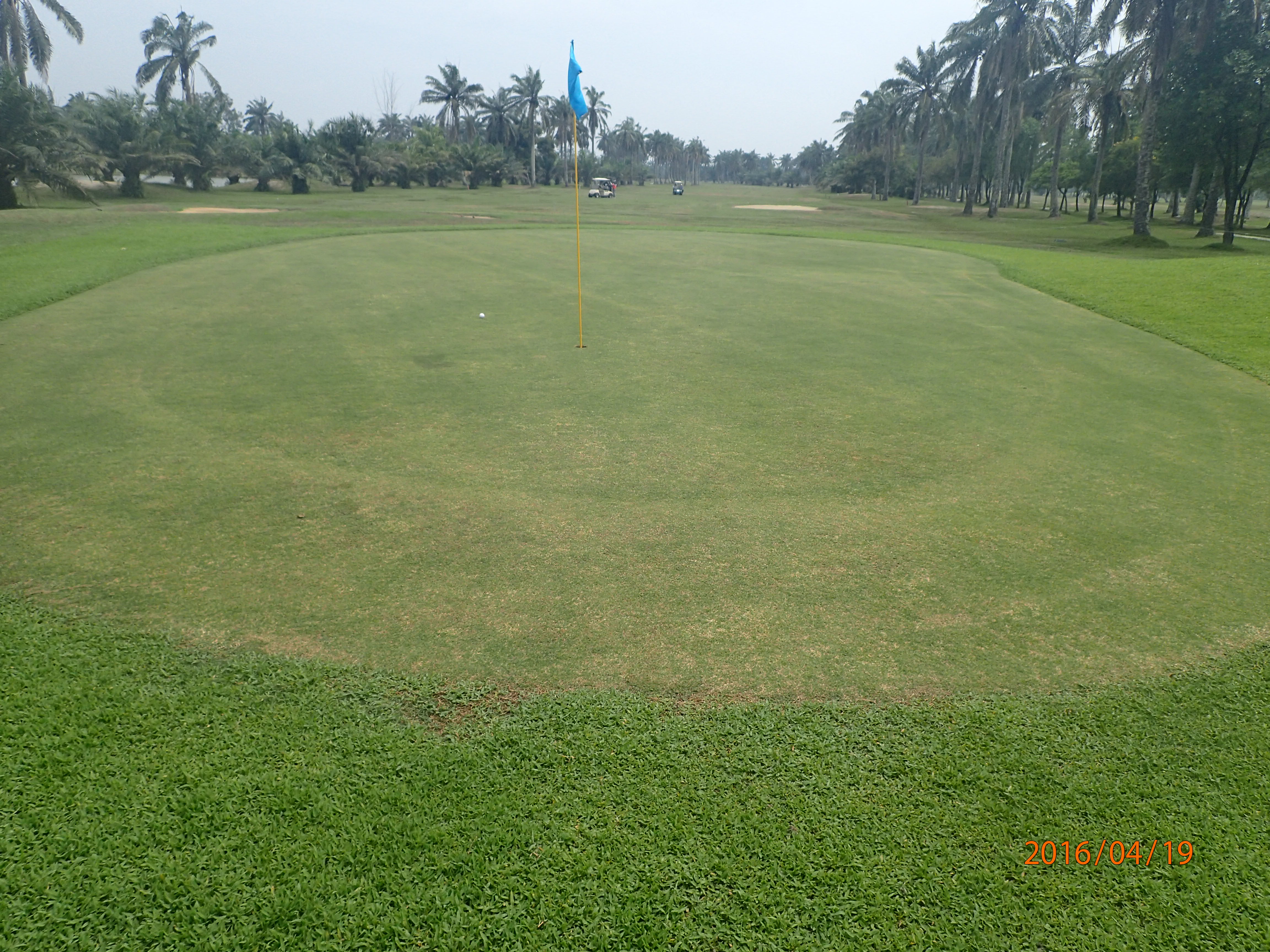
Its quite a ‘lonely club’ in the sense that if you look at it from the air, all you see surrounding it are oil palm plantations. Here’s a picture of it at night. The picture in the daytime is a little bit crowded with clouds.teluk-intan-google-earth-lonely-club

I suppose originally it was maintained with a complete fleet of machinery but like many golf clubs in Malaysia, no plans were made with regard to long-term machinery replacement and they keep losing machines. On top of that, they also lose workers and after that, golfers; when the novelty of a new golf club and in fact, the novelty of golf wore out. Fewer and fewer golfers came by until one day some KL golfers forgot there was a golf club in Teluk Intan.

A few years back, one of the original investor in the operating company left and the remaining investor, a self-made rags-to-riches guy decided to take positive steps to rebrand or renew the club. I was engaged for a one-year period and a hefty sum of money was forked out to purchase new machinery.

A year later there were obvious improvements and even the local council praised the changes at the club. Of course this is all comparative, either in terms of current condition compared to its condition in previous years and to other clubs in the area. I was asked to stay on as consultant for two more years after that. I guess you could say I was the de facto superintendent.

More importantly this, this is a case of a little club that tried. It wanted to improve and it did its best to improve. It would be a shame if golfers continue to ignore it. The operator, the owner, the committee and the staff worked hard to improve it with limited resources. I’ve seen urban clubs with better resources, experienced staff and educated superintendents that don’t give a hoot about course conditions, preferring to play the victim game and blame the weather, the budget, the construction, the boss, the committee, the grass, the previous superintendent; anyone but themselves.

Teluk Intan G&CC is the only long-term client that insists I do a presentation at a meeting to their biggest boss every month, where he will then question the superintendent and club manager. Other clubs make do with a written report that usually go unread or perhaps misunderstood (except perhaps by the superintendent who sometimes ignore it). There is also another exception to this; one club who insisted on written reports and whose superintendent was being targeted for early retirement went through my reports with a magnifying glass, accusing the superintendent of NOT implementing my recommendations. He was – diligently. Which resulted in his greenspeed increasing from an average of about 7’6″ to 9′ plus (one green had a reading of 11′ +) in two months WITHOUT reducing their cutting height. Don’t get mixed up: this is not Teluk Intan G&CC I’m talking about: this other club’s superintendent’s job is now safe; mine wasn’t; my contract wasn’t renewed and seven months later, this club up north close to the border of Thailand (are you reading this?) still haven’t paid me my fees yet. Teluk Intan pays me regularly.

In Teluk Intan G&CC, the green fee is cheap, the fairways are nice, the greens are small, the bunkers are shallow and the design is what I would describe as ‘Highway’ type of design, y’know, the kind where bunkers are in the rough and the fairways are like roads leading to the green. The cost of hotel and food in Teluk Intan is pretty low too.

It is perfect for new golfers or hackers or for those who like to play without pressure of other golfers, without feeling being cheated by high green fees with bad greens or just to have fun playing on a totally different course. I know your home club is good, but how many times can you play the same course over and over again?

Should the temptation of ‘cheating’ on your club arise, call Teluk Intan Golf and Country Club at: 016-417 2661 and speak to Khairul Anuar, he’s the friendly Club Manager or just go to their website for more details. While you are there, don’t forget to visit the leaning tower of Teluk Intan and other attractions too and do stuff.


Posted in Golf club, Golf Course, Golf Course Superintendents | 1 Comment »

Penjagaan padang di musim hujan.

Posted by mynormas on November 1, 2016

Kita akan melalui musim hujan ataupun kita boleh kata, musim hujan sudah pun bermula. Pada masa ini kebanyakkan penjaga padang kalau boleh mahu padang kurang di gunakan, tetapi walau macamanapun, padang akan digunakan juga. Apakah langkah penjagaan rumput yang perlu diambil di  waktu musim hujan? Mari kita berkongsi.

1. Pembajaan. Penggunaan baja di musim hujan akan menyebabkan baja larut dan lesap ke dalam sistem saliran yg menyebabkan pembaziran dan pencemaran air. Elakkan menggunakan baja kimia biasa ketika dah tahu hujan lebat setap hari. Amalkan pembajaan ‘sikit tapi selalu’ contohnya baja yang kita bajet untuk sebulan, kita bahagi kepada empat bahagian dan baja seminggu sekali. Ataupun jika hujan terlalu selalu, kita baja dengan baja foliar selang beberapa hari.

2. Menggunakan racun makhluk perosak juga boleh menyebabkan pencemaran di tambah pula air dalam tanah atau air hujan boleh mencairkan racun dan menyebabkan kelalian pest kepada racun. Jika anda ada masalah penyakit atau anda ada sejarah penyakit merebak di waktu musim hujan, cuba gunakan racun jenis serap atau sistemik yang akan masuk ke dalam rumput dan menjadikan rumput itu racun kepada kulat. Begitu juga serangga tetapi elakkan menggnakan racun granul sistemik seperti Carbofuran. Saya pernah guna Carbofuran di musim hujan dan akibatnya ikan mati dengan banyak di kolam.

3. Wetting agent. Memang di luar dugaan dan counter intuitive “Kenapa nak guna wetting agent waktu dah basah giler?” Kebanyakkan wetting agent, terutamanya wetting agent generasi kedua (tanya supplier, klau dia tak tau, tanya supplier lain) akan menjadikan tanah lebih ‘mesra-air’ dan memudahkan ia masuk ke dalam tanah. Gunakan ia secara berterusan dari musim kering hinggalah ke musim hujan.

4. Pengudaraan. Kerja hollow-tine tu bagus tetapi untuk membuatnya di musim hujan adalah kerja yang ‘kurang pandai’ kerana nak mengutip sisa hollow-tine yang basah dan menabur pasir topdressing adalah amat amat susah. Cuba spiking or slicing. Buat selalu. Malah sepatutnya anda dah mula beberapa bulan sebelum bermulanya musim hujan. Ia akan membantu memecahkan algae dan/atau permukaan keras supaya air masuk ke bawah.

Pengudaraan tanah.

5. Vertical-cutting. Tidak bijak untuk buat kerja dethatch yang terlalu dalam kerana kerja mengutip sisa adalah susah. Saya pernah dethatch dua jam sebelum hujan lebat, nak kutip sisa ambil masa hingga seminggu. But grooming or light dethatching: amat baik kerana ia menipiskan rumput utk mudah udara keringkan rumput.

6.  Potong kenalah potong rumput. Jangan biarkan rumput terlalu panjang kerana alasan tak boleh masuk mesin; gunakan manpower dengan brush-cutters or push mowers. Jika terlalu lama tidak di potong, ia akan menggalakkan rumput liar membiak dan juga menyebabkan kita memotong terlalu banyak daun bila kita dah boleh masuk mesin nanti. Lepas potong, jangan biar sampah rumput bertaburan untuk di larikan oleh air hujan! Ia akan menjadikan tanah tidak rata dan menjadi masalah di masa akan datang.

7. Growth regulator:  Ia sangat membantu di waktu ini kerana ia melambatkan rumput tumbuh jadi jika kita ada masalah padang atau fairway yang terlalu lecak dan tak boleh potong, sembur dengan Primo (takde jenama lain di Malaysia) supaya kita tidak ada tekanan memotong sewaktu hujan tengah lebat.

8. Tree pruning: Kurangkan dahan pokok yang ada risiko untuk patah dan sekaligus akan mengurangkan daun yang gugur dan terpaksa di kutip.

9. Rubbish and leave collection. Kutip sampah, daun atau clipping yang akan menyumbat longkang dan menjadi masalah di masa akan datang.

10.  Cuba pastikan air tidak bertakung terlalu lama. Buat longkang sementara atau tebuk tanah supaya air mengalir.

11. Jika kawasan anda mempunyai selut,  buang lapisan selut itu supaya ia tidak menutup permukaan tanah dan air tidak mengalir.


Jika anda mendapati ada tempat yang mempunyai masalah air tidak mengalir atau lecak; tandakan tempat itu di atas peta dan buat rancangan untuk membuat longkang bawah tanah, atau apa cara pun supaya masalah yang sama tidak berulang. Saya dapati, pembetulan dan tindakan jangka masa panjang adalah lebih berkesan dari kerja sementara yang di buat berulang kali.

Selamat mencuba!
Read the rest of this entry »

Posted in Fields, Golf club, Golf Course, Greens, Padang, Padang Bola, Padang Golf, Rumput, stadium, Taman | Tagged: , | 3 Comments »

A winner

Posted by mynormas on April 21, 2016

I was at a client club the other day going round the course with the superintendent. I was in crisis mode because their green no. 2 had the highest number of insects per square meter I’ve ever seen. Plus the hot weather was thinning out the other greens.

On one green, we met a flight of golfers and I as usual try to be unobtrusive without being unfriendly; a nod here, a smile there and a thumbs-up where appropriate. One of them approach us “Whatcha doing? Checking the greens?” he asked. “Yes” I whispered (one of his friend was putting). “The greens are quite fast now” he said. “Really?!” I said, wide-eyed. “Yes, really, it really is different from what it was before” or words to that effect. I’m assuming the ‘it’ he was referring to was the whole golf course.

OLYMPUS DIGITAL CAMERA

Just another green in another day on another golf course…

I pushed the superintendent to the front “Here’s the guy responsible for it. All his work” The golfer nodded to the super and the super was unsure of how to respond but I suppose it’s safe to say he was pretty proud and he should be.

He only has one triplex greensmower for 19 greens. That same mower is used for dethatching and rolling. One tractor pulled fairway mower, one unreliable front deck mower, one bunker raker and nine workers; four of which works for only half of the day. He mows his tees with backpack brushcutters. He fertilises his greens with slow-release greens’ grade fertiliser alternating with big-prilled oil palm fertiliser.

He has been working at the same course since the day it was planted with grass, in fact, he was one of the workers doing the planting. He stayed on through a few management changes and rose up through the ranks.

He doesn’t speak English and he doesn’t have formal training or even much education, what he has is a good attitude. He takes notes of almost everything that I said (doesn’t necessarily mean he does everything) and asks questions if he doesn’t understand. He is not afraid of trials and tests which I have come to fear more than he does but there were a few chemicals that I am using now that I learnt from him. He doesn’t complain or whine and he definitely does not have the victim mentality.

What he has achieved came through a victor mentality of wanting to try anything new.

Sure, the greens and even the course may not be much to KL folks but considering the resources he has, the location of the club and the price golfers pay; I think the club did well to improve the course and at least this flight of golfers agree.

OLYMPUS DIGITAL CAMERA

Those black things? Those are the bugs.

Posted in Golf club, Golf Course, Golf Course Superintendents, Greens | Tagged: , , | Leave a Comment »

Emperor, General & Concubine

Posted by mynormas on February 23, 2016

I was in a client club recently and the Superintendent was telling me of his new staff who despite having agriculture or horticulture certificates are lacking in knowledge in what to do on a golf course. He did not see himself as responsible for his workers knowledge.

As a consultant, I see things at a client company as an outsider, usually with a fresh set of eyes and (hopefully) an unbiased mindset. I’m sometimes called in when the company wants the golf course to reach another level; not necessarily because there’s a problem. Other times, I’m called because there is a need for a third-party opinion, a referee even, to resolve a problem at a club that led to a (real or imagined; yes, IMAGINED) deterioration of the golf course. I will meet with a few people at the company and talk to them to see what the issues are. It never fails to surprise me how many people believe that the problem is other people.

These issues reminded me of a story about Sun Tzu – he who wrote the Art of War and an emperor of his era. Be reminded that China wasn’t one whole nation yet but were divided into a few smaller nations.

The version of the translation that I read was written by James Clavell, a renowned novelist himself and this version were full of interesting side stories that serves to illustrate better Sun Tzu’s 13 chapters. It was a very interesting book and I read it several times, it was also the only book I ever burned; I had it when I was working in a plantation 25 years ago and electricity was shut off at 10pm. To continue reading, I put a candle between the pages of the book and I must’ve dozed off. The book was singed but still readable so I kept it. I’ve lost it since then, probably loaned out and never returned or lost in the house moves I’ve made over the years. It’s been a long while so I may have forgotten a few details and I may be adlibbing or paraphrasing a few dialogues therefore if you are into details and accuracy, I would advise you to look it up.

So the story goes like this. The book written by Sun Tzu about the art of war called umm… The Art of War turned into a bestseller and probably would’ve been a blockbuster opera too if only America was as civilized as the kingdom of Wu was 2,000 years ago.

Anyway, the emperor of Wu called up Sun Tzu to his court and asked if what he wrote was good.

“Of course it is, Your Majesty” said Sun Tzu.

“All 13 chapters?” asked the emperor (should ‘emperor’ be with a capital ‘E’? Maybe I should capitalise it next time; just to be on the safe side. Don’t want to be struck by lightning or hit by car eh?)

“All 13 chapters are good Your Majesty” replied Sun Tzu.

“Can it be put to a test?”

“Yes Your Majesty”

“Can the subjects of the test be women?”

“Yes Your Majesty”

The Emperor asked that all the women in the palace be brought out to the courtyard. 180 women came out and lined up.

Sun Tzu arranged them into two companies and put the Emperor’s favourite concubines as the leaders of each company.

Sun Tzu addressed the women “I assume you know the difference between left and right, front and back?” The women nodded “Of course we do”

“Everybody facing front” Sun Tzu yelled, parade ground style to the two companies of women in front of him; they all stood at attention. “Now, everybody; right turn!” shouted Sun Tzu. Immediately the ladies burst out laughing.

Sun Tzu calmly said “When the soldiers cannot and do not know how to follow orders; or if the order is not clear; it is the general’s fault”.

So he started to train and drill the ladies on how to face forward correctly, how to turn left and right upon hearing the commands and so on.

Satisfied that the ladies are now properly trained, he barked the command “Everybody: right turn!” and the girls promptly started laughing again.

Sun Tzu said, “if the orders are clear, if the soldiers have been trained properly and yet the soldiers still can’t follow the orders properly, then it is their officers fault”

In saying so, Sun Tzu ordered the leaders of the two companies executed. The Emperor watching from a raised pavilion, upon seeing that two of his favourite concubines about to be beheaded, promptly sent a message down to Sun Tzu saying that he recognises the greatness of the general and the exhibition can now be concluded without anyone losing their heads. To which Sun Tzu replied “Having first received the appointment to be general, there are certain orders of the Emperor that I am unable to accept.”

He then had the two concubines beheaded and made the next two women to be the new leaders of the companies.

Now when orders are given, the ‘soldiers’ are able to turn to the left or right in perfect order; without uttering a sound.

Sun Tzu then sent a message to the Emperor “Your soldiers are ready and properly trained now, Your Majesty and can be put to any test you desire”

To which the Emperor replied “Let our general dismiss our forces and return to camp. We have no wish to come down and inspect the troops”

The reply from Sun Tzu was a classic man-with-balls “The Emperor is only fond of words and cannot translate into action”

Reading this and thinking about how it relates to someone in your workplace is fine, just don’t forget that sometimes it could also be about you too. There are a few classes of people in the story; The Emperor; who talks about wanting to be the best but not wanting to pay the price. The General, who assumes his people know what to do and does not do training. The Concubines; people who thinks that they know what to do but don’t. The Favourite Concubines; those that cannot be told what to do.

Lest this leads to a flurry of finger pointing, I must hasten to add that we should all be careful of who to blame. I mean, how embarrassing would it be if you thought that the problem of the company is everyone and everything or someone or something when the real problem is you?

Posted in Golf club, Golf Course, Golf Course Superintendents | Tagged: , , , , | Leave a Comment »

Cheap maintenance

Posted by mynormas on January 28, 2016

“Times are bad and it will get worse this year” I hear that like almost every alternate year but yet here we are. “Really! It will be worse this year!” Ya. Ok! I hear you! Like I heard you in 2008 and 1998 too. “Was the budget amended in 2008 or 1998?” Hmm… maybe you have a point. Maybe your golf course is not that badly hit yet or you think its immune or if someone really wants to buy your hole 5 for the right price, the management would sell it but I’d like to share some ways of saving costs without sacrificing too much quality in golf course maintenance.

OLYMPUS DIGITAL CAMERA

The Malaysian government is amending their budget on the 28th January 2016. How many clubs are amending their budgets? How many golf courses have taken another look at their budgets in view of rising costs, reduced demands and increasing competition? You may argue that some golf clubs are closing down so there will be less competition but the existing golf course will be going after the same golfers as you are. Some will take the easy way out and reduce prices though I’ve heard of one golf club that want to increase their green fees.

From experience, many golf clubs will cut their maintenance budget because that is easily the biggest expense for the club. But as golfers paying green fees or as a member paying dues you don’t really want your golf course standard to deteriorate and let it be blamed on the economic situation do you? So you would expect the club – if they don’t want to lose you as a customer – to take other measures to cut costs right? At the same time, you don’t want to pay higher green fees or more subscription too.

Experienced Superintendents will have a few things they can do on the golf course to help on the cut-backs without much disruption on your golf game. Unfortunately some of them will choose from these options after they have recovered from their initial knee-jerk reaction they took or were forced to take.

  1. Clean out the store.

Big club or small club; I have yet to find a golf course store that does not have left-over fertiliser or chemicals. They are left behind because they bought one tonne of fertiliser when what they need for 18 holes was actually 0.8 tonne or perhaps the new guy has a different idea than the previous guy or there is a new trend or for whatever reason; most of the time; those few bags of fertiliser or chemicals pushed to the back of the store can still be used.

Your Superintendent won’t mix different fertilisers or chemicals on one hole or green, though I see no harm using different types on different holes as long as they calculate the nutrients or active ingredient to be more or less the same for every hole.

Always read the label! I almost advised someone to use the herbicide DSMA on greens once, believing it to be fungicide until I saw the label on the sack underneath it. If in doubt; I will prefer to tell the storekeeper to waste it.

  1. Small is beautiful.

Your Superintendent may reduce the areas that he/she needs to maintain. I would not recommend shrinking the greens but there are other areas that can be considered.

Sacrifice the OBs or out-of-play areas.

There are usually areas in the rough that are far enough from play that the maintenance crew can let it go wild. This will cut down on man and machinery hours. Save on manpower, diesel, machinery wear-and-tear and spare-parts. The Superintendent could let it become an ‘environmentally sensitive area’ or just let it become a wild rough. Look at it this way; your Superintendent is training you to hit straight.

For aesthetic value or if there is intention to bring the rough back to normal, once a month they may send a team of people to poison or cut new woody growth (including what Planters call ‘volunteer oil palms’) and creepers. Nothing ruins the ‘natural look’ more than the sight of short oil palms and big-leaf creepers creeping or hanging from trees.  You don’t really want your rough to look like a haunted forest.

If slow play becomes an issue because of ‘lost balls’ then they may do what I did once; put up a “Beware of Snakes” sign. Believe you me; even after knowing its purpose, even after knowing that for the past 10 years no one has seen snakes in that hole, no golfer will dare venture into knee-high rough looking for golf balls when they see that sign. It’s a psychology thing.

Reduce the fairways.

Fairways are a source of expenditure by virtue of the fertiliser and effort required to maintain it. In some areas, your Superintendent may shrink the fairways into rough.

Your Superintendent can’t really reduce the width of your fairways but he can shorten it up to the point where the slope rating measurements are taken, and it is possible to take out the fairways on a par 3. I once took out all the fairways on a golf course par 3s though on one long par 3, I increased the size of the approach since it is cut with the collar-mower. Collar; I cannot not have, fairway; I can. So collar I make slightly bigger, huge fairway I take out. Save money on big fairway mower operating hours and fertiliser.

  1. Use the expensive fertiliser.

What?! Some of you might ask. Well this is where I’m sure your Superintendent will insist – and I would agree – not to cut: slow-release fertiliser. At least for the greens. It comes in many types; polymer-coated, sulfur-coated, polymer-sulfur coated, long-chain methylene ureas, etc and all are more expensive than your normal ordinary routine regular standard fertiliser, some more than others. Believe it or not, using the expensive fertilisers will save money. I have to mention these because this is what management will demand first: buy the cheapest one!

Using cheaper quick release ordinary fertiliser may mean losing the nutrients by leaching or evaporation especially in our weather; these problems are supposed to be taken care of by the technologies of the new slow-release fertilisers. Use expensive fertiliser and more of the nutrients will get into the grass and you can also reduce your fertilizing frequency and amount of fertiliser.

Your Superintendent shouldn’t get into the habit of using cheap fertilisers, they are like cheap vitamins. As I always say; cheap vitamins equals expensive urine like cheap fertiliser equals expensive drainage water; the nutrients comes out with the liquid. Of course, bad fertilizing practices can cause that too but that is material for another article. Contact me for more information about it by emailing me at mynormasATconsultant.com replacing AT with @.

  1. Be more scientific and specific.

If the economic pressure does not let-up and the golf course starts to feel that it will soon need to mortgage hole 14 to the local Ahlong loanshark, there is another way to save on fertiliser cost. Your Superintendent may want to ask you for some money to do soil tests to determine how much nutrient is in the soil and maybe even tissue tests too to determine the connection between what’s in the soil and what’s taken up. He would take another look at plant requirements of the grass. Dr Micah  Woods of Asian Turfgrass Center has released guidelines for minimum levels  for sustainable nutrition that he calls umm… Minimum Levels for Sustainable Nutrition or MLSN  and apply just enough fertiliser the turfgrass needs to avoid wastage.

Amazingly, there are still golf courses that fertilise their greens by “one bag for each green method” or 15 bags for 18 +1 greens (perhaps because some greens are just too small to justify one bag). Measure your greens or at the very least: calibrate your spreaders! Then you can be accurate and consistent in your fertilising.

  1. Get a second opinion

You may see a new person going round your golf course poking and scratching on the grass. This may mean that your golf club has hired a consultant. A person who could look at the whole thing from a new perspective may be a good option, right? Having looked at the same thing for years may dull one’s objectivity, so a fresh set of eyes will be useful.

I like poking and probing

I like poking and probing

The best kind of consultant the club can get is one who has actually survived the economic crisis of the late 1990s and 2008 and has worked on both side of the fence; the side that asks for money and the side that wants to cut costs.

How does this save on costs? By looking at the golf course from a different view, he may see all the cost-cutting measures that the Superintendent does not have the heart to cut. Or he could identify a wasteful habit that was not noticed before.

Contact me now to find out more how I can help you save cost by emailing me at mynormasATconsultant.com replacing AT with @

  1. Renovate!

This is one suggestion that is going to fly in the face of convention. Why would anyone renovate a golf course during an economic crisis and call it a cost-saving measure? Well, look at it from the management point of view; traffic is going to be low, some materials’ prices are going to be cheap and some contractors want work.

The management would not want to be dragged into a green fee price war with the neighbouring clubs and if they do cut their prices, at least they can feel justified that it is partly because the golf course is literally, a work-in-progress. If the golf course across the street yells at you “Why are you setting your green fees so low?!” you can tell him “Relax bro, chill, I got three temporary greens, I have to sell cheap”

That reasoning may not go down well with some of you but let’s face it – unless you are the kinda guy who believes that “the end is near” or “the sky is falling” and is ready to jump a bridge soon – times will get better and there will be golfers with money to spend when the economy improves and they will be heading to the newly renovated and improved golf course which will be in the best position to increase green fee prices.

Add to that fact some suppliers and contractors will be reducing prices perhaps to get their stock moving or to get some quick money or to improve cash flow; now would be a good time for the club to get a good bargain.

Of course, all this is relevant only if the club has money in the bank for the work. Or now would be the time membership clubs to beg the Trustee for the use of the sinking fund.

  1. Buy that machine.

What if you really, really, really need to buy a machine? Should you defer? Why? You think it’s going to get cheaper next year or in the following year? Perhaps the currency exchange will improve but by then the machinery price may go up due to inflation and between now and then the costs of repairing your existing junk may eat into whatever amount you think you’re saving and you could end up spending more money in total while at the same time, the aggravation of operating and maintaining that junk eats into your staff’s productivity (and the golf course’s quality).

In the meantime, do consider that the machinery supplier is desperate to sell his machine too and may be willing to offer discounts or longer warranty or maybe even free parts. If he/she is corrupt and offer you kickbacks tell him to reduce the price of the machine even more or tell him to never set foot in your office again. Don’t deal with people like that; you’ll be indebted and trust me, the industry is small enough that words get around. Yes, you, we do know about you and how much you got. Shame on you for giving the rest of us a bad name.

Should you go for reconditioned/used machinery? My experience says no, not unless your golf course is right next to the supplier’s workshop and he can service you. I’ve seen reconditioned machine that work for only a week before the engine fell off; it wasn’t bolted on, it was welded on and when the machine worked for a week, the vibration broke the weld. Of course, I shouldn’t generalise, no one should; send your mechanic with your accountant to look at the machines before deciding. Who knows? Maybe there exist honest second-hand machinery dealers…

For fairway or rough mowers, you could try using a mini-tractor with mowing implements. That way, when you finally got a budget and you can finally afford a machine that the superintendent dreamt of, the tractor can be used for other works. They’re like one third or half the price of a five-gang mower anyway, plus almost any mechanic worth the job-title can repair a tractor.

By the way, there’s this friend of mine who wants to sell of some pre-loved machinery. No, I’m not contradicting myself; these are not reconditioned, these are from the days when golf courses in US are leasing their machines for two or three years and then returning them back the leaser. She managed to get a fleet of them and wants to sell them off. Let me know if you are interested by emailing me at mynormasATconsultant.com and replacing AT with @.

8. Train your staff.

What? “This guy is off his rocker” you say. No money coming in and you want me to spend on my staff who may leave? Well, firstly, I have always considered staff training as an investment, not an expense so you won’t get my sympathy but what the heck, I’ll give you face; secondly I assure you, when handling machinery worth hundreds of thousands of ringgit and applying chemicals/fertilisers on a golf course worth millions of ringgit to build, keeping untrained workers are more expensive compared to training workers and then they leave.

Are you part of the problem or are you part of the solution?

Are you part of the problem or are you part of the solution?

By the way, if you are one of those companies that have been contributing to the Malaysian Human Resource Ministry’s Development Fund or HRDF, this may be the time to use those for training. Ask your HR manager for more info.

If you want to focus on staff training for the golf club, contact someone with more than 22 years of experience in the industry and has a Train-the-Trainer certificate at O3-5I3I OO66 or mynormasATconsultant.com replacing AT with @.

The above list is just some of the things I have done for the golf courses I’ve worked with. Your Superintendent, who knows your golf course infinitely better and are more intimately familiar with the management may have other options he or she will look at.

All they ask is for is some understanding if you see some decline in the golf course standard. They don’t like it any more than you do; it is their reputation on the line. Sometimes some of the cuts were forced on them; it has happened to me too due to management knee-jerk responses when I was a Superintendent. Sometimes we just have to follow instructions even if we don’t agree. When I was part a general manager, I do the knee-jerk responses and expect the staff to follow instructions even if they don’t agree… Hey! I have a budget to balance you know, otherwise I may really have to sell Hole 5.

Contact me at 03-5[31-OO66 or email me at mynormasATconsultant.com replacing AT with @.

Posted in Golf club, Golf Course, Golf Course Superintendents | Tagged: , , | 2 Comments »

Unaffordable Course

Posted by mynormas on January 26, 2016

The USGA Green Section wrote a tongue-in-cheek, sarcastic even, article on its website on how golf courses increase their maintenance costs. I may not agree with all of them (edging the buggy paths, for example) but there are plenty that I agree with and am surprised that Malaysian golf courses continue to do them or even constructing them. Lets list and summarise  them here; words in bold are from the article (ok, maybe I paraphrased here and there: sorry) and those not in bold are my comments.

  1. Having (or adding) a lot of bunkers which should be maintained to be consistent and uniform. The more bunkers a golf course has, the more difficult it is to be maintained to be consistent and uniform or even maintained regularly. And no, I don’t think consistently and uniformly not maintaining them at all counts.

    Now almost all new bunkers in Malaysia 'must' look like this. I once asked "Why?!" and was told "There's a new cloth/coat/technology to hold the sand". "Thats good" I said "but it will still increase your construction and maintenance cost and it looks out of character from your older bunkers!" "Ya... but everyone else has them" was the reply.

    Almost all new bunkers in Malaysia ‘must’ look like this. I once asked “Why?!” and was told “There’s a new cloth/coat/technology to hold the sand”.
    “Thats good” I said “but it will still increase your construction and maintenance cost and it looks out of character from your older bunkers!”
    “Ya… but everyone else has them” was the reply.

  2. Plant more trees. Ya… There are owners and bosses who love to plant trees. Committees too. Perhaps some people think its a legacy thing. With too much trees, grass don’t get enough sunlight and the efficiency of your mowers is less to mow around them. Plus your rough/fairways dries out slower because less air and sun.
  3. Lakes and stream banks. Mowing and trimming them as close to the water edge as possible. These are mostly manual work.
  4. A ball washer for every hole. If you must have them (they’re sponsored perhaps?) install them at tees of holes 1, 10 and at your par-3s. Golfers or caddies can make use of them while waiting for their turn. If I have a ball washer I’d be changing the soap water every week.
  5. Let the maintenance staff fill the divots instead of educating golfers (and caddies) to do it.
  6. Blowing debris from fairways and roughs (I may not agree totally on this.  Though I usually blow the leaves on Fridays only)
  7. Have a multitude of mowing heights. This is my pet peeve. I try very hard to not roll my eyes when superintendents proudly tell me that their tee is mowed at 14mm, the collar is at 12mm the apron is at 15; the fairway collar at 20, the light rough… As if golfers or even the staff can tell the difference of 2mm. I’m betting the Myanmarese mechanic back at the workshop is laughing to himself while setting everything at 17mm… For most clubs; I suggest only three mowing heights: greens, fairway (=tee, collar, apron etc) and rough (=light rough, deep rough etc).
  8. Mow the greens and/or tees with walk-behinds. Mind you most clubs in Malaysia get away with it because instead of either two ride-ons or six walk-behinds greensmowers for 18 holes; some clubs have two or three walk-behinds for 18 holes and don’t see a problem with it.
  9. Ornamental flower beds. I totally agree. Why have an unmaintained flower bed? I actually conspired with a superintendent of a client club by removing a long neglected flower bed while the boss is away and pretending it was never there. Long story… Maybe one day I’ll tell it.
  10. Irrigate non-playing areas. I took out a lot of sprinklers from rough areas.
  11. Overseed turf that would go dormant. Not applicable to Malaysia.
  12. Make your natural unnatural. Yeah… about this. I think we shold keep natural areas to be natural however, this does not mean unmanaged; I usually send workers once a year to kill new trees, ‘volunteer’ oil palms and creeper plants.
  13. Plant the wrong grasses for your area. You know; Seashore Paspalum for fields far from the seashore or Bermudagrass/Tifeagle for areas with a lot of shade.
  14. Edge the buggy paths frequently. I actually see nothing wrong with this if you have the manpower. I do this at least at holes 1 and 10 for the best first impressions.
  15. Let your irrigation system get too old. At the very least the pump house lah…
  16. Use plenty of signs, stakes and ropes. Ya. Mowing around these takes time and reduce efficiency.

For detailed sarcasm, visit the page at www.usga.org/course-care/forethegolfer/steps-to-make-your-course-unaffordable.html.

For sharing information about how to not increase the cost of your course, call Normas at 03-5I3I-OO66 or email me at mynormasATconsultant.com replacing AT with @. 
Posted in Golf club, Golf Course, Golf Course Superintendents, Padang Golf | Tagged: , | Leave a Comment »

Low Budget Success

Posted by mynormas on July 31, 2015

I attended a  meeting with a local district council and their golf club operator last month. I have worked with that operator for the past two years and was expecting to be ignored or be a scapegoat. Yet I was first praised by a club official who said “The golf course has improved a lot in the past two years; thanks to Normas”. and later on, the chairman, when talking about club’s finances also said something about how the golf course “…is now good and very different from how it was two, three years ago”. I was humbled.

If you go to the club, you – the seasoned golfer – may not be impressed but to me, it was incredible: they had only one greensmower; their main greens fertiliser, was plain quick-release fertiliser bought from the contractor who harvested the oil palm in the golf course by deducting the cost from the tonnage (that means they didn’t actually ‘buy’ the fertiliser); their pesticides were bought from the local hardware or stores that cater to the local farmers; they have five foreign workers and three or four local workers . The club had one tractor-towed-ground-driven fairway mower and two rough mowers, one of which spends more time in the workshop than in the field (note: do not buy refurbished machinery if your club is FAR from the supplier, unless its cheap enough you can buy two when you need one). It has one topdresser that is too big for the greens and too small for the fairways (note: get a third opinion before spending so much money on machinery) and until recently – and by recently I mean two months ago – no working greens’ aerator.

The toughest part of it all for me was that the person in charge; the superintendent, was someone who worked his way up almost 20 years ago in the club, not a golfer and has never been on another golf course. Ever. This made him a hard worker with good discipline and very loyal. However, it also means he sees things in one dimension and tend to drift back to old habits. I concentrated on being friends and not on being a consultant and managed to get things done. Though I suspect I won his respect because when things go bad; I took the blame even when he knew it wasn’t my fault.

You see, the boss took an interest in the golf course and after every visit I made, I have to do a presentation to him the following day and he wants to know what went on, what went wrong and what comes next. So when there were an insect attack and I had already instructed what chemical to be applied at what rates and in which order, he would assume it would be the end of it. Once or twice, that wasn’t the case and I can trace it back to wrong application or even no application but I would explain it away as a new attack or when a wrong chemical was bought, applied and the grass died, I said that I had misjudged something.  I do have a different way of doing things compared to most Superintendents and adding that to this Superintendent’s experience would give him a steep learning curve.

The operator was a rags-to-riches kind of guy and quitting wasn’t in his vocabulary, he chose to want to succeed and I suppose, that was the main driver for the improvement in the golf course. Its not the best golf course in the country yet and is at a precarious balance so I wouldn’t recommend the kind of knife-edge work to any other club, but for it to come from greens with no grass to healthy grass shows what a willingness to improve can do even at low budgets. If they can, you can. Call me.

Posted in Golf club, Golf Course, Golf Course Superintendents | Tagged: , , | 1 Comment »