Turf Matters

The Site To Go To For All Your Turf Matters

  • Facebook Likes

  • The new Brushcutter

    Pengganti Brushcutter

    Increase productivity, cut labour. Try the AM61A

  • Trees Nursery

    Forest trees nursery

    Get your Trees from this nursery

Archive for the ‘Taman’ Category

Weeds

Posted by mynormas on November 18, 2011

Most people don’t pay too much attention to those grasses that don’t seem to belong to the rest of the grasses surrounding them. The reason being those grasses doesn’t usually impose themselves on people.  Other than aesthetics that is. Even if the grasses seem – at first glance – to be similar, there is that slight difference in colour, texture or something that makes people dislike.

What are these grasses?  How did they come to be where they are?  Why are they left alone?  How do we get rid of them? Should we get rid of them?  What are they called?

They are called – other than the colourful names some people use to describe them – weeds.

A weed is defined as a plant that grows where it is not wanted. So, because of the  definition, a rare black orchid growing in the middle of a fairway would be attacked by changkul-wielding workers before we can finish saying “Rare black orchid is a weed?” Similarly, a banana plant three feet from the pin on a green is a weed, never mind the nutritional qualities of a banana.

These weeds are called ‘sedges’ and they love wet areas.

Weeds are transplanted in many ways. Assuming a particular golf course or field or taman is constructed, planted and maintained to perfection (this would presumably be on Planet Krypton), weeds can be transported by wind, animals, water, humans or machinery.  Sometimes it could also inadvertently be transported by the maintenance staff when they borrow a machine or equipment from another place. This does not only necessarily mean from one golf course to another, but also from one hole to another in the same golf course.

Why Weeds Happen – During Construction.

You would think that no one would plant a weed on their field. No one intentionally would; but sometimes that’s what happens when the owner/manager purchases new planting material like seeds, stolons or sods. To cut cost the planting material might be purchased from the nursery that gave them the lowest quote.  Chances are that these nurseries may not apply the best management practices to ensure weed-free materials. How else can they quote so cheap?

Are they planting pure grass stolons are are there weeds seeds mixed in? Did you check? By now, can anyone check?

What some nurseries do is to regularly mow their plots to keep most weeds down to the same height as the surrounding grasses.  And when they smell a potential sale, they do a hurried manual weeding job before the buyer’s representative arrives for an inspection visit.

For golf courses, this may be the same scenario if we get our planting material – especially in big quantities – from the award-winning golf course that our boss has friendly relations with.  You don’t think they will rip off their best greens and fairways to give us the stolons do you?  You might as well ask for their right arm.  We may get away with getting the stolons during their renovation works like hollow-tining or verti-cutting.  Just be aware that it’s almost impossible to be weed free on all 18 holes (we are not on Planet Krypton) and a verti-cutter machine going on a weed the size of the palm of your hand will create hundreds of tiny baby weeds waiting to sprout on the golf course.

Actually, the story can begin long before the first planting material is purchased.  It starts when the soil is being prepared for planting.  When the earth was pushed to make way for a golf course, or when the soil is expertly shaped waiting for the planting of the seeds or stolons of the chosen species of grass, it contains planting material of many different species of plants. Each and every viable seed is a potential weed waiting for the right time to sprout.

There are, of course ways to treat the soil – from simply turning the soil over to expose the seeds to sunlight to the complex way of covering it with plastic sheets and injecting it with chemicals – which, by the way, should only be done by licensed applicators.

If you are planting your own field/lawn visit the nursery, ask the supplier to show you which part of nursery they want to harvest for you, then on planting day, insist that they do NOT harvest before you or your rep being there. You don’t want them to show you one part of the nursery then harvest from another part to plant in your field/lawn.

Why Weeds Happen – During Maintenance

As so often is the case, an ill-advised attempt at cost reduction is usually the root cause of many evils when aesthetics is one of the performance indicators.  You will hear me repeat this line often: nothing is free in this world; we will pay for it one way or another. Maintain the grass poorly, it will not grow well and, in this instance, will provide an opportunity for weeds to move in.  We will eventually spend money to remove the weeds from the golf course. This paragraph will still hold true when I write about disease or pests in the golf course in future articles.
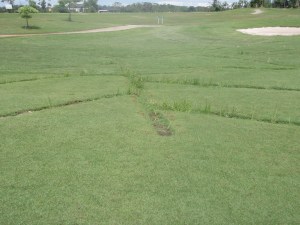
Poor maintenance can cause weeds, this drainage line was left open. So weed came in.

In short; do not expect the maintenance staff to cut costs to the point the grass’ health suffers.  Starve it if you must. But make it suffer it you mustn’t.

In the quest for being environmentally friendly, some golf courses used organic fertilizers to feed their grasses. Now, these organic fertilizers are good food for the soil as much as it is good for the grass, but if we calculate on the amount of nutrient it can deliver, it may prove to be quite expensive. Fertilizer made from organic products that are not properly treated may contain weed seeds. Chicken dung and other animal waste or even products made from plant waste may be contaminated at source or during the process to turn it into plant food.

There is a legend of how a Superintendent of a golf course placed an order of several tons of processed chicken dung fertilizer.  The purchasing clerk, who with good intentions, believes that all chicken dung are alike proceeded to buy the cheapest one available.  The cost of weeding the golf course in the months afterward probably is much higher than the savings on the purchase of the fertilizer.

Weeds can occur in places where there is compaction, such as high-traffic area. Or wet/damp areas. Or dry sandy areas. Different weeds will thrive and specialise in different areas.

The Cure

So now you know where weeds has its roots (pun intended) and you want to roll up your sleeves and ask your maintenance staff on how you can help fight this scourge on the grass field.

How does the staff take care of the weeds?  He/she has quite a few things in his arsenal. First and foremost are the mechanical means, which includes sending an army of labourers digging up the weeds with small screwdriver-like implements. It works to a certain extent; at the very least it controls the population of the weeds. More often than not, the staff may miss out the small ones or neglect to dig up the roots which may sprout again. But if you have the budget, this would be one of the best ways to get rid of them.

Another option would be to use chemicals. And there are plenty of chemicals; ranging from those to be used before the weed seeds germinate – called pre-emergent – to those designed for use on living weeds – called post emergent. Most weedicides or herbicides, for this is the category the chemicals used to kill weeds is called, belong to the post-emergent type.

More often than not, the staff will choose a ‘selective’ herbicide; these are the chemicals that may spare the original grass and kill a certain type or family of weeds. The danger is that if the wrong mixture or rate is used, it may kill the original grass itself.  You might also note that even if it doesn’t kill the original grass, there may be a slight discoloration that will be visible for a week or two.  The opposite of a ‘selective’ herbicide will be a ‘kill-all’ herbicide, for want of a better word.

The staff can also choose to use either a contact herbicide that will kill the weeds it is supposed to on contact or he can choose to use a systemic one, which will be absorbed through the plant and start to kill from within. If he chooses a contact, he may need to use a reliable sprayer so that full coverage can be effected. Otherwise, the herbicide may only kill parts of a grass instead of all of it.

Please be reminded that all the above information is only a fraction of a branch of knowledge used by maintenance staff.  For more information regarding herbicides in particular or weeds in general; get in touch with me.

Posted in Fields, Golf Course, Greens, Landscape, Lanskap, Taman, Topdress | 12 Comments »

Mowing during rainy weather

Posted by mynormas on October 26, 2011

Mowing during rainy weather is pretty tricky. But if the machine operator does not have disicipline, he/she could turn a wet situation worse. A wet fairway,  rough or field is bad enough but a mower mowing in a wet patch will churn up the ground. You can end

It could've been worse. But more often than not, this is just the beginning.

up with a muddy patch on your field, fairway or rough that will take ages to be brought back to shape. Not to mention you may end up with tyre marks or compaction below the surface.

Ask your operator to back off from mowing that particular area if he finds that he is leaving tyre marks or churning up the ground. He should report it in so that a solution will have to be found if that area could not be mowed for too long. A lighter machine, a push behind or even a back-pack brush cutter may have to be utilized.

Note: you should look at draining or topdressing that particular area when the weather is better.

In the same vein, for those of us who are into striping our fields, fairways or roughs; now may be a good time to not concentrate too much on them too. Alternate mowing patterns for a couple of months won’t make much difference. Remember mowing in the same place all the time (such as when you are mowing for stripes) will make the tyres stay in the same ‘lanes’ all the time thereby creating compaction or worse: ruts. In fact; I would recommend changing patterns once in a while (say every couple of years?)

The stripes look nice, but don't forget you are putting your mower's tyres (tires?) in the same line everytime you mow.

Stripes on a football field.

Posted in Fields, Golf Course Superintendents, Maintenance, Padang Golf, Taman | Leave a Comment »

Choosing grass

Posted by mynormas on October 18, 2011

One of the most common question I get asked is; what type of grass should I use?

There are actually three important criteria to think about when choosing grass, and I write this in layman terms, mainly:

  1.  The condition of the area – whether it is shaded, it gets too much water (for example it is next to non-porous area e.g. road or pavement or perhaps it is out in the open with poor or no irrigation).
  2. The budget for future maintenance of the grassed area and
  3. The use of the grassed area; simply whether it is more for aesthetics or more as a playing field. In the golf course, this question will also refer to whether that area is a green or a rough.

Now for home-owners (and I get a lot more questions from these people) I usually tell them the order of priority will be 1. The condition of the area; 2. The budget and time they are willing to spend on maintenance and 3. The use; whether the lawn is for impressing passers-by or is it for grandchildren to play on? Stuff like that.

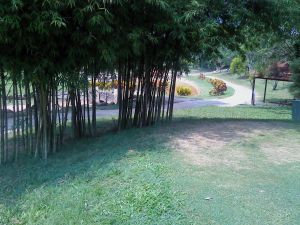
The Bermuda carpetgrass planted at cost under the bamboo? Dead. The Cowgrass that came on its own for free? Nice. Lesson? Use cowgrass under shade.

For golf courses, playing fields, stadiums and large areas like municipal councils, the order of priority is reversed: I ask them to think of what is the use of the area – whether it is for greens, for tees, for out-of-play areas,

football, picnic, or whatever. Then they should think of the budget they are willing to spend for maintenance (and I would like to emphasise FOR MAINTENANCE) and lastly only about the condition of the area. Why is the order reversed? Because, for these kind of construction, the condition can be modified, trees can be moved, or the green can be redesigned away from the large 100 year-old tree, for instance.

Most of these owners, be them developers, local government or large bungalow owners etc, will have a huge budget during construction but when it comes to routine daily maintenance; they scrimp and save.

Zoysia is a nice grass but needs to be cut once a week - at least. If you can't afford to do that, why use it?

So what I advise is: design and pick plants for the place so that it will be cheap and easy to maintain in the future! Naturally,  people want the best and most designers/contractors who are paid by percentage don’t mind at all to oblige.

But I digress. The world of grass is divided into three main areas; warm-season and cool-season. The third area? What is termed as the transition zone area, this area is cold enough in the winter to make it difficult to maintain warm-season grasses and warm enough in the summer to make it difficult to grow cool-season grasses, therefore, no single species of grass is well adapted in this region.

So there are only two types of grasses; warm-season and cool-season grasses. In the transition zone areas, they will use quick growing cool-season grasses in the autumn and early winter and warm-season grasses in spring/summer.

What are the characteristics of warm season grasses? They thrive in air temperatures from 27 – 35 degrees Celsius and soil temperatures of 21 – 32 degrees Celsius. They’ll lose chlorophyll in autumn and turn from green to brown.

Cool-season grasses grow very well when soil temperature is between 10 – 18 degrees Celsius and air temperatures a cool 15 – 24 degrees Celsius.

Tall fescue is a cool-season grass

Other than those, there are of course a few other things that should be taken into consideration too. Soil types, quality of water for irrigation – in fact, quantity of water too; there are a few other things if we want to go into details. But lets leave it at that for now.


Weights and Measures, Metric Conversions Weights and Measures,
Metric Conversions


Posted in Fields, Greens, Landscape, Lanskap, Maintenance, Padang, Padang Golf, Rumput, Rumput halaman rumah, Rumput secara am, Taman | Tagged: , , , | Leave a Comment »

Menyiram rumput

Posted by mynormas on October 16, 2011

Bagaimana patut kita menyiram rumput? Ada dua tiga sebab kita menyiram rumput.

  1. Kerana rumput memerlukan. Diantara tanda-tanda: tanah kering atau rumput layu: ini ertinya perlu siram.
  2. Kerana kita meletakkan bahan keatas rumput yang perlu di siram supaya ia meresap ke tanah. Contohnya baja, setengah jenis racun, bahan pelembab (wetting agent),  topdressing dan sebagainya.
  3. Kerana cuaca terlalu panas dan kita menyejukkan permukaan tanah untuk melindungi akar rerambut atau menurunkan suhu permukaan. Siraman ini dinamakan ‘syringing’ dan bukan bertujuan memberi rumput air; HANYA untuk menyejukkan permukaan. Ertinya siraman dua minit biasanya mencukupi. Untuk kawasan yang rumput di potong pendek, contohnya green di padang golf (3-6mm) kadang kadang syringing di lakukan hingga dua kali sehari (contohnya kul 11pagi dan 2 petang)

Jangan, jangan, jangan siram mengikut jadual. Contohnya setiap Isnin, Rabu dan Jumaat. Atau setiap hari pukul 4pagi. Jangan siram jika ia akan menyebabkan tanah lembab hingga ke malam: ini akan menyebabkan penyakit. Ertinya elakkan menyiram di kebanyakkan tempat selepas pukul 5 petang (ada tempat pukul 3petang pun dah tak boleh siram contohnya jika tempat yang teduh).

Amalkan siram di awal pagi. Ini memberi peluang tanah menyimpan air hingga ke tengahari di waktu ia paling memerlukan air. Menyiram di waktu petang; rumput mungkin kata “Aku dah nak mati kering baru kau nak siram!” dan juga akan menyebabkan tanah lembab hingga ke malam yang boleh menggalakkan kulat dan lumut.  Lagipun waktu pagi kurang angin yang menyebarkan air terlalu jauh/dekat (bergantung arah angin dan arah air).

Berapa lama nak siram? Siram jarang-jarang tapi lama-lama (Water irregularly but deeply). Ini akan menggalakkan akar tumbuh panjang mencari air. Siraman terlalu kerap akan memanjakan rumput. Pasal tu kita siram hanya bila rumput memerlukan, bukan ikut jadual. Biasanya saya siram 20 minit. Tapi awas, untuk kawasan yang terlalu curam atau tanah yang padat (air akan bertakung atau mengalir dan tidak masuk ke dalam tanah) saya mungkin akan menyiram 10minit x 2 ataupun 5minit x 4; tunggu hingga air meresap… dan ulang. Perkara ini perlukan pemerhatian dan pemahaman.  Lain tanah, lain siraman.

Sprinkler irrigation in a golf course

Sprinkler irrigation in a golf course.

Posted in Fields, Golf club, Landscape, Padang, Padang Golf, Rumput halaman rumah, Taman | Leave a Comment »

Managing Malaysian lovegrass (C. aciculatus)

Posted by mynormas on September 15, 2011

Lets not kid ourselves, there are many Malaysian golf courses, football fields and tamans that are plagued by the lovegrass (presumably named because it loves our pants). I have seen golfers comments that hate a particular golf course because that golf course has a lot of lovegrass on its fairways.

Lets start a discussion – although from experience this ‘discussion’ will end up being a monologue – but lets discuss anyway. Lets clarify what is ‘lovegrass’. Its that type of plant that has seeds that sticks to pants or socks. The leaf are light green. It is sometimes called as ‘kemuncup’ in some places in Malaysia. In the U.S it is called as the pilipiliula or golden false beardgrass or false beardgrass (http://plants.usda.gov/java/profil

This field was cut about 5 days ago! But the amount of lovegrass now would make a pious man curse...

e?symbol=CHAC) and Mackie’s pest.

What ever it is called I am sure most of us agree that it is a pest.

The leaf and the plant per se is tolerable but it is the seeds and how they were made to propagate that gets most golfers, footballers, joggers (or their wife, mom or maid) worked up. They stick to the pants and socks with no regard to price, brand or label.

Why on earth Malaysians called it love grass is a mystery.

It is also a stubborn pest. The only effective selective pesticide I know that we can use against it is Facet (available in Malaysia). Of course you can use Round-up but that may fall into the ‘overkill’ territory.

It resists mowing with regular reel mower, no matter what brand or how many reels. I have had arguments with two golf course superintendents (actually, make that three but in the end that one guy bought a rotary mower though I suspect it could be because of the price)   who insisted to buy five-gang reel mowers even though their fairways are infested with lovegrass. Why? Because all the other golf courses use a five-gang how can I use a tractor mounted rotary mower?

I have pictures of this golf course with better stripes; but no tractor, so this will have to do. Not to mention that I'm late already. Just take my word that rotarys make stripes

Using Facet has its drawbacks, one of it (other than price) is that it affects cowgrass. I am currently helping a Superintendent testing a few rates of Facet to see which will not kill cowgrass permanently. Lets see what happens; I have my doubts because as I see it, there is just too much lovegrass on his fairways. In my opinion, he would be better off changing his old five-gangs with second-hand mini-tractors equipped with new rotary mowers and mow twice or thrice a week.

Newsflash: Facet kills lovegrass. But the broadleaf survives! Not the cowgrass. And those are RM240 Hush Puppies.

Of course, if your golf course, field, taman or lawn that was planted with Bermuda or Zoysia, by all means; spray it out. Unfortunately, if your bla bla bla was planted (or is now covered) with cowgrass or Serangoon then your options are limited: if not much or only a few areas are invaded by lovegrass – you still could do chemical control. Otherwise you may have to replant (though I would still advise you to use chemical first to ensure no seeds or roots are left behind to continue) or buy new rotary mowers. For lawn owners, you may need to buy your own cutters or adopt one of the foreigner-who-mows-house-lawns as ‘anak angkat’.

Plus, a certain brand of golf course machinery is now coming out with five-gang rotary mowers too so you don’t lose your prestige when talking to other peers at the networking dinner of the club/stadium/local council/dewan bandaraya. And don’t worry, rotary mowers can make stripes as well as reel mowers too.

Try it.

The lovegrass just springs back up behind the mower. But notice that the leaves are quite nice.

Posted in Fields, Golf club, Golf Course Superintendents, lovegrass, Padang, Padang Golf, Taman | 1 Comment »

Rekabentuk lanskap: macamana nak mula

Posted by mynormas on August 25, 2011

Pelik betul. Artikel ni saya publish sebagai sebuah page dan bukan posting. Kita hanya perlu lalukan mouse di atas menu “Halaman Rumah” di atas dan beberapa artikel tentang halaman rumah akan dropdown, tapi dari statistik, orang hanya baca posting ‘Rekabentuk lanskap: nak tanam apa, kenapa dan bagaimana’ tetapi tidak artikel ini. So saya jadikan dia sebagai post jugak supaya dia tidak kesunyian dan orang tidak rasa ‘tergantung’ kerana artikel pertama tidak sepenuhnya cerita bagaimana nak rancang lanskap dan kebanyakkan pembaca pemalu untuk memberi komen atau pendapat.  Silakan…

Sebelum ini kita ada berbincang tentang prinsip rekabentuk lanskap (apa, kenapa dan bagaimana). Itu teorinya, macamana praktiknya? Praktiknya ialah kita memulakan projek lanskap dengan tidak menanam  apa-apa pun selagi kita belum ada projek di atas kertas.

Kita boleh bercerita tentang topic ni secara serius tapi kalau nak serius, boleh lah berhenti baca disini dan mungkin lebih baik kita semua cari buku atau laman web yang serius tentang lanskap. Saya berpendapat bahawa menanam lanskap di sekeliling rumah boleh menjadi suatu hobi yang menarik dan mudah. Maka adalah hasrat saya untuk memudahkan projek lanskap untuk orang awam.

Terlalu selalu kita biarkan kontraktor yang tentukan pokok apa, berapa banyak dan kat mana nak tanam, dan kita lupa bahawa lagi banyak pokok dia tanam lagi besar bil dia. Saya tengok banyak orang yang halaman rumahnya penuh dengan pokok yang dia tak terbela dan dia tak kenal nama pun. Akhirnya pokok-pokok terbiar.

Secara umumnya artikel ini di tujukan kepada orang awam yang tidak mempunyai latihan dan pengalaman merekabentuk lanskap. Ia banyak merujuk kepada ‘rumah’ tapi boleh digunapakai kepada ‘sekolah’, ‘pejabat’, ‘ kilang’ atau sebagainya. Bila saya sebut ‘keluarga’ boleh gantikan dengan ‘rakan sekerja’, ‘rakan sekolah’ atau sebagainya. Dan bila saya sebut ‘isteri’ maka boleh lah ganti dengan ‘bos besar’ (dengan tiada lain yang sebagainya…)

Kita mulakan: pertama sekali, pastikan semua ahli keluarga terlibat sama. Siapa tahu? Ada ahli keluarga kita yang mempunyai bakat artistic yang terpendam? Atau mereka lihat kawasan rumah orang lain yang menarik perhatian? Dalam perbincangan, letak kan beberapa kriteria yang di jadikan panduan perbincangan.

  • Jangan bergaduh atau tarik-tarik rambut
  • Ingat atau perhatikan saiz tanaman atau pokok itu bila ia matang nanti. Biasanya bila kita dah tinggal kat satu rumah kita akan duduk situ selama 10 atau 20 tahun akan datang, jadi bayangkan ketinggian atau saiz pokok itu 10-20 tahun lagi. Boleh tak bayangkan pokok pisang kipas di rumah 20×70 kaki? Atau pokok Araucaria setinggi 30 kaki di rumah teres setingkat?
  • Tahap penjagaan. Jika anda adalah keluarga yang sibuk dan umm… ‘kurang rajin’ maka janganlah cari pokok, rumput atau tumbuhan yang perlukan banyak penjagaan.
  • Beri perhatian kepada kawasan kejiranan juga. Adakah tema atau pokok lanskap itu akan kelihatan janggal dengan keadaan rumah-rumah jiran?
  • Untuk rumah yang mempunyai kawasan kecil, menanam dalam pasu yang boleh di susunatur atas pelantar bertingkat, atau di gantung boleh memberi lebih banyak tumbuhan dalam ruang yang lebih kecil. Atau boleh guna pergola yang mempunyai bumbung tumbuhan menjalar seperti bougainvilla.
  • Di belakang atau tepi rumah mempunyai tebing curam? Menanam dengan rumput bermakna akan susah memotong di masa akan datang. Mungkin boleh tereskan tebing (tapi jangan tanam kelapa sawit; itu dah luar topik) atau tanam dengan tanaman penutup bumi seperti Wedelia atau Arachis. Jika kawasan tersebut besar, boleh juga tanam dengan Weeping Lovegrass atau wild flower.
  • Apa personality keluarga anda? Formal atau informal? Terbuka atau lebih sukakan privasi? Padankan tema lanskap dengan keluarga anda.
  • Rumah anda mungkin mempunyai bentuk atau warna yang bertema, maka jangan lupa juga untuk padankan lanskap anda dengan tema rumah anda. Atau anda kena padankan rumah anda dengan tema lanskap anda. Terpulang.
  • Adakah ahli keluarga anda yang mempunyai keperluan istimewa? Laluan yang lebih lebar mungkin di perlukan untuk orang yang berkerusi roda. Atau tanaman tidak berduri untuk keluarga yang mempunyai kanak-kanak riang.
  • Bajet. Mungkin kriteria ni sepatutnya yang pertama tapi nanti perbincangan jadi tak seronoklah bila cerita pasal duit dulu.

Jika anda telah melalui langkah di atas tanpa drama, ini bermakna orang lain tak berminat atau anda telah menggunakan kuasa veto di setiap peringkat perbincangan.

Belanja minum?

Derma untuk belanja saya dan memberi lebih tenaga supaya lebih kreatif!

5.00RM

Seterusnya ialah langkah-langkah perbincangan itu di adakan. Bagaimana cara untuk membuat rekaan lanskap secara mudah?

Langkah-langkah:

  1. Buat keputusan tentang keperluan dan kemahuan keluarga anda. Apakah kegunaan lanskap itu nanti? Jika anda mahu ia berfungsi sebagai tempat riadah atau bersenam atau bersantai, maka anda mungkin mahukan kawasan rumput yang lebih besar. Jika anda mahukan ia sebagai tempat anda menghabiskan masa lapang sebagai hobi, maka anda perlu utamakan pokok kegemaran anda ataupun pokok dalam pasu yang lebih mudah di tukar bila dah jemu. Beri perhatian juga kepada berapa banyak masa anda mampu luangkan untuk penjagaan lanskap anda.
  2. Kenali kawasan anda. Mungkin ada kawasan anda yang tak boleh atau tak mahu di ubah (contohnya jalan masuk atau pokok besar).
  3. Jika kawasan anda besar, anda mungkin perlu membuat penanaman secara berperingkat. Tapi rekaan mesti di buat secara keseluruhan.
  4. Cari atau buat suatu peta kawasan anda. Lukis ‘pandangan satelit’ dan pastikan ia bersekala (ukuran yang mengikut skala). Contohnya; apa-apa yang panjangnya 1 meter di atas mukabumi, lukiskan ia sebagai 1 sentimeter di atas kertas.
    Lukiskan juga: rumah atau bangunan lain dalam kawasan anda. Pagar atau sempadan (jangan terlanskap tanah orang!). Kawasan merbahaya seperti longkang terbuka, paip bawah tanah yang cetek, wayar letrik (sambungan ke eletric gate) dan sebagainya.
  5. Ambil sekeping kertas nipis (kertas surih atau tracing paper), lekapkan di atas peta tadi dan lukis idea anda. Anda boleh buat lebih dari satu idea dan labelkan setiap kertas nipis itu sebagai ‘Idea 1’, ‘idea2’ dan sebagainya.
    • Ingat, anda perlu mengikut skala peta.
    • ‘Idea1’ mungkin ada pelantar/gazebo. ‘Idea2A’ mungkin ada kolam ikan dan pokok shrub renek setinggi  dua kaki di kiri kanan jalan. ‘Idea2B’ mungkin ada kolam ikan tapi pokok palma di kiri kanan jalan. ‘Idea3’ mungkin ada banyak pokok besar dan sebagainya. Lekap kertas di atas peta dan bincang dengan “ahli jawatankuasa” anda.
    • Tak perlu letak nama pokok dahulu. Hanya letak lokasi dan saiz setiap tumbuhan dahulu. Pokok A di tengah-tengah halaman, batas B bunga warna kuning dekat tepi bilik Abang, kolam ikan sebelah tingkap Adik, Palma kecil setiap 2meter di kiri kanan jalan.
  6. Akhir sekali, rombak semula idea anda ke atas suatu ‘masterplan’ dan pastikan semua orang tandatangan. Tak pandai tandatangan suruh dia cap jari. Lepas ni jangan nak komplen.
  7. Satu lagi perkara tentang pemilihan tanaman. Saya pasti dari awal lagi anda dah tahu pokok apa nak tanam kat mana, tapi kadang-kadang bila dah lukis atas kertas baru kita nampak ‘kaitan’ pokok itu dengan tanaman, pagar, jalan ataupun rumah kita. Tapi kalau anda tak pasti pokok apa nak tanam (tapi tahu rupa, saiz dan warna) maka ada beberapa cara anda boleh pilih pokok:
    • Pergi ke nursery dan pilih.
    • Jika anda nampak pokok yang anda suka di taman bunga atau rumah Mak Limah hujung jalan, ambil gambar dan bawak ke nursery.
    • Bawak orang nursery ke taman bunga atau ke rumah Mak Limah.
  8. Lepas tu gantikan nama pokok itu ke atas ‘masterplan’ tadi. Contohnya: Allamanda kat Batas B, Green Palm kat tepi jalan, pokok Janda Merana kat tepi rumah, Ixora Sunkist tepi pagar dan sebagainya.
    Satu peringatan; pilih pokok yang sesuai dengan iklim rumah anda. Maksud saya, jangan pergi beli pokok kat Cameron Highland jika anda tinggal di Kuala Pilah.

Saya tahu, saya tahu, pada peringkat ini ada yang dah mengalirkan air mata kerana rasa susah sangat nak buat lanskap untuk tanah sebesar stem pos. Jangan stress. Yang tertulis di atas tu hanyalah panduan sahaja dan anda boleh langkah mana-mana bahagian atau buat bahagian baru seperti yang anda rasa patut. Itu rumah anda, peduli apa orang lain cakap. Tapi lanskap boleh menjadi suatu hobi dan memberi kepuasan kepada anda, jadi buat perlahan-lahan! Ikut kemampuan! Dan penting sekali; Have Fun!

Saya minta bantuan untuk ‘Like’ artikel ini; ‘Follow’ laman web ini dan klik mana-mana iklan di sini. Ini semua akan membantu saya menambah pendapatan untuk terus berkongsi pengetahuan dengan pembaca. Atau anda boleh terus beri sumbangan di bawah:

Maintaining this Website. Sumbangan.

Saya menyumbang ilmu secara ikhlas melalui laman web ini. Tetapi pengendalian laman web ini perlukan wang. Setiap tahun USD99 (lebihkurang RM400). Sedikit sumbangan anda amat membantu. Anda mendapat manafaat dari laman web ini? Sumbangan bermula dari $10. Jangan lupa ‘Like’ artikel ini; ‘Follow’ laman web ini dan klik mana mana iklan di page ini. This website is maintained and managed with my own money. I’ve done my best to not allow advertisement on this site thus far so that I can be independent. I’m going to start to ask for donations and see if I can get enough to sustain it that way. Donations start from $10.

$10.00

Posted in Lanskap, Rumput halaman rumah, Taman | Tagged: , | 5 Comments »

How big is yours?

Posted by mynormas on August 17, 2011

I am amazed and amused when I found out that there are still golf courses in Malaysia that do not know the size of their greens. Some that DO know, has the figures handed down to them over the generations since construction began during the Malacca Sultanate. The measurement came in ‘hasta and jengkal’ which was converted to feet and inches during the British Occupation and finally to meters. And get this; the size of the green was measured by the construction company. Why the owners  trusted the measurements of the company in the first place is anybody’s guess. Why the current Superintendent persisted with measurements done by people he(or she) doesn’t know is a mystery. Why can’t golf courses measure their greens once a year or couple of years?

Ok. Forgive my outburst. “Why do people need to know the size of the greens?” you ask. And before people who don’t manage golf courses turn away, this goes for any turf area too: you need to know the size of the area to manage it better. Stadiums, football fields, lawn-owners, parks, tuan rumah, majlis daerah etc etc.

I mean, how do you know how much fertilizer to put on each area? How much fertilizer should you buy? What should your budget be for fertilizer next year? Not just fertilizer too, fungicides, insecticides, growth regulators, wetting agents, machinery etc.

Yeah, yeah, yeah, I’ve heard the excuse “I use the setting on the fertilizer spreader/chemical applicator”. But fertilizer granules comes in different size and weight, how do you justify using the same setting for one fertilizer that looks like flour and another that is as big as pebbles? You think the same amount of fertilizer will come out? And how about for stuff that has recommendation of kilogram per hectare or gram per square meter, how do you measure that? And if your soil test report say: apply 5 pounds of CaCo3 per 1,000 square feet, how do you measure that?

How many people actually calibrate their fertilizer spreaders and chemical applicators anyway? Once a week? Once a year? Or only one time; purchase time?

Grr… just last week I had a (small) argument with a guy who insisted that it is ok to put one bag of fertilizer for every green. All greens. He doesn’t grasp that  small greens will have received a lot of nutrients and big greens will have received less. I am not surprised. That was how I was taught 17 years ago by a local Superintendent with 20 years experience; until a foreign superintendent came in and

For calibration only. Not suited on the ground (unless you want to draw little squares on green)

taught me otherwise. But still, in this age of environmental-friendliness, expensive fertilizer and cheap knowledge, there are still these kind of things?

Not knowing the size is also one reason why if you go into the store and you see leftover fertilizer/chemicals from years ago.

I once saved a club one bag of fertilizer for every round of fertilizing (at that time he was fertilizing once every two weeks) by measuring his greens. So you see, its worth it. And you should do it periodically since sometimes greens are shrunk by workers mowing at 6.00 am (or increase in size).

Measuring size is easy. For football fields or other geomatrically shaped area (square, round, triangle etc) you probably just have to find the right formula. For areas that do not have regular shapes; there are two ways of doing it. In both cases you need a sketch of the area or greens.

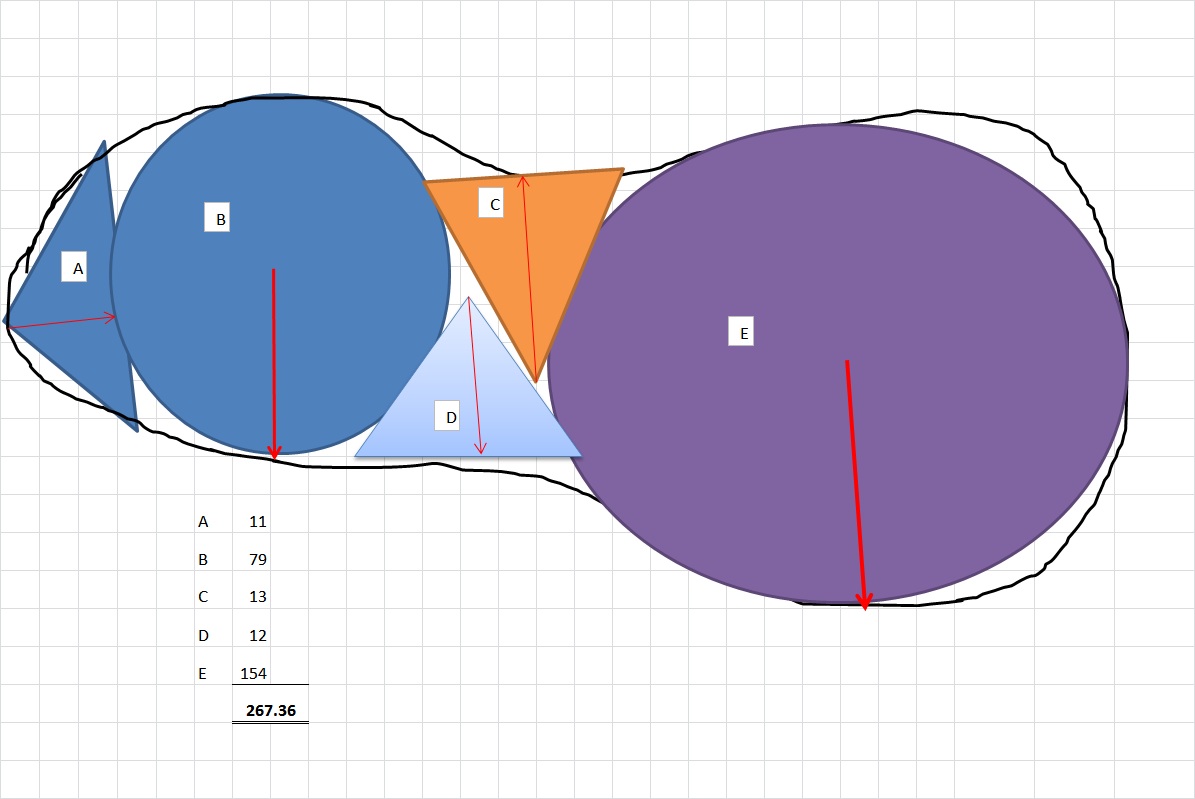
1. Put in geometrically correct shapes in it and measure those shapes. You may need quite a lot of water-based paint, a length of rope, one or two metal spike and measuring tape. First sketch out the geometry shapes on paper, then mark the boundaries of the shapes on the ground (you don’t need to draw the whole circle, only where you want to measure and where it touches the boundary of another shape or the end of the area/green). Put the stake in the ground where the center of the circle is; tie a rope to it and tie a know to where you want the circle to … well… circle.

Putting (imaginary) geometry shapes

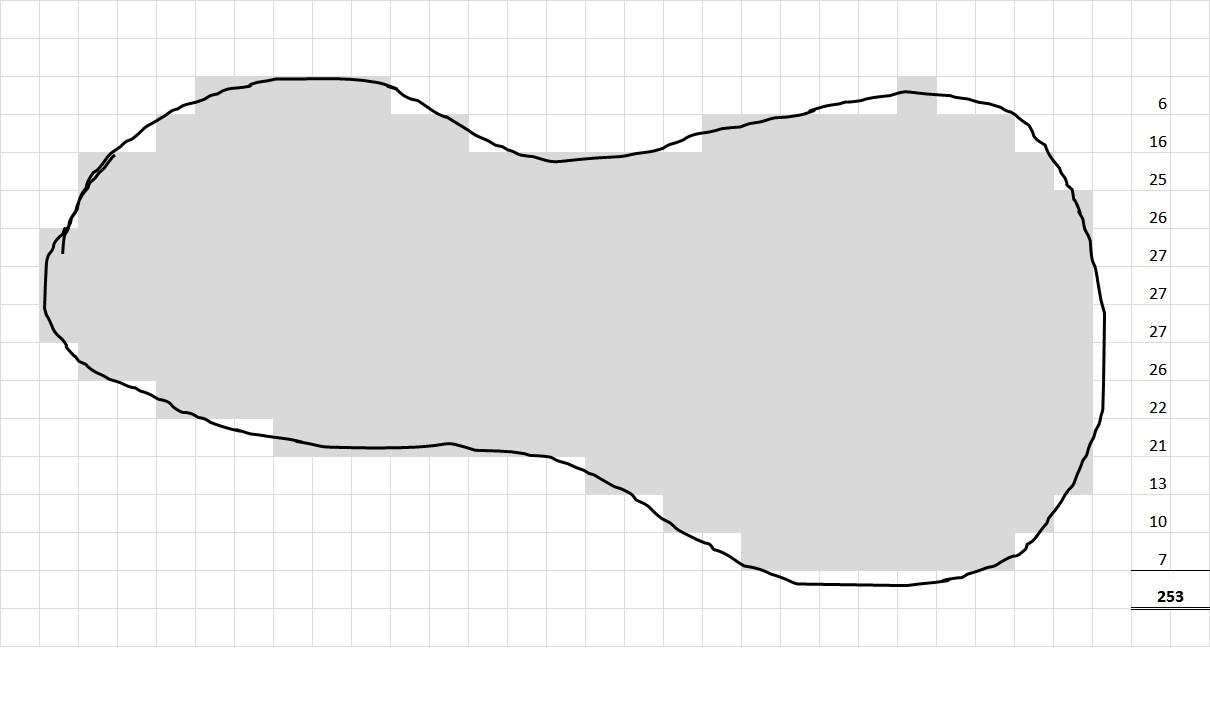
2. Find the longest part of the area/green. Measure that and consider it as distance A to B. Divide the distance into a few equidistances; I usually use 10 because I find it easy to divide any length by 10. Actually, the more equidistance (what does that actually mean?) you have the more accurate your calculation. Then measure the length of each equidistance and find the average. Lastly multiply distance of A-B with average length of equidistance and you get the size.

Its almost like lenght x width. Except that you get width by averaging the length of several  equidistant lines.

Irregular shape - size measurement.

The first picture above is drawn with Excel and is used to calibrate whether my two calculations method are correct. I assumed one Excel box is 1m x 1m. By calculating the number of boxes I get the size of the area.


Weights and Measures, Metric Conversions Weights and Measures,
Metric Conversions


Posted in Fields, Greens, Landscape, Padang Golf, Taman | Leave a Comment »

A slow green is better than a fast brown

Posted by mynormas on July 16, 2011

I just came back from a golf course in north Malaysia where the weather has been hazy; little sunlight. But at the same time, in central region, we are having thunderstorms/heavy rains in the evenings with about the same result; little sunlight.

For both situations, I would advise people to raise their cutting heights. But please don’t stop or skipping mowing. Just mow higher. For green, raise it by 0.5mm and for fairways and fields, well, if the weather doesn’t improve soon or when you start to notice that you are cutting more leaf or the grass starts turning brown after mowing; raise your mowers by a notch or by 2mm.

For rough or fields under shade (trees, buildings etc) you may need to take action sooner.

Remember that grass is a plant that uses photosynthesis to make food and that process needs sunlight to work. If there is not enough sunlight, the leaf and stem will start to lengthen

Same grass. Gues which one got not enough sunlight

. When they lengthen and you cut at the same height; you are cutting off more leaf than usual.

The usual response I get to that advice is: but my greenspeed will be slower! And my usual answer is: A slow green is better than a fast brown.

Posted in Fields, Greens, Padang, Rumput secara am, Taman | Leave a Comment »

Rekabentuk lanskap: nak tanam apa, kenapa dan bagaimana.

Posted by mynormas on June 8, 2011

Rumput hanyalah sebahagian dari lanskaping. Bahagian-bahagian lain yang berkaitan ialah pokok, pokok renek (shrub), kolam, ukiran dan sebagainya. Oleh kerana kadang-kadang saya di minta untuk memberi tip rekabentuk lanskap, saya kali ini nak bercerita sedikit tentang hal itu.

Ada macam-macam cara untuk merekabentuk lanskap. Ramai dari kita merasakan bahawa nak lanskap halaman rumah hanyalah tanam rumput, pokok, bunga dan juga batu hiasan; semuanya di susun mengikut citarasa tertentu. Sebenarnya ada tiga cara untuk merekabentuk lanskap.

  Jenis tumbuhan Cara susunan Pemilihan tumbuhan
Lanskap tradisional Menggunakan tumbuhan bukan tempatan (dan mungkin ada juga tempatan) Di susun secara bentuk formal (kadang-kadang ada juga tak formal) Tumbuhan di pilih berdasarkan kecantikan sahaja.
Lanskap semulajadi Menggunakan tumbuhan tempatan. Di reka supaya mencontohi kawasan semulajadi dan mengekalkan hidupan liar tempatan. Tumbuhan di pilih berdasarkan kecantikan DAN nilai semulajadi serta untuk mengekalkan keadaan semulajadi suatu kawasan.
Pemulihan ekologi Menggunakan tumbuhan tempatan. Di reka untuk menjadi suatu komuniti semulajadi dan memulakan proses ekologi. Tumbuhan di pilih untuk memaksimakan struktur dan fungsi ekologi komuniti itu.

Cara ketiga iaitu pemulihan ekologi tidak sesuai untuk halaman rumah walaupun mungkin ramai yang lebih suka untuk membiarkan lalang, semak dan pokok tumbuh liar dengan alasan ia adalah untuk kebaikan ekologi alam sekitar.

Cara kedua mungkin lebih sesuai di cadangkan untuk kegunaan kebanyakkan orang biasa. Kita akan menggunakan rumput tempatan seperti Cowgrass, Serangoon ataupun Mutiara. Tapi yang pentingnya ialah pemilihan pokok. Bila kita sebut pokok tempatan, maksudnya ialah pokok yang boleh di lihat di kawasan sekitar tempat itu; pergi ke Cameron Highland untuk membeli bunga yang tumbuh di sana ataupun membela satu spesis anggerik eksotik tidak lagi di anggap lanskap semulajadi.

Contoh lanskap “cara pertama”; kita nampak pokok cantik, kita beli dan kita tanam.

Carilah contoh di kawasan tempat tinggal kita dan kemudian beli atau mintak dari orang yang berkenaan – menggunakan tumbuhan tempatan tidak memberi lesen untuk mengambil tanpa kebenaran dari rumah sebelah. Kemudian, beri tumbuhan dan pokok itu ruang untuk tumbuh secara semulajadi dengan penjagaan yang minima. Bukan tidak berjaga langsung, tetapi biarkan ia tumbuh secara semulajadi; kita masih lagi memerlukan keseragaman atau corak tertentu.

Di sebuah kelab golf tempat saya bekerja dahulu, saya mengamalkan konsep ini kerana kawasan lanskapnya tidak berbela dari lama dulu dan saya tidak mampu membeli tumbuhan baru. Saya buang pokok yang paling sedikit dan tidak mempunyai nilai kecantikan (contohnya betik liar) dan biarkan rumpai dan pokok lain hidup secara semulajadi. Saya cuba biakkan rumpai yang mempunyai bunga warna putih dan ekor kucing supaya tumbuhan di situ kelihatan lebih seragam. Setiap tahun, saya akan hantar orang untuk memotong anak pokok (supaya tidak menjadi hutan) dan tumbuhan menjalar. Dalam masa setahun, kelab tersebut memenangi tempat kedua dalam pertandingan lanskap peringkat negeri.

Belanja minum?

Derma untuk belanja saya dan memberi lebih tenaga supaya lebih kreatif!

5.00RM

Dengan pemilihan tumbuhan yang kita bincangkan di atas, kita akan terus pergi ke topik corak atau keseragaman rekabentuk. Prinsip-prinsip utama ialah:

  1. Konsistensi. Kita boleh terjemah ini sebagai mempunyai suatu tema tertentu (Bali, Zen, modernistic, simple  dan sebagainya) ataupun semata-mata bersifat konsisten dalam memilih tumbuhan dari segi warna (warna hijau, warna cerah dsb), ketinggian (lebih tinggi dar 5 kaki, lebih rendah dari lutut dsb),  sifat (menjalar, tropika dsb) dan sebagainya. Ia adalah tentang memberi ekspressi utama tentang lanskap kita.
  2. Keseimbangan. Ini tentang sifat simetri dalam lanskap; contohnya pokok palma di kedua-dua belah pintu masuk, mempunyai jumlah pokok yang sama di kiri dan kanan taman dan sebagainya. Sebenarnya “ketidakseimbangan” juga adalah suatu konsep atau prinsip dalam rekabentuk lanskap; iaitu bentuk abstrak atau ‘bebas-bentuk’ (free-form) tetapi masih lagi konsisten. Contohnya bentuk flower-bed yang bebas bentuk tetapi mempunyai bunga yang sama warna di dalamnya. Atau bila kita ada sebaris pokok palma hijau dan kita selangkan dengan palma merah pada jarak yang rawak supaya warna itu lebih ceria tanpa monotoni.
  3. Warna ialah sebab utama kita memilih bunga atau tumbuhan tertentu. Warna terang seperti merah, kuning dan oren akan nampak dekat dan warna lembut seperti hijau, biru dan pastel akan nampak jauh. Jadi jika menanam tumbuhan berwarna terang di hadapan dan warna lembut di belakang, halaman boleh kelihatan lebih besar.
  4. Garisan. Ini ialah tentang pagar, jalan, titian, susunan batu ataupun bentuk flower bed. Kita nak lurus ataupun berombak? Apa tema lanskap kita?
  5. Kadar atau proportion. Ini adalah prinsip tentang saiz bahan bahan dalam kawasan lanskap. Jika kawasan lanskap anda kecil dan anda akan menggunakan pokok kecil kenapa tiba-tiba ada satu ukiran besar di tengah-tengah? Biarkan semua tumbuhan, hardscape dan sebagainya dalam lanskap anda mempunyai saiz pada kadar yang serupa.
  6. Ulangan. Konsep ni sama dengan prinsip ‘konsistensi’ tadi. Cuma ingat satu benda; terlalu banyak satu warna atau satu tumbuhan akan membosankan. Tetapi terlalu banyak jenis atau variety juga akan menyebabkan lanskap nampak semak dan seperti tidak mempunyai rencana.

Kita berhenti di sini. Tapi ini tidak bermakna bahawa ini adalah muktamad. Masih ada banyak lagi bijak pandai di sana yang akan mempunyai idea atau prinsip rekabentuk lanskap mereka sendiri. Saya tidak suka kata orang lain salah dan saya betul. Kalau saya nampak rumah orang yang tidak menggunakan prinsip lanskap langsung, saya akan kata “suka hati dia lah, rumah dia”

Sila bantu saya dengan ‘Like’ artikel ini; ‘Follow’ laman web ini dan ‘Click’ di mana-mana atau semua iklan di laman web ini.

Maintaining this Website. Sumbangan.

Saya menyumbang ilmu secara ikhlas melalui laman web ini. Tetapi pengendalian laman web ini perlukan wang. Setiap tahun USD99 (lebihkurang RM400). Sedikit sumbangan anda amat membantu. Anda mendapat manafaat dari laman web ini? Sumbangan bermula dari $10. Jangan lupa ‘Like’ artikel ini; ‘Follow’ laman web ini dan klik mana mana iklan di page ini. This website is maintained and managed with my own money. I’ve done my best to not allow advertisement on this site thus far so that I can be independent. I’m going to start to ask for donations and see if I can get enough to sustain it that way. Donations start from $10.

$10.00

Jangan lupa membaca part II artikel ini “Rekabentuk Lanskap: macamana nak mula” 

Posted in Landscape, Rumput halaman rumah, Taman | Leave a Comment »

Slicing on fairways/fields/padang bola

Posted by mynormas on June 7, 2011

Many – or maybe I should say all – Malaysian golf courses would do cultural practice on their greens. They would dethatch, they would scarify and they would aerate them by hollowtine at least once a year, more often, twice a year. But rarely do we see the same thing being done on fairways or fields; whether football or municipal.

Why not?

Most of the time it is because the size of the area demands that a lot of resources; machinery and manpower have to be devoted to complete the job. In the case of dethatching or hollowtining, we will have to get rid of the

Many machines needed to just collect the thatch. Not all in picture; the trailer not here.

thatch and cores and over the size of the 18 holes; that is a lot of stuff. Plus the work will also be in the way of the golfers. If the weather is unkind, a sudden downpour halfway through the job may mean a messy fairway for days if not weeks.

should we?

You mean should we actually do these cultural practice on fairways, roughs or fields? Of course lah! For the same reasons that we do the work on the greens. The fairway has thatch, it needs aeration, bla bla bla. We may not need to do it at the same frequency or intensity of the green, but do it we must. In fact, for areas close to the green like approach and collars, perhaps we shuld do it at the same intensity. Because they are played on  with almost the same pressure as on the green.  Plus with too much thatch, there will be less ball roll espcially when wet. Same principal for padang bola too coach. The thatch acts like a sponge holding water.

How?

I would recommend dethatching to be done at least once a year. And hollow-tining too. The thatch will have to be sweeped and disposed. The cores can be flailed or perhaps mown with a rotary to break them up (I’ve never actually tried that though) and then dragged as topdressing.

Really?

I understand, it is tough to do, what with not enough equipment and the pressure of trying to fit in as many golfers as possible during the dry periods and these works can’t be done in the wet season. So what can be done alternatively 1. Do it only at the landing areas (though you may get fairways with different characteristics) 2. Do it only on selective fairways (but do it on whole fairways) or 3. Slice.

A slicer that is used regularly.

Now we get to the punchline for this whole post. Why are some golf courses, football fields, padang bola letting their slicers rust in the workshop? I seen it with my own eyes. The slicer, can be used frequently to help water and air penetrate through to help the micro environments under the thatch to do their stuff. Slice the fairway once every two months alternating with rough; that way, we could create a contrast between rough and fairway more. Some golf courses have this expensive small flags to mark their sprinklers, but I used to have workers who mark the sprinklers with oil palm leaves (not fronds) that they can afford to just leave there after the operation or let the mower run over.

Slicing during dry season tends to leave a dry edge to the sliced turf but it is temporary and I think it is better than the alternative; localized dry spots!

Posted in Fields, Maintenance, Padang, Taman | Leave a Comment »