Turf Matters

The Site To Go To For All Your Turf Matters

  • Facebook Likes

  • The new Brushcutter

    Pengganti Brushcutter

    Increase productivity, cut labour. Try the AM61A

  • Trees Nursery

    Forest trees nursery

    Get your Trees from this nursery

Archive for the ‘Fields’ Category

Stadiums, parks etc.

Lumut di rumput

Posted by mynormas on November 17, 2011

Lumut atau algae bukan suatu penyakit. Ia adalah simptom kepada satu masalah: masalah kelembapan yang keterlaluan. Kadang-kadang kelembapan di sebabkan oleh:

Lumut bermula di celah-celah rumput

  1. air yang bertakung dan lambat kering,
  2. kawasan redup yang kurang matahari
  3. tanah yang terlalu padat dan tidak mengalirkan air ke bawah.
  4. Terlalu banyak air dari siraman atau hujan.

Rumput akan menjadi semakin jarang kerana akar rumput memerlukan udara untuk bernafas dan jika tanah itu lembab terlalu lama maka akar rumput akan reput atau mati. Algae akan tumbuh kerana algae sesuai atau suka dengan kawasan lembab.

Algae adalah tumbuhan mudah (simple plant) tetapi ia masih memerlukan cahaya matahari untuk membuat makanan.

Jadi untuk mengurangkan algae, kita boleh buat dua perkara; kurangkan kelembapan dan atau menafikan cahaya matahari dari kena kepada algae tersebut. Ada juga pendapat yang mengatakan bahawa algae suka kepada tanah yang sedikit berasid, tetapi dari pengalaman, saya pernah juga jumpa algae di green yang di uji sebagai tanah pH neutral dan green padang golf yang baru di tabur dengan kapur CaCo3.

Menebuk lubang lebih kurang 2 inci supaya air mengalir ke bawah.

Bagaimanapun cadangan saya ialah dengan menebuk lubang kecil di kawasan yang berlumut supaya air boleh mengalir kebawah; kurangkan kelembapan dengan mengurangkan dahan-dahan yang membayangi tanah, melakukan topdressing dengan pasir supaya ‘melemaskan’ algae yang lebih rendah dari rumput dan mengurangkan pengairan serta menambah saliran.

Saya pernah mencakar lumut supaya rumput dapat tumbuh tapi apa yang saya dapati ialah ia akan tumbuh semula selepas beberapa hari jika masalah kelembapan tidak di atasi.

Satu caveat: menebuk lubang di permukaan supaya air mengalir ke bawah hanya berkesan jika bahagian bawah tanah mempunyai saliran yang berkesan (contohnya mempunyai kandungan pasir yang tinggi), tetapi jika bahagian bawah permukaan juga adalah tanah liat atau tanah yang memegang air, maka mungkin terpaksa di korek dalam lagi, menggunakan besi panjang ataupun penggali lubang seperti auger.

Topdress mempunyai 2 kegunaan: 1 ialah menutup lumut dari menerima cahaya matahari dan 2 ialah membantu akar rumput tumbuh di tempat kosong. Tetapi, seperti dalam gambar ini; topdressing sewaktu musim hujan adalah kerja mencabar.

Jika permukaan sahaja yang bermasalah (selalunya kerana di lanyak atau di lenyek) maka kadang-kadang menggunakan sekadar parang tumpul dan mengguris permukaan supaya air tembus algae dan masuk ke bawah.

Selamat mencuba!

Posted in Fields, Greens, Lanskap, Padang Golf, Rumput halaman rumah, Topdress | 1 Comment »

Mowing during rainy weather

Posted by mynormas on October 26, 2011

Mowing during rainy weather is pretty tricky. But if the machine operator does not have disicipline, he/she could turn a wet situation worse. A wet fairway,  rough or field is bad enough but a mower mowing in a wet patch will churn up the ground. You can end

It could've been worse. But more often than not, this is just the beginning.

up with a muddy patch on your field, fairway or rough that will take ages to be brought back to shape. Not to mention you may end up with tyre marks or compaction below the surface.

Ask your operator to back off from mowing that particular area if he finds that he is leaving tyre marks or churning up the ground. He should report it in so that a solution will have to be found if that area could not be mowed for too long. A lighter machine, a push behind or even a back-pack brush cutter may have to be utilized.

Note: you should look at draining or topdressing that particular area when the weather is better.

In the same vein, for those of us who are into striping our fields, fairways or roughs; now may be a good time to not concentrate too much on them too. Alternate mowing patterns for a couple of months won’t make much difference. Remember mowing in the same place all the time (such as when you are mowing for stripes) will make the tyres stay in the same ‘lanes’ all the time thereby creating compaction or worse: ruts. In fact; I would recommend changing patterns once in a while (say every couple of years?)

The stripes look nice, but don't forget you are putting your mower's tyres (tires?) in the same line everytime you mow.

Stripes on a football field.

Posted in Fields, Golf Course Superintendents, Maintenance, Padang Golf, Taman | Leave a Comment »

Choosing grass

Posted by mynormas on October 18, 2011

One of the most common question I get asked is; what type of grass should I use?

There are actually three important criteria to think about when choosing grass, and I write this in layman terms, mainly:

  1.  The condition of the area – whether it is shaded, it gets too much water (for example it is next to non-porous area e.g. road or pavement or perhaps it is out in the open with poor or no irrigation).
  2. The budget for future maintenance of the grassed area and
  3. The use of the grassed area; simply whether it is more for aesthetics or more as a playing field. In the golf course, this question will also refer to whether that area is a green or a rough.

Now for home-owners (and I get a lot more questions from these people) I usually tell them the order of priority will be 1. The condition of the area; 2. The budget and time they are willing to spend on maintenance and 3. The use; whether the lawn is for impressing passers-by or is it for grandchildren to play on? Stuff like that.

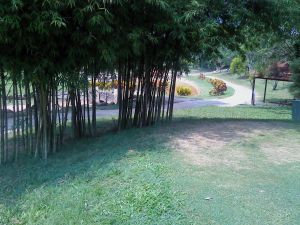
The Bermuda carpetgrass planted at cost under the bamboo? Dead. The Cowgrass that came on its own for free? Nice. Lesson? Use cowgrass under shade.

For golf courses, playing fields, stadiums and large areas like municipal councils, the order of priority is reversed: I ask them to think of what is the use of the area – whether it is for greens, for tees, for out-of-play areas,

football, picnic, or whatever. Then they should think of the budget they are willing to spend for maintenance (and I would like to emphasise FOR MAINTENANCE) and lastly only about the condition of the area. Why is the order reversed? Because, for these kind of construction, the condition can be modified, trees can be moved, or the green can be redesigned away from the large 100 year-old tree, for instance.

Most of these owners, be them developers, local government or large bungalow owners etc, will have a huge budget during construction but when it comes to routine daily maintenance; they scrimp and save.

Zoysia is a nice grass but needs to be cut once a week - at least. If you can't afford to do that, why use it?

So what I advise is: design and pick plants for the place so that it will be cheap and easy to maintain in the future! Naturally,  people want the best and most designers/contractors who are paid by percentage don’t mind at all to oblige.

But I digress. The world of grass is divided into three main areas; warm-season and cool-season. The third area? What is termed as the transition zone area, this area is cold enough in the winter to make it difficult to maintain warm-season grasses and warm enough in the summer to make it difficult to grow cool-season grasses, therefore, no single species of grass is well adapted in this region.

So there are only two types of grasses; warm-season and cool-season grasses. In the transition zone areas, they will use quick growing cool-season grasses in the autumn and early winter and warm-season grasses in spring/summer.

What are the characteristics of warm season grasses? They thrive in air temperatures from 27 – 35 degrees Celsius and soil temperatures of 21 – 32 degrees Celsius. They’ll lose chlorophyll in autumn and turn from green to brown.

Cool-season grasses grow very well when soil temperature is between 10 – 18 degrees Celsius and air temperatures a cool 15 – 24 degrees Celsius.

Tall fescue is a cool-season grass

Other than those, there are of course a few other things that should be taken into consideration too. Soil types, quality of water for irrigation – in fact, quantity of water too; there are a few other things if we want to go into details. But lets leave it at that for now.


Weights and Measures, Metric Conversions Weights and Measures,
Metric Conversions


Posted in Fields, Greens, Landscape, Lanskap, Maintenance, Padang, Padang Golf, Rumput, Rumput halaman rumah, Rumput secara am, Taman | Tagged: , , , | Leave a Comment »

Menyiram rumput

Posted by mynormas on October 16, 2011

Bagaimana patut kita menyiram rumput? Ada dua tiga sebab kita menyiram rumput.

  1. Kerana rumput memerlukan. Diantara tanda-tanda: tanah kering atau rumput layu: ini ertinya perlu siram.
  2. Kerana kita meletakkan bahan keatas rumput yang perlu di siram supaya ia meresap ke tanah. Contohnya baja, setengah jenis racun, bahan pelembab (wetting agent),  topdressing dan sebagainya.
  3. Kerana cuaca terlalu panas dan kita menyejukkan permukaan tanah untuk melindungi akar rerambut atau menurunkan suhu permukaan. Siraman ini dinamakan ‘syringing’ dan bukan bertujuan memberi rumput air; HANYA untuk menyejukkan permukaan. Ertinya siraman dua minit biasanya mencukupi. Untuk kawasan yang rumput di potong pendek, contohnya green di padang golf (3-6mm) kadang kadang syringing di lakukan hingga dua kali sehari (contohnya kul 11pagi dan 2 petang)

Jangan, jangan, jangan siram mengikut jadual. Contohnya setiap Isnin, Rabu dan Jumaat. Atau setiap hari pukul 4pagi. Jangan siram jika ia akan menyebabkan tanah lembab hingga ke malam: ini akan menyebabkan penyakit. Ertinya elakkan menyiram di kebanyakkan tempat selepas pukul 5 petang (ada tempat pukul 3petang pun dah tak boleh siram contohnya jika tempat yang teduh).

Amalkan siram di awal pagi. Ini memberi peluang tanah menyimpan air hingga ke tengahari di waktu ia paling memerlukan air. Menyiram di waktu petang; rumput mungkin kata “Aku dah nak mati kering baru kau nak siram!” dan juga akan menyebabkan tanah lembab hingga ke malam yang boleh menggalakkan kulat dan lumut.  Lagipun waktu pagi kurang angin yang menyebarkan air terlalu jauh/dekat (bergantung arah angin dan arah air).

Berapa lama nak siram? Siram jarang-jarang tapi lama-lama (Water irregularly but deeply). Ini akan menggalakkan akar tumbuh panjang mencari air. Siraman terlalu kerap akan memanjakan rumput. Pasal tu kita siram hanya bila rumput memerlukan, bukan ikut jadual. Biasanya saya siram 20 minit. Tapi awas, untuk kawasan yang terlalu curam atau tanah yang padat (air akan bertakung atau mengalir dan tidak masuk ke dalam tanah) saya mungkin akan menyiram 10minit x 2 ataupun 5minit x 4; tunggu hingga air meresap… dan ulang. Perkara ini perlukan pemerhatian dan pemahaman.  Lain tanah, lain siraman.

Sprinkler irrigation in a golf course

Sprinkler irrigation in a golf course.

Posted in Fields, Golf club, Landscape, Padang, Padang Golf, Rumput halaman rumah, Taman | Leave a Comment »

Tukang kebun glamour (part 1)

Posted by mynormas on September 20, 2011

“Hello, excuse me, you GM sini ke? Padang you cantik lah” kata seorang pemain golf/bola kepada GM sebuah kelab/stadium ketika mereka terserempak di kedai makan kelab/stadium tersebut. “Thank you” kata Encik GM “ini adalah kerana program pembangunan sumber manusia yang sedang giat di lakukan ketika ini. It is all a team effort” “Team effort” adalah kata pujian yang paling sipi terkena kepada orang-orang yang menjaga padang, samada padang golf ataupun padang bola. Orang-orang yang bekerja di waktu awal pagi, di akhir petang untuk menyiapkan padang untuk pemain.

Kesian siapa yang ofis nya macam ni.

Siapa mereka ini? Siapa orang yang bertanggungjawab memastikan rumput dipotong, membetulkan kerosakkan paip, menyembur racun, mengganti lubang pin, menukar tee marker, menyiram, membersihkan longkang, memotong pokok dan seribu satu macam kerja lagi di padang?

Siapa mereka ini? Siapa mereka yang namanya tidak di kenali, kulit hitam di bakar matahari, mata pedih kepanasan, bekerja dalam risiko terkena bola golf, terhidu racun, dengan memakai baju lusuh, berbau baja organic, kalau kayu golf hilang; orang pertama jadi suspek, bila bercakap dengan mereka; ada golfer guna isyarat tangan seolah mereka tak tahu bahasa?

Siapa mereka ini? Siapa mereka yang ada padang golf anggap sebagai orang penting, atau dianggap tak penting; yang mempunyai jabatan paling besar di sebuah kelab golf; yang boleh mengharumkan atau membusukkan nama sebuah kelab golf; yang boleh merosakkan alam sekitar dengan racun dan baja jika lalai; yang mempunyai kelulusan tinggi atau yang tiada kelulusan; yang mempunyai belanjawan hingga mencecah jutaan ringgit setahun atau yang tiada belanjawan rasmi?

Siapa mereka ini? Kadang-kadang di puji, selalu juga di keji?

Kata orang dulu-dulu; lain padang lain belalang, kata orang sekarang; lain padang, lain lah nama penjaga nya. Kadang-kadang, mereka di panggil Pengurus Padang Golf, kadang-kadang, Eksekutif Padang Golf, ada kelab yang memberi mereka nama tinggi seperti Pengarah Operasi Padang Golf atau nama biasa seperti Supervisor Padang Golf. Jarang-jarang mereka di panggil “Penguasa” (terjemahan dari perkataan Superintendent dari jabatan Polis). Saya ingin mencadangkan kita tetap dengan nama Superintenden (tanpa ‘t’ seperti dalam Bahasa Inggeris). Selain itu, jawatan Greenkeeper (bukan goalkeeper) dan Groundsman juga telah mula di perkenalkan.

Apa pun nama di beri, tugas hakiki mereka serupa. Menyediakan padang permainan golf sebaik mungkin menggunakan sumber-sumber yang di beri, dengan kebolehan yang ada untuk pemain golf di padang itu, dan menjaga pelaburan atau harta tuan punya padang.

Orang yang kerja kat padang golf kena boleh kerja luar dan dalam; keperluan utama jawatan ini ialah orang yang suka bekerja di luar pejabat, sama ada di dalam panas atau di bawah hujan. Di masa yang sama, seorang Superintenden masih perlu tahu membuat kerja pejabat sama seperti eksekutif atau pengurus lain. Mereka perlu tahu menggunakan komputer, menjaga akaun, membuat laporan, memberi alasan dan kerja-kerja pengurusan yang lain. Ia juga adalah tugas yang melibatkan kombinasi sains dan seni; sains dari segi penjagaan dan seni dari segi penyampaian atau orang putih kata ‘presentation’. Belang-belang kat fairway tu bukan senang! Nak buat belang kiri ke kanan ke, kanan ke kiri atau terus dari tee ke green? Potong rough ikut arah jam ke lawan jam? Bila dan di mana kita nak letak pokok lanskap berwarna merah? Samada orang yang menjaga itu ada seni atau tidak yang membuatkan ada padang golf nampak buruk walau rough dia di tanam dengan pokok lanskap yang mahal, tapi padang lain nampak cantik walaupun rough dia sengaja tak di bela.

Gambar hiasan

Nak kerja kat padang golf; kerja atas pun boleh, kerja bawah pun boleh; maksud saya, kadang-kadang kerja seperti seorang boss dan menjadi ketua, kadang-kadang, kerja macam seorang buruh dan sama-sama mencangkul. Perawakan lembut dan menarik kadang-kadang di perlukan kerana kerja di padang golf akan menyebabkan pekerja terpaksa berhadapan dengan VIP besar dan terkenal, tetapi perawakan keras dan lasak juga di perlukan bila berhadapan dengan pekerja buruh yang memerlukan pimpinan tegas. Kerja di bahagian hadapan pun boleh, kerja di bahagian belakang; pun boleh.

Posted in Fields, Golf Course Superintendents, Padang Golf | Leave a Comment »

Managing Malaysian lovegrass (C. aciculatus)

Posted by mynormas on September 15, 2011

Lets not kid ourselves, there are many Malaysian golf courses, football fields and tamans that are plagued by the lovegrass (presumably named because it loves our pants). I have seen golfers comments that hate a particular golf course because that golf course has a lot of lovegrass on its fairways.

Lets start a discussion – although from experience this ‘discussion’ will end up being a monologue – but lets discuss anyway. Lets clarify what is ‘lovegrass’. Its that type of plant that has seeds that sticks to pants or socks. The leaf are light green. It is sometimes called as ‘kemuncup’ in some places in Malaysia. In the U.S it is called as the pilipiliula or golden false beardgrass or false beardgrass (http://plants.usda.gov/java/profil

This field was cut about 5 days ago! But the amount of lovegrass now would make a pious man curse...

e?symbol=CHAC) and Mackie’s pest.

What ever it is called I am sure most of us agree that it is a pest.

The leaf and the plant per se is tolerable but it is the seeds and how they were made to propagate that gets most golfers, footballers, joggers (or their wife, mom or maid) worked up. They stick to the pants and socks with no regard to price, brand or label.

Why on earth Malaysians called it love grass is a mystery.

It is also a stubborn pest. The only effective selective pesticide I know that we can use against it is Facet (available in Malaysia). Of course you can use Round-up but that may fall into the ‘overkill’ territory.

It resists mowing with regular reel mower, no matter what brand or how many reels. I have had arguments with two golf course superintendents (actually, make that three but in the end that one guy bought a rotary mower though I suspect it could be because of the price)   who insisted to buy five-gang reel mowers even though their fairways are infested with lovegrass. Why? Because all the other golf courses use a five-gang how can I use a tractor mounted rotary mower?

I have pictures of this golf course with better stripes; but no tractor, so this will have to do. Not to mention that I'm late already. Just take my word that rotarys make stripes

Using Facet has its drawbacks, one of it (other than price) is that it affects cowgrass. I am currently helping a Superintendent testing a few rates of Facet to see which will not kill cowgrass permanently. Lets see what happens; I have my doubts because as I see it, there is just too much lovegrass on his fairways. In my opinion, he would be better off changing his old five-gangs with second-hand mini-tractors equipped with new rotary mowers and mow twice or thrice a week.

Newsflash: Facet kills lovegrass. But the broadleaf survives! Not the cowgrass. And those are RM240 Hush Puppies.

Of course, if your golf course, field, taman or lawn that was planted with Bermuda or Zoysia, by all means; spray it out. Unfortunately, if your bla bla bla was planted (or is now covered) with cowgrass or Serangoon then your options are limited: if not much or only a few areas are invaded by lovegrass – you still could do chemical control. Otherwise you may have to replant (though I would still advise you to use chemical first to ensure no seeds or roots are left behind to continue) or buy new rotary mowers. For lawn owners, you may need to buy your own cutters or adopt one of the foreigner-who-mows-house-lawns as ‘anak angkat’.

Plus, a certain brand of golf course machinery is now coming out with five-gang rotary mowers too so you don’t lose your prestige when talking to other peers at the networking dinner of the club/stadium/local council/dewan bandaraya. And don’t worry, rotary mowers can make stripes as well as reel mowers too.

Try it.

The lovegrass just springs back up behind the mower. But notice that the leaves are quite nice.

Posted in Fields, Golf club, Golf Course Superintendents, lovegrass, Padang, Padang Golf, Taman | 1 Comment »

How big is yours?

Posted by mynormas on August 17, 2011

I am amazed and amused when I found out that there are still golf courses in Malaysia that do not know the size of their greens. Some that DO know, has the figures handed down to them over the generations since construction began during the Malacca Sultanate. The measurement came in ‘hasta and jengkal’ which was converted to feet and inches during the British Occupation and finally to meters. And get this; the size of the green was measured by the construction company. Why the owners  trusted the measurements of the company in the first place is anybody’s guess. Why the current Superintendent persisted with measurements done by people he(or she) doesn’t know is a mystery. Why can’t golf courses measure their greens once a year or couple of years?

Ok. Forgive my outburst. “Why do people need to know the size of the greens?” you ask. And before people who don’t manage golf courses turn away, this goes for any turf area too: you need to know the size of the area to manage it better. Stadiums, football fields, lawn-owners, parks, tuan rumah, majlis daerah etc etc.

I mean, how do you know how much fertilizer to put on each area? How much fertilizer should you buy? What should your budget be for fertilizer next year? Not just fertilizer too, fungicides, insecticides, growth regulators, wetting agents, machinery etc.

Yeah, yeah, yeah, I’ve heard the excuse “I use the setting on the fertilizer spreader/chemical applicator”. But fertilizer granules comes in different size and weight, how do you justify using the same setting for one fertilizer that looks like flour and another that is as big as pebbles? You think the same amount of fertilizer will come out? And how about for stuff that has recommendation of kilogram per hectare or gram per square meter, how do you measure that? And if your soil test report say: apply 5 pounds of CaCo3 per 1,000 square feet, how do you measure that?

How many people actually calibrate their fertilizer spreaders and chemical applicators anyway? Once a week? Once a year? Or only one time; purchase time?

Grr… just last week I had a (small) argument with a guy who insisted that it is ok to put one bag of fertilizer for every green. All greens. He doesn’t grasp that  small greens will have received a lot of nutrients and big greens will have received less. I am not surprised. That was how I was taught 17 years ago by a local Superintendent with 20 years experience; until a foreign superintendent came in and

For calibration only. Not suited on the ground (unless you want to draw little squares on green)

taught me otherwise. But still, in this age of environmental-friendliness, expensive fertilizer and cheap knowledge, there are still these kind of things?

Not knowing the size is also one reason why if you go into the store and you see leftover fertilizer/chemicals from years ago.

I once saved a club one bag of fertilizer for every round of fertilizing (at that time he was fertilizing once every two weeks) by measuring his greens. So you see, its worth it. And you should do it periodically since sometimes greens are shrunk by workers mowing at 6.00 am (or increase in size).

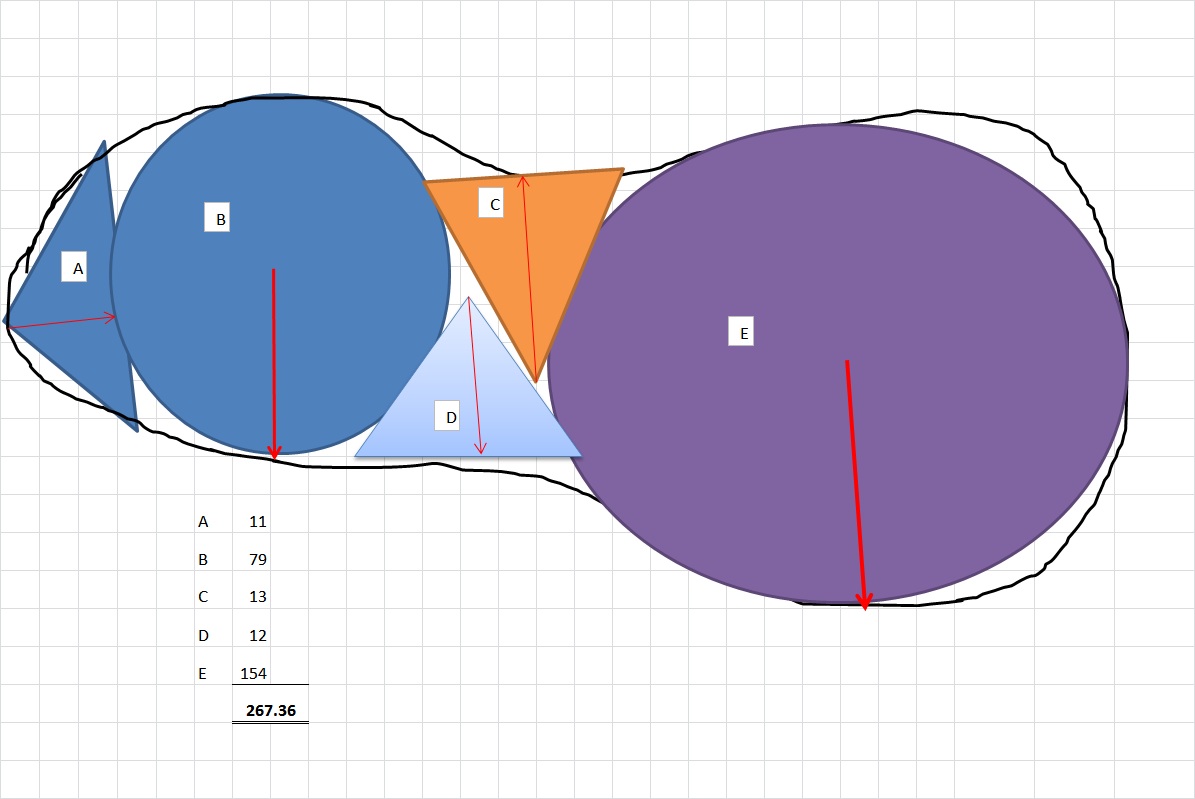
Measuring size is easy. For football fields or other geomatrically shaped area (square, round, triangle etc) you probably just have to find the right formula. For areas that do not have regular shapes; there are two ways of doing it. In both cases you need a sketch of the area or greens.

1. Put in geometrically correct shapes in it and measure those shapes. You may need quite a lot of water-based paint, a length of rope, one or two metal spike and measuring tape. First sketch out the geometry shapes on paper, then mark the boundaries of the shapes on the ground (you don’t need to draw the whole circle, only where you want to measure and where it touches the boundary of another shape or the end of the area/green). Put the stake in the ground where the center of the circle is; tie a rope to it and tie a know to where you want the circle to … well… circle.

Putting (imaginary) geometry shapes

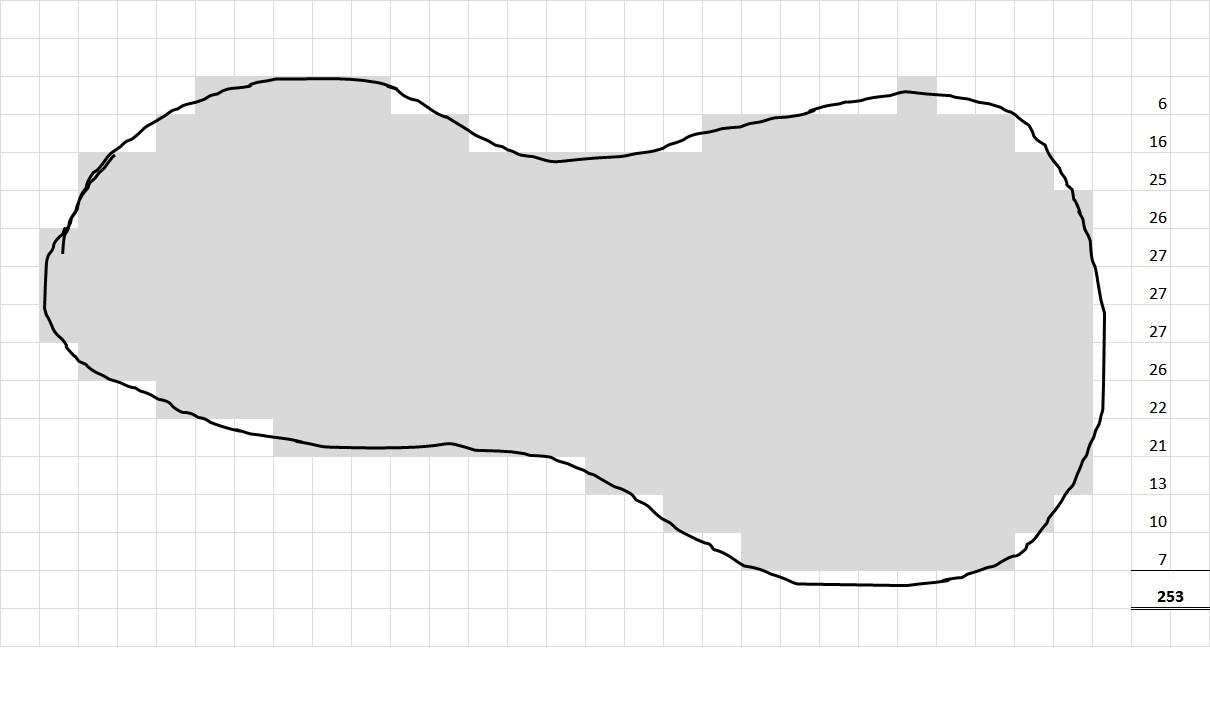
2. Find the longest part of the area/green. Measure that and consider it as distance A to B. Divide the distance into a few equidistances; I usually use 10 because I find it easy to divide any length by 10. Actually, the more equidistance (what does that actually mean?) you have the more accurate your calculation. Then measure the length of each equidistance and find the average. Lastly multiply distance of A-B with average length of equidistance and you get the size.

Its almost like lenght x width. Except that you get width by averaging the length of several  equidistant lines.

Irregular shape - size measurement.

The first picture above is drawn with Excel and is used to calibrate whether my two calculations method are correct. I assumed one Excel box is 1m x 1m. By calculating the number of boxes I get the size of the area.


Weights and Measures, Metric Conversions Weights and Measures,
Metric Conversions


Posted in Fields, Greens, Landscape, Padang Golf, Taman | Leave a Comment »

A slow green is better than a fast brown

Posted by mynormas on July 16, 2011

I just came back from a golf course in north Malaysia where the weather has been hazy; little sunlight. But at the same time, in central region, we are having thunderstorms/heavy rains in the evenings with about the same result; little sunlight.

For both situations, I would advise people to raise their cutting heights. But please don’t stop or skipping mowing. Just mow higher. For green, raise it by 0.5mm and for fairways and fields, well, if the weather doesn’t improve soon or when you start to notice that you are cutting more leaf or the grass starts turning brown after mowing; raise your mowers by a notch or by 2mm.

For rough or fields under shade (trees, buildings etc) you may need to take action sooner.

Remember that grass is a plant that uses photosynthesis to make food and that process needs sunlight to work. If there is not enough sunlight, the leaf and stem will start to lengthen

Same grass. Gues which one got not enough sunlight

. When they lengthen and you cut at the same height; you are cutting off more leaf than usual.

The usual response I get to that advice is: but my greenspeed will be slower! And my usual answer is: A slow green is better than a fast brown.

Posted in Fields, Greens, Padang, Rumput secara am, Taman | Leave a Comment »

Slicing on fairways/fields/padang bola

Posted by mynormas on June 7, 2011

Many – or maybe I should say all – Malaysian golf courses would do cultural practice on their greens. They would dethatch, they would scarify and they would aerate them by hollowtine at least once a year, more often, twice a year. But rarely do we see the same thing being done on fairways or fields; whether football or municipal.

Why not?

Most of the time it is because the size of the area demands that a lot of resources; machinery and manpower have to be devoted to complete the job. In the case of dethatching or hollowtining, we will have to get rid of the

Many machines needed to just collect the thatch. Not all in picture; the trailer not here.

thatch and cores and over the size of the 18 holes; that is a lot of stuff. Plus the work will also be in the way of the golfers. If the weather is unkind, a sudden downpour halfway through the job may mean a messy fairway for days if not weeks.

should we?

You mean should we actually do these cultural practice on fairways, roughs or fields? Of course lah! For the same reasons that we do the work on the greens. The fairway has thatch, it needs aeration, bla bla bla. We may not need to do it at the same frequency or intensity of the green, but do it we must. In fact, for areas close to the green like approach and collars, perhaps we shuld do it at the same intensity. Because they are played on  with almost the same pressure as on the green.  Plus with too much thatch, there will be less ball roll espcially when wet. Same principal for padang bola too coach. The thatch acts like a sponge holding water.

How?

I would recommend dethatching to be done at least once a year. And hollow-tining too. The thatch will have to be sweeped and disposed. The cores can be flailed or perhaps mown with a rotary to break them up (I’ve never actually tried that though) and then dragged as topdressing.

Really?

I understand, it is tough to do, what with not enough equipment and the pressure of trying to fit in as many golfers as possible during the dry periods and these works can’t be done in the wet season. So what can be done alternatively 1. Do it only at the landing areas (though you may get fairways with different characteristics) 2. Do it only on selective fairways (but do it on whole fairways) or 3. Slice.

A slicer that is used regularly.

Now we get to the punchline for this whole post. Why are some golf courses, football fields, padang bola letting their slicers rust in the workshop? I seen it with my own eyes. The slicer, can be used frequently to help water and air penetrate through to help the micro environments under the thatch to do their stuff. Slice the fairway once every two months alternating with rough; that way, we could create a contrast between rough and fairway more. Some golf courses have this expensive small flags to mark their sprinklers, but I used to have workers who mark the sprinklers with oil palm leaves (not fronds) that they can afford to just leave there after the operation or let the mower run over.

Slicing during dry season tends to leave a dry edge to the sliced turf but it is temporary and I think it is better than the alternative; localized dry spots!

Posted in Fields, Maintenance, Padang, Taman | Leave a Comment »

Awas suhu panas

Posted by mynormas on May 9, 2011

Suhu tempatan sekarang semakin panas. Pertama kalinya saya nampak thermometer mencecah 42 darjah Celsius.

Rumput musim panas (warm season grasses) aktif pada suhu lebih kurang 27 – 35 darjah Celsius. Jadi suhu sekarang dah terlampau panas untuk rumput – ia akan menjadi dorman dan bertukar warna kepada perang/coklat. Terutamanya Cowgrass dan Pearlgrass yang mempunyai akar pendek.

Tanda-tanda awal ialah rumput layu dan tidak kembali pada ketinggian asal. Contohnya, bila kita pijak, kita boleh nampak kesan tapak kaki kita. Atau boleh nampak kesan bekas tayar kenderaan.

Jika anda lihat rumput anda menjadi coklat dan anda tak pasti samada penyakit atau suhu; lihat pada daun, jika daunnya kecut bergulung – ianya akibat suhu panas. Kadang-kadang ia hanya bertukar coklat dan di kelilingi daun hijau. Itu juga tanda kekeringan. Daun yang berpenyakit akan berbintik-bintik atau berjalur-jalur dan akan berjangkit ke rumput sebelah.

Rumput di kawasan kering

Sejukkan rumput dengan ‘syringing’ iaitu merenjis atau menyiram secara ‘ringan-ringan’ pada waktu matahari terik. Jangan takut tentang teori bahwa air akan menjadi kanta untuk memfokuskan cahaya matahari dan membakar daun. Ia tidak pernah di buktikan. Jika matahari cukup panas untuk membakar daun; ia akan menyejat air itu dahulu.

Jangan siram terlalu banyak. Bahagian bawah tanah akan tepu dan bahagian atas masih boleh kering – dan di situlah di mana kebanyakkan akar berada. Jangan siram lewat petang, tanah basah hingga ke malam boleh menjadi punca penyakit kulat.

Jika anda ada wetting agent (agen pembasah): gunakan. Ia membantu menjadikan air lebih basah (?) dan menembusi kawasan kering yang benci air (localized dry spot).

Jika anda ada spiker atau slicer, ini waktu baik untuk menggunakannya, tapi ingat, pada awalnya, luka pada tanah bekas slicer itu akan kering dahulu. Tapi ini lebih baik dari seluruh kawasan kering. Bukan?

Posted in Fields, Greens, Landscape, Maintenance, Padang, Padang Golf, Rumput halaman rumah, Taman | Leave a Comment »