Turf Matters

The Site To Go To For All Your Turf Matters

  • Facebook Likes

  • The new Brushcutter

    Pengganti Brushcutter

    Increase productivity, cut labour. Try the AM61A

  • Trees Nursery

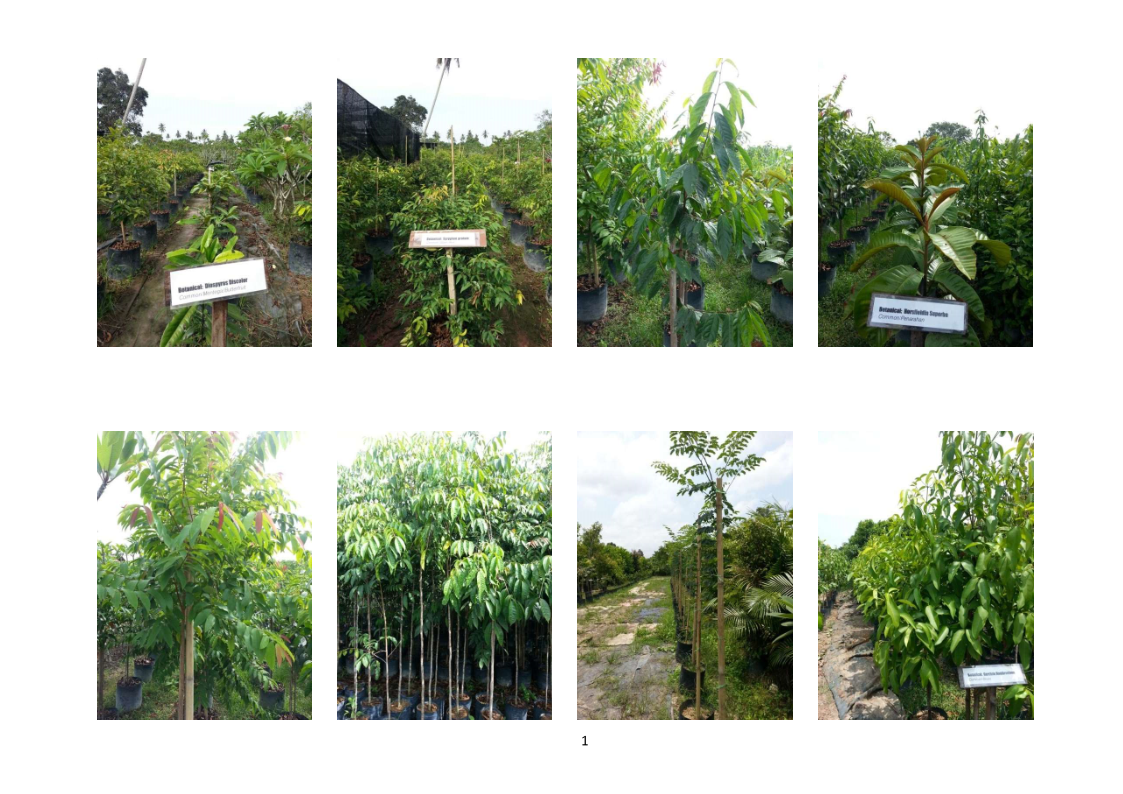
    Forest trees nursery

    Get your Trees from this nursery

Posts Tagged ‘golf course’

Penyemburan salah dengan mesin.

Posted by mynormas on January 31, 2012

Lihat Boom kiri dan kanan tinggi di hujung. Ini menyebabkan nozel di hujung akan menyembur tak sama dengan nozel di tengah.

Mesin boom sprayer, secara definasinya ialah sebuah mesin yang mempunyai lebih dari satu nozel spray yang di sangkut kan untuk menyembur kawasan besar. Ada banyak jenis mesin spray. Tetapi oleh kerana laman web ini adalah tentang rumput, maka kita akan khususkan mesin menyembur racun menggunakan boom yang biasa terdapat di padang golf.

Saya bercerita tentang mesin yang mempunyai tiga boom di belakangnya. Boom kiri, boom tengah, dan boom kanan. Setiap satu boom biasanya mempunyai 3 – 5 nozel menyembur. Ada juga mesin yang ada satu boom sahaja, contohnya walking boom.

Pertama sekali, sepatutnya setiap nozel pada boom tersebut mesti mengeluarkan kadar air yang sama. Bukan hampir sama, bukan lebih kurang sama, bukan dekat-dekat sama; Sama. Selepas itu, setiap nozel tersebut mesti berada pada ketinggian dari aras tanah yang sama sewaktu menyembur. Ini semua kita lakukan sewaktu kalibrasi atau penentu-ukuran.

tayar kecil itu digunakan untuk mempastikan boom sentiasa rata, walaupun tanah berbukit.

Semalam sewaktu saya bermain golf (di kelab yang bukan client saya)  saya terjumpa dengan mesin boom yang menyembur dengan nozelnya tidak sama tinggi di antara satu sama lain kerana boom kiri dan kanannya senget. Ini akan menyebabkan nozel yang tinggi akan menyembur kawasan yang lebih luas dan mempunyai peluang yang lebih tinggi untuk di tiup angin.

Tapi perkara kedua yang di lakkukannya yang saaaaangat menyakitkan hati saya ialah mereka menyembur secara berputar. Memusing. Konar. Belok.

Tak Boleh.

Bagilah apa alasan pun; terlalu dekat kolam, kawasan tu kecik sangat, tak nampak garisan, boss tak ajar, boss tak ada dan apa pun, jangan menyembur sewaktu boom tidak lurus.

Jika kita menyembur sewaktu belok, apa akan terjadi, nozel yang di sebelah dalam akan berpusing sedikit sahaja maka air/racun/baja/sirap/oren/apa2pun yang kita spray akan jatuh di kawasan lebih kecil berbanding dengan nozel yang berada di sebelah jauh. Jadi satu kawasan akan dapat lebih banyak dari yang satu kawasan lain.

sejuk mata saya memandang; dia menggunakan buih sabun untuk menanda di mana dia spray dan dia spray dalam garis lurus walau bagaimana bentuk mukabumi.

Ini benar samada kita bercerita tentang padang golf, bola ataupun taman. Asalkan kita cerita tentang boom sprayer, inilah masalahnya.

Sentiasa, sentiasa spray (atau semprot) dalam garis lurus! Gunakan penanda dengan air bercampur pewarna ataupun buih sabun.

Menyembur dengan cara lurus juga mempastikan senang untuk kita sembur bila kita datang balik dari arah bertentangan.
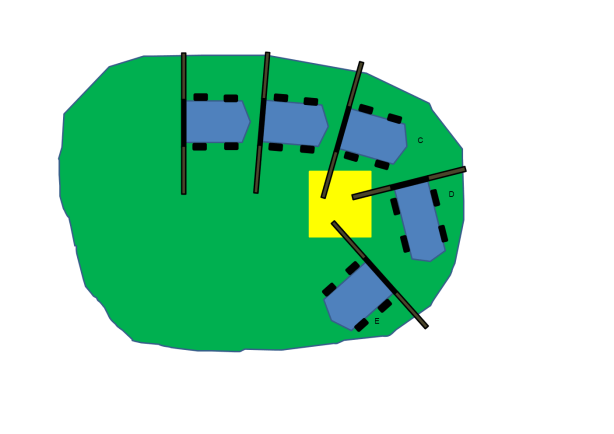
Ini gambar satu sprayer yang sedang menyembur sambil berpusing. Nampak tak bahawa nozel sebelah dalam (kotak kuning imaginasi) menjadi paksi pusingan dan menyembur di kawasan kecil sedangkan di masa sama nozel sebelah sana memusing jauuuuuhhh, dan air keluar dari semua nozel pada kadar yang sama.

Topik ini penting dan panjang, kita akan sambung di post lain lagi.
Posted in Fields, Golf Course, Golf Course Superintendents, Padang, Padang Golf, Taman | Tagged: , | Leave a Comment »

Choosing grass

Posted by mynormas on October 18, 2011

One of the most common question I get asked is; what type of grass should I use?

There are actually three important criteria to think about when choosing grass, and I write this in layman terms, mainly:

  1.  The condition of the area – whether it is shaded, it gets too much water (for example it is next to non-porous area e.g. road or pavement or perhaps it is out in the open with poor or no irrigation).
  2. The budget for future maintenance of the grassed area and
  3. The use of the grassed area; simply whether it is more for aesthetics or more as a playing field. In the golf course, this question will also refer to whether that area is a green or a rough.

Now for home-owners (and I get a lot more questions from these people) I usually tell them the order of priority will be 1. The condition of the area; 2. The budget and time they are willing to spend on maintenance and 3. The use; whether the lawn is for impressing passers-by or is it for grandchildren to play on? Stuff like that.

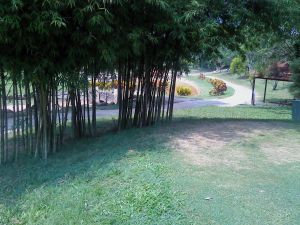
The Bermuda carpetgrass planted at cost under the bamboo? Dead. The Cowgrass that came on its own for free? Nice. Lesson? Use cowgrass under shade.

For golf courses, playing fields, stadiums and large areas like municipal councils, the order of priority is reversed: I ask them to think of what is the use of the area – whether it is for greens, for tees, for out-of-play areas,

football, picnic, or whatever. Then they should think of the budget they are willing to spend for maintenance (and I would like to emphasise FOR MAINTENANCE) and lastly only about the condition of the area. Why is the order reversed? Because, for these kind of construction, the condition can be modified, trees can be moved, or the green can be redesigned away from the large 100 year-old tree, for instance.

Most of these owners, be them developers, local government or large bungalow owners etc, will have a huge budget during construction but when it comes to routine daily maintenance; they scrimp and save.

Zoysia is a nice grass but needs to be cut once a week - at least. If you can't afford to do that, why use it?

So what I advise is: design and pick plants for the place so that it will be cheap and easy to maintain in the future! Naturally,  people want the best and most designers/contractors who are paid by percentage don’t mind at all to oblige.

But I digress. The world of grass is divided into three main areas; warm-season and cool-season. The third area? What is termed as the transition zone area, this area is cold enough in the winter to make it difficult to maintain warm-season grasses and warm enough in the summer to make it difficult to grow cool-season grasses, therefore, no single species of grass is well adapted in this region.

So there are only two types of grasses; warm-season and cool-season grasses. In the transition zone areas, they will use quick growing cool-season grasses in the autumn and early winter and warm-season grasses in spring/summer.

What are the characteristics of warm season grasses? They thrive in air temperatures from 27 – 35 degrees Celsius and soil temperatures of 21 – 32 degrees Celsius. They’ll lose chlorophyll in autumn and turn from green to brown.

Cool-season grasses grow very well when soil temperature is between 10 – 18 degrees Celsius and air temperatures a cool 15 – 24 degrees Celsius.

Tall fescue is a cool-season grass

Other than those, there are of course a few other things that should be taken into consideration too. Soil types, quality of water for irrigation – in fact, quantity of water too; there are a few other things if we want to go into details. But lets leave it at that for now.


Weights and Measures, Metric Conversions Weights and Measures,
Metric Conversions


Posted in Fields, Greens, Landscape, Lanskap, Maintenance, Padang, Padang Golf, Rumput, Rumput halaman rumah, Rumput secara am, Taman | Tagged: , , , | Leave a Comment »

How many staff in a Malaysian golf course?

Posted by mynormas on October 11, 2011

I visited a golf course that was built in an oil palm plantation; for the second time yesterday. The golf course was started in 1917 as three holes, finished as 9 holes in 1929 and was completed as 18 holes only a few years ago.
But what fascinated me was that it had only 5 permanent workers to keep it going. I guess it had to do on how it was built. It was flat, it had few landscaping features and there were almost no slopes (whether drain, bunker, hill etc) there. They also had big trees that were planted far enough apart that machine can mow between them. And they had cowgrass on fairways and serangoon on the old 9.
The guy in charge believed in mechanization and I could see the big and relatively new machinery working on the golf course. And best of all? I’ve seen worse golf courses that had more than three times the number of staff this course had. When I praised him and his assistant (who attended to me in my second visit because the boss was sick) their immediate reaction was to say: I have dedicated staff.
We have a lot to learn from En. Azman and his team Carey Island Golf Club.

Posted in Golf club, Golf Course Superintendents, Padang, Padang Golf | Tagged: , | Leave a Comment »

The ‘real’ real estate

Posted by mynormas on June 16, 2011

I just came back from visiting two golf courses that admitted to me they have never fertilized their fairways for years. Needless to say, the colour, health and uniformity of their fairways leaves a lot to be desired.
I agree that in Malaysia, the measure of quality of a golf course is by the quality of the green. So most of the money used in golf course maintenance will be spent on greens. In other words, the most expensive real estate – per square foot – on a golf course is the green.
But what causes the real estate surrounding the golf course to increase in price? For a non-golfer – the speed and quality of a green means little. Even for a golfing house-owner, his house price will not increase with the quality or speed of a 500sq meter patch at the end of the fairway. It is the visual of the golf course that will impress his guests or potential buyer. And most of this will come from the fairway.
The colour, the contrast with the sand in the bunker, the stripings, the uniformity, thats what going to make the guests go green with envy.
And these particular golf courses have property surrounding them for sale/rent. Would it surprise you that they have a lot of property left unsold? I don’t think its the location; they wouldn’t have build the golf course/property there in the first place.
My belief is that, no golf course should neglect the appearance of their fairways. Cut costs by reducing the size and even not have fairways on par3s but make what is left beautiful.
Use quick release fertilizer or foliar fertilizer and apply them during the dry months. Do spot topdressing with excess sand. Slice the fairways regularly. Have discipline when mowing them.
Golfers will judge the quality of a golf course on the greens. Non-golfers (and even golfers who are house-owners) will judge them from what they see most – the fairways.

Posted in Uncategorized | Tagged: | Leave a Comment »